|
ROMAN CATHOLIC[1] Before the Chief Mass on Sundays. |
LIBERAL CATHOLIC[2] Before all Eucharistic Services. |
|
Antiphon. Thou shalt sprinkle me with hyssop and I shall be cleansed: thou shalt wash me and I shall be made whiter than snow. |
Antiphon. Thou shalt sprinkle me with hyssop, O Lord, and I shall be clean: Thou shalt wash me, and I shall be whiter than snow. |
|
Psalm Have mercy on me, O God, according to thy great mercy. |
Psalm. I will lift up mine eyes unto the hills: from whence cometh my help. |
|
My help cometh even from the Lord: who hath made heaven and earth. He will not suffer thy foot to be moved: and He that keepeth thee will not sleep. Behold, He thatr keepeth Israel: shall neither slumber nor sleep The Lord Himself is thy keeper; the Lord is thy defence upon thy right hand. So that the sun shall not smite thee by day: neither the moon by night. The Lord shall preserve thee from all evil; Yea, it is even He that shall keep thy soul. The Lord shall preserve thy going out, and thy coming in: from this time forth for evermore. |
|
|
Glory be to the Father, and to the Son. and to the Holy Ghost. As it was in the beginning is now, and ever shall be, world without end. Amen |
Glory be to the Father, and to the Son. and to the Holy Ghost. As it was in the beginning, is now and ever shall be, world without end. Amen |
|
Antiphon. Thou shalt sprinkle me with hyssop and I shall be cleansed: thou shalt wash me and I shall be made whiter than snow. |
Antiphon. Thou shalt sprinkle me with hyssop, O Lord, and I shall be clean: Thou shalt wash me, and I shall be whiter than snow. |
The Liturgy begins with the asperges, or purificatory ceremony. Asperges is simply the Latin for the opening words of the antiphon "Thou shalt sprinkle," for it is constantly the custom in the Church to use the first word or words of a psalm or canticle as its name.
The procession having already stirred up the people and assisted them to become united in thought and feeling, the celebrant by means of the asperges makes a special effort to clear out of the church any accumulation of worldly thought. He does this by sprinkling holy water, which has been strongly magnetised with a view to this sort of work.
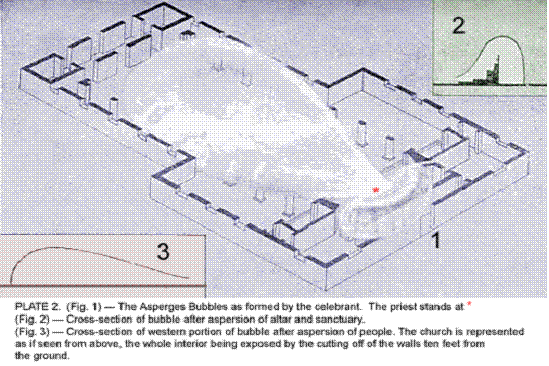
Upon reaching the sanctuary the Priest kneels before the Altar and sings the opening words of the antiphon: "Thou shalt sprinkle me," the choir and congregation continuing the melody from this point. The Priest receives the aspergill, which has been dipped in the holy water, and, after making with it the holy sign of the cross over himself, sprinkles the Altar thrice, as it is especially necessary that this part of the church should be carefully prepared for the reception of the tremendous force which is so soon to radiate from it. He need not scatter any large quantity of water in so doing, since the purification is produced less by the falling drops than by the will of the priest directing the energy stored in the magnetized water. With each throwing movement of the aspergill he aims this force in any desired direction, and it flows immediately along the line laid down for it. In this way he can direct a jet of force towards the cross above the tabernacle, across the Altar to the candles, and so on. the clergy and choir are then aspersed, and finally the congregation; in each case a rush of cleansing force is shot out, which is capable of travelling, when aimed at the people, down to the very end of the church, however large it may be. This outrush blows what looks like a vast flat bubble of etheric and astro-mental matter, a thought-edifice, ethereal, diaphanous—a bubble which just includes the congregation. (See Plate 2.) Inside this the psychical atmosphere is purified, the bubble pushing back that which has not been affected. In this way an area is cleared for the operations of the Angel who will presently be invoked.
While the celebrant is performing this ceremony, the choir and congregation are singing the hundred and twenty-first psalm, which might be epitomized in a well-known phrase borrowed from another psalm: "Except the Lord build the house, their labour is but lost that build it; except the Lord keep the city, the watchman waketh but in vain." It emphasizes the thought that only by the power of our Lord can evil be kept at a distance; the implication obviously is that only by keeping our thought constantly fixed upon Him can we preserve the condition of mental and astral purification which has been established in the building by means of the asperges. As ever, the psalm is provided with an antiphon, which indicates to us the thought which we should hold in mind while singing it—in this case the thought of perfect purity.
Originally in the primitive Church the verses of the psalm were sung by the Priest or by a cantor alone, while the antiphon was repeated after each verse by the congregation as a kind of chorus or refrain, and it was only at a somewhat later period that it was relegated to the beginning and end of the psalm, as we have it now. So, having that intention of extreme purity of thought and feeling in our minds all the while, we sing the various verses of the psalm, which tell us that it is only by dwelling on the thought of God and of the higher things that such purity can be maintained. The idea here is not primarily that of general purity of life, eminently desirable though that unquestionably is. It is rather the conception of purity of intention—what we should describe as single-mindedness or one-pointedness. All other thoughts must be rigorously banished, all inclination to wander must be firmly checked, so that we may concentrate our energies upon the work which we have in hand.
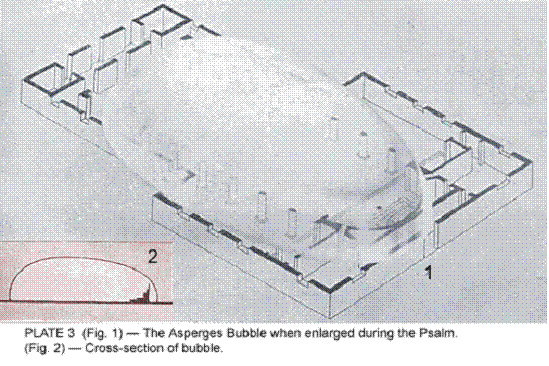
While these thoughts are steadily pouring forth from the minds of Priest and people, the actual chanting of the words which embody them is simultaneously producing its effect—strengthening, enlarging and enriching the bubble blown by the effort of the Priest. (See Plate 3.) This psalm is not necessary to the effectiveness of the cleansing; indeed, it will be seen that in the shorter form of the Service we dispense with it altogether. But when we have plenty of time at our disposal, it no doubt helps to gather together the scattered thoughts of the people. We have to realize that sudden and intense concentration of thought is not easy—is indeed scarcely possible—to the untrained mind; most people need a little time and more than one effort before they can raise their enthusiasm and their devotion to the highest point, so that their forces are fully in action. The psalm is inserted to give time for this "working up" to those who need it.
It is desirable to use for this psalm one of the simplest of the Gregorian tones; the 6th, 1st ending, for example, has been found satisfactory, or the 8th tone, 1st ending. (These numbers are according to the system of the well-known Helmore Psalter) the clairvoyant who studies the effect of ecclesiastical music can hardly fail to be struck with the difference between the broken though glittering fragments of the Anglican chant, and the splendid glowing uniformity of the Gregorian tone.
At the end of the psalm appears the ascription of glory to the ever-blessed Trinity, with which it has been the custom of the Church from very early days to close all its psalms and canticles. It calls for no comment beyond the remark that "world without end" is a somewhat unsatisfactory translation of per omnia sÊcula sÊculorum; which clearly means exactly what it says: "throughout all ages of ages". The conception of the aion or dispensation as the title of a long period of time was perfectly familiar to the Greeks and Romans, as was also the further idea of a still far greater period called an Êon of Êons—as we might poetically call ten thousand years a century of centuries. So "through all ages of ages" is equivalent to "throughout all eternity".
Here, too, we have for the first time in our Service the work "Amen," by which the people are supposed to signify their endorsement of what the Priest said. This is usually taken as a strong asseveration; the words which Christ so often uses, translated in our English version as "Verily, verily" are in the New Testament "Amen, Amen." This is not a Greek but a Hebrew word; I am told that it exist in several of the Semitic languages, with the meaning of certainty, truth, reliability. This is the only interpretation which Western scholars recognize, but in the time of our Lord there were those who attributed it to quite another source, who derived it from one of the Egyptian Names of the Sun-God—Amen-ra. To swear by Amen was an oath which none dared to break; none who called Amen to witness what he said would venture to speak other than the truth; and so this formula, "By Amen I say unto you," carried absolute conviction to the hearers. So when our Lord wished to be especially emphatic, He used the form to which His audience was accustomed, which could not fail to convince those who heard it. Spoken at the end of a speech or a prayer, it conveyed the entire agreement and approbation of those who used it: "By Amen, it is so," or "By Amen, we agree to it"; and so it finally comes to be considered as an equivalent to "So be it," or "So it is." An example of its earlier use may be seen in Isaiah lxv, 16, where the English Authorized Version translates: "He who blesseth himself in the earth shall bless himself in the God of truth, and he that swearth in the earth shall swear by the God of truth." The Hebrew word here translated "of truth" is Amen; so the real statement is simply that people shall swear by the God Amen, precisely as was done in ancient Egypt.
|
ROMAN |
LIBERAL |
|
V. Show us, O Lord, thy Mercy. R. And give us thy salvation. |
P. O Lord, open Thou our lips. C. And our mouth shall shew forth Thy praise. |
|
V. Lord, hear my prayer. R. And let my cry come unto thee. |
P. Who shall ascent into the hill of the Lord? C. Even he that hath clean hands and a pure heart. |
The Priest then sings the versicle; "O Lord, open Thou our lips," and the choir responds: "And our mouth shall shew forth Thy praise." This versicle has been used from an early period in Church history at the beginning of one of the morning Services, though not in the Mass. Its underlying idea is that it is only by the help of the divine power in ourselves that we can hope to praise or worship at all worthily. When we speak of the help of the Lord we should try to understand that we can draw upon the divine power without—upon what is commonly called the Power of God—only because we ourselves are God also, because we are fundamentally part of Him.
The intention of this versicle is that the Divine within man may aroused to come into harmony with the Divine without, while the response tells us that after our lips are unsealed, the first use we should make of speech is to offer praise unto the Lord. It is important to notice that not prayer for benefits, but praise, is the first thing we should offer. The celebrant then sings: "Who shall ascend into the hill of the Lord?" meaning by this: Who can usefully and suitably ascent the steps leading to the Altar? Immediately the answer comes: "Even he that hath clean hands and a pure heart." Now, with this conviction firmly implanted within himself, the celebrant turns to the people and for the first time in the Service gives the Minor Benediction.
| ROMAN | LIBERAL |
| V. The Lord be with you. R. And with thy spirit. | P. The Lord by with you. C. And with thy spirit . |
Anyone who watches attentively the Roman Service of the Mass can hardly
fail to notice the frequency with which the celebrant turns round to the
congregation and utters the words:
Dominus vobiscum ("The Lord be with you.")
The people reply:
Et com spiritu tuo ("And with thy spirit,")
a sentence which seems to need revision, since the Spirit is the sole
possessor, and can never by any possibility be the thing possessed. A more
accurate expression would be : "And with thee as a spirit," The early Church,
however, did not speak with such careful precision, but adopted rather the
phrasing of the Hebrew Psalmist, who not infrequently adjures his soul to
bless the Lord, apparently identifying himself with his body.
St. Paul was better instructed, for he writes of body, soul and spirit as the threefold division of man, though even he still puts them as possessions of the man.
A more scientific statement is that the Spirit (sometimes called the Monad) is the divine Spark in each of us which is the cause of all the rest, and consequently the true man; that this Spirit puts down into levels lower than his own a partial manifestation of himself which we call the soul or the ego; that this soul unfolds its latent divine qualities by many successive lives in still lower world, in the course of which it clothes itself in vehicles suitable to that world, to which we give the name of body. So at any given moment of physical life man, the Spirit possesses a soul and body—indeed, several bodies, for St. Paul furthers explains: "There is a natural body and there is a spiritual body." These words are not well translated; but the context makes it clear that by the "natural body" he means this garment of flesh with which we are all well acquainted, and that by the term "spiritual body"—divided by later investigators into the astral and the mental vehicles.
However much the idea may have been obscured in the course of the ages, it is certain that the Service of the Holy Eucharist is intended to be a coherent ceremony, moving steadily onward to a climax, and skillfully calculated to produce certain magnificent effects. Regarding the ritual scientifically from that point of view, one might perhaps wonder a little at the frequent repetition of a remark which, though beautiful in itself, seems at first sight to have no obvious connection with the splendid purpose of the great spiritual act of which it forms a part.
The phrase occurs no less than nine (in the shorter form, three) times in the course of the Liturgy, with a slight but important addition in one case—the salutation of peace—to which I shall refer when we come to it. The Service as a whole centres round the tremendous outpouring of power which comes at the Consecration. All that is said and done before that moment is intended in various ways to lead up to it. and all that happens afterwards is concerned with the conservation of distribution of the power. the idea of preparing the Priest to perform the great act is undoubtedly present, but also, and more prominently that of preparing the congregation to receive it and to profit by it. This preparation of the people is achieved largely by drawing them more and more closely into magnetic harmony with the Priest—by bringing them mentally and emotionally into sympathy with him in the mighty work which he is doing. To assist in the steady augmentation of power all the time, and to promote the ever-increasing harmony of vibration between Priest and people, are the objects of this constantly repeated Minor Benediction.
To one possessing clairvoyant vision its value is clearly apparent, for when the celebrant turns to the people and sings or speaks the prescribed words, a powerful current of force rushes down over the congregation and then a moment later surges back towards the Altar, greatly increased in volume, because it sweeps up and bears with it all the little jets of force which individual worshippers have generated, which would otherwise float upward and be dissipated. It all converges upon the Priest with the words: "And with thy spirit": and the rush is sometimes so strong that, if he be at all sensitive, he is almost staggered by it, but his duty is to receive it into himself and hold it for the use of the Angel whom he is about to invoke.
This interaction is most effective in welding celebrant, assistants and congregation into one harmonious whole—a veritable living instrument to be used in the magic of the Eucharist. These words are repeated throughout the Service whenever the Priest has performed some act or uttered some prayer which will exalt his emotions or fill him with some particular force, the idea being that he is able through the Minor Benediction to share this exaltation or force with the people, and thereby lift them nearer to God. In this case it is the idea and realization of purity and concentration which is to be shared: the comprehension of the necessity of those virtues, and the determination to attain them.
Note The celebrant begins by blowing the asperges bubble, and the psalm which is meanwhile being sung, and the versicles following it, establish a rapport between him and the congregation. This condition is used to enable the celebrant, at the Minor Benediction which immediately follows, to throw out a net over his people, which he can hold them as a driver holds his horses with the reins. This net is of very great use in the Service, and it is along its lines of communication that the celebrant sends out the power at every subsequent repetition of this sentence—"The Lord be with you""—which is so effective in preserving the harmony between himself and his congregation, and, at the same time in keeping the pressures of force, at the Altar and in the body of the church, more or less equalized. This net is constantly being revivified, and is made to glow strongly by each repetition of the Dominus Vobiscum, until the Offertorium, when it is no longer needed. When a Bishop says Mass, he seems to include the people on a higher level with his net than a Priest does. And when a Bishop is present at a Priest's Mass, he is not altogether included—as it were, not quite submerged—by this outpouring. From this, his more lofty vantage-ground, he is able to do much to help. In the shorter form of the asperges, the sentence "Brethren, let us now lay the foundation of our temple" makes this net.
The Priest now turns to another part of the reparation and says:
|
ROMAN |
LIBERAL |
|
Let us pray. Mercifully hear us, O holy Lord, almighty Father, everlasting God: and vouchsafe to send thy holy angel from heaven to guard, nourish, protect, visit, and defend all that dwell in this dwelling. Through Christ our Lord. R. Amen |
Let us pray. Guide us, O Almighty Father, in all our doings, and from Thy heavenly throne send down Thy holy Angel to be with Thy people who have met together to serve and to worship Thee. Through Christ our Lord. R. Amen. |
The phrase "Let us pray" is a signal given by the celebrant to the people when he is about to say a prayer, and it is therefore time for them to kneel. Such a sign was even more necessary in the primitive Church when the people were not supplied with copies of the liturgy (nor, in most cases, able to read them if thy had had them), and were therefore obliged to rely entirely upon the Priest for directions as to the position which they should assume. Indeed for a considerable time there was no written liturgy, and each celebrant filled in extemporaneously the outline of the ceremony as given by the Christ.
That Christ did give such an outline is certain from clairvoyant investigation. The account of the institution of this Sacrament given in the various gospels is probably substantially accurate, though we must remember that the writers were compiling a wonderful and beautiful mystery-drama, in which they were far more concerned to convey successfully the mighty truths which lay behind their symbolism than to observe exactly the unities of the story-form in which they had decided to cast their narrative. But the words spoken at that first Eucharist on the evening of Maundy Thursday (or as seems more probable, immediately after midnight, and so very early on Good Friday morning1) were merely the formal institution of the great ceremony.
The Jews began their day at sunset, so in either case it would already be Friday according to their reckoning.
Detailed information as to its method and intention were given by the Lord after His resurrection among the many things "pertaining to the Kingdom of God" which He then taught to His disciples. But while it is certain that He gave them clear directions as to the main points of the eucharistic Service, and explained what effect each was meant to produce, it is also clear that He left this framework of the ceremony to be filled in by His apostles as they found it convenient under the constantly varying conditions of their early evangelistic work. The follows of each apostle would naturally try to remember and to reproduce his improvizations; and so a number of rituals would grow up, all built upon the same skeleton, but clothing it differently. It was only as centuries rolled on that the Church evolved by experience and by compilation the various liturgies which we now possess; though again we must not forget that He Himself stood ever behind her efforts, always ready to inspire and direct those of her leaders who laid themselves open to spiritual influence.
Having effected a preliminary purification, and so provided a field (inside the huge bubble blown by the Priest's effort) in which an Angel will feel it possible to work, the celebrant now invokes the aid of one of these beneficent helpers. There are many orders and races of these radiant non-human spirits, and most of them have at the present stage of human evolution but little connection with mankind. Certain types, however, are ever ready to take part in religious ceremonies, not only for the pleasure of doing a good action, but because such work offers them the best possible opportunity for progress.
Four times in the course of the eucharistic Service does the Priest call upon the holy Angels for their help, and we may be well assured that he never calls in vain, for a link with these celestial hosts is one of the advantages which are conferred upon him at his Ordination. On this occasion he invokes what is commonly called the Angel of the Eucharist, whose special work in connection with it is to assist in the building of the edifice of which I have already spoken. He determines the size of the form which can be erected upon any given occasion, taking into account the number of people present, the intensity of their devotion, the amount of their knowledge, their willingness to cooperate, and so on. A large congregation working intelligently can give much more material for the building of the form than a small congregation; again, far more material is available at a High Celebration than at a Low one.
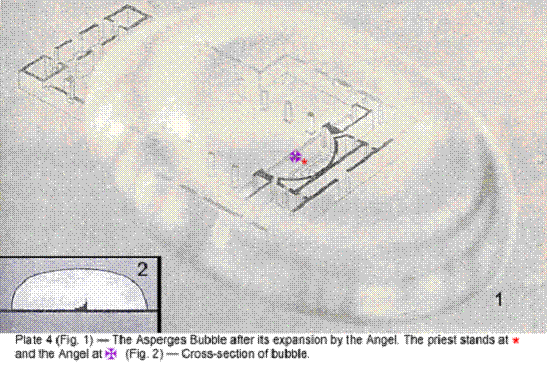
It lies within the work of the Angel to see that our material is wisely used in the building of the edifice. If too large a pavement were built at the singing of the canticle, the eucharistic edifice, when complete might be so attenuated as scarcely to hold together. The form is moulded and directed by this Angel, although its outline can to a certain extent be changed by the will of the celebrant, if he knows of the existence of the form and the purpose for which it is being built. The first act of the Angel upon his arrival is to expand the bubble formed by the will of the Priest at the asperges. (Plate 4.) He pushes it beyond the Altar until it has cleared a space as far to the east of the Altar as the original had cleared to the west. To make this expansion possible without the bubble becoming too tenuous, the Priest, at the time when he asperses the Altar, should mentally picture the film of the bubble as being much thicker in the neighbourhood of the Altar and sanctuary than elsewhere.
It will be seen that the Roman form of the asperges prayer makes no direct reference to the Angel's work in the erection of the edifice, though it is by means of that construction that he guards, protects and defends the congregation to a large extent from the intrusion of evil or wandering thoughts, even while by his powerful yet most restful magnetism he truly visits and nourishes those who are willing to receive his influence. I do not mean that if a man allows his mind to be filled with private worries the Angel will specially interfere to drive them out; but he does exclude from his building the vast swarms of vague thought-forms which in ordinary life are constantly pressing upon us and drifting through our minds whenever for a moment we leave them blank. His very presence is a blessing, for a calming and uplifting radiance is ever streaming forth from him; so his visit clearly offers a valuable opportunity to those who are prepared to take advantage of it. In the shorter Service we compress the entire action of the asperges into one collect. Making the sign of the cross over himself with the aspergill, the Priest says:
May the Lord purify me that I may worthily perform his service.
He asperses the Altar and chancel.
In the strength of the Lord do I repel all evil from this His holy altar and sanctuary,
He asperses the people.
and from this House, wherein we worship Him;
He faces the Altar.
and I pray our heavenly Father that He will send His holy Angel to build for us a spiritual Temple through which His strength and blessing may be poured forth upon His people. Through Christ our Lord.
R. Amen.
This is in every way as effective as the longer form, but it requires alert and concentrated thought on the part of the Priest. He will probably find it advisable to recite the collect somewhat slowly, throwing the whole strength of his will into each clause. The invocation which immediately follows the asperges in the longer form is in the shorter made to precede it, thus making the purification definitely part of the eucharistic Service instead of a preparation for it.
It has been our endeavour in the shortened form to suit the wording more exactly to the effect which is being produced, so that it may be easier for the congregation to follow the inner side of the Service. All the manual actions of the Priest are precisely the same; there is no perceptible difference between the edifices erected by the two forms, or in the amount of force outpoured. When the Epistle and gospel are not read, we lose the amount of useful material generated by the Gradual; and such members of the congregation as need a good deal of steady pressure to work up their enthusiasm have time to contribute somewhat more during the longer prayers. But in practice this slight lack is generally compensated by increased alertness and by the clearer comprehension of what is being done. In the shorter form the important actions of the ritual succeed one another more rapidly because all that is not actually necessary to the inner work has been eliminated. Many beautiful passages have to be omitted; but nevertheless the abbreviated form will be found convenient on many occasions when it would be impossible to perform the full ceremony.
Note The celebrant now calls the Angel of the Eucharist, who is to build our form for us. One does not seen to see him approaching from afar off, but he is suddenly appears in such a manner as to suggest that there is a thick veil of mist at the back of the altar, and that, when called, he just steps forward through this and is with us. I do not know what is the cause of this effect; it may be due to the speed with which he travels, so that the moment at which he is seen in the distance is so nearly simultaneous with his arrival in the church that it seems to us to be actually so, and thus, by the time we have first seen him he has already arrived. A more likely explanation is that he comes to us on some high plane—possibly where space does not exist—and then materialized lower bodies for himself.
We noticed that in a few cases which we examined, where the celebrant was himself an evolved person—an Initiate of the Great White Lodge—the colours of the Angel corresponded with certain colours in the upper part of the officiant's aura. this suggests that, in cases where the Priest is sufficiently evolved for his character to have a definite effect on things, other considerations being equal, the Angel who comes to work with him is likely to be of the same type as himself. Of course, there are churches which have definite Angels attached to them who habitually patronize them but similarly there seem to be celebrants who have their own Angels, who have these colour similarities.
With regard to the position of the Angel during the various parts of the Service, I give the results of a number of observations in one particular church.
He seems to move about a good deal within a limited area round the Altar, but is mostly near the officiating Priest. When he first shows himself, he is in front of the celebrant, but rather to the Epistle side—among the candles on that side of the Altar. This is the more masculine side of the church, as the rays represented by the candles, the jewels and crosses on this side—the South—are more positive than those to the North. In this connection it is tempting to speculate as to possible reasons for this being found in the fact that certain great earth currents are received at the North Pole and given off at the South Pole. Be that as it may, the fact remains that the South of the church is more masculine, and as the ecclesiastical power is meant to flow through male channels, it is probably easier for the Angel to work on this side.
He remains here, almost in the centre, during the Canticle and Introit; except that during the latter, he stands a little further to the side of the Altar so as to handle the swirls of power going from the celebrant, deacon and subdeacon, up to the central line (made by the tabernacle, cross and picture) and back again. During the Kyrie, he is just over the head of the officiant; for the Gloria in Excelsis, he floats up somewhat higher and moves towards the people, so that he is over the sanctuary gates, gathering from and drawing strongly on the people for his building material.
During the Collects he is mostly in his original place, in line with the three officiants, and is there receiving the power sent up through this line. While the Epistle is being read, the Angel is near the centre of the Altar, so that, as well as the more mental power which he is pouring down through the celebrant and deacon into the subdeacon, he may be in a convenient position to draw from the candles on the North and also pour down emotionally uplifting power which stimulates and raises the level of the subdeacon's emotions, and consequently, of his thought as well. As the power flows out through him on to the people, it has the same effect on them. Except for a few moments when he comes out just to the left of the subdeacon—who is standing in the centre line of the Altar on the lowest step—and when he goes behind the Altar for a moment in connection with making the pillars and ornaments during the Gradual, the Angel keeps his central position till the end of the Gospel. He seems to be busy at this part of the Service in equilibrating and transmuting emotional and thought power, of which there is a swirl going round and round the church. The row of candles acts as a useful sieve for this purpose, and strains of much dirt, while greatly intensifying (and at the same time being intensified by ) the power from the people. This activity reacts on and further stimulates the people, and so the swirl is worked up.
During most of the Creed, the Angel is over the head of the celebrant, but towards the end, he floats high up above the Altar cross. After this, he is more at his leisure, and is receiving the reward for his work. Still, he continues to be very useful as a source of power, and busies himself in beautifying things. Although it is the directing Angel who is in charge when the whole edifice is enlarged at the Tersanctus, the building Angel is still very helpful even in this act, as he contributes so much power himself, which helps in swelling out the dome.
|
ROMAN |
LIBERAL |
|
In the name of the Father, |
In the name of the Father, |
Now that the actual Service is about to begin the cope is removed from the shoulders of the celebrant and he is endued with the chasuble, the sacrificial vestment which has, from the earliest days of the Church, been reserved for the celebration of the Holy Eucharist. The meaning and use of this garment will be described in part III, "The Instruments of the Sacraments."
The Eucharist begins, as do all Services of the Church, with a Word and Sign of Power. Fully to understand the use and force of such words and signs we must study an aspect of nature which is almost wholly forgotten in modern days. We must learn that we live not in an empty and unresponsive material world, but in the midst of a vast ocean of teeming life—that we are always surrounded by a great clout of witnesses, a mighty host of beings unseen by our physical eyes. This huge army includes superhuman beings (angels of all degrees and types), the innumerable hosts of the dead (who are of course still at the human level) and incalculable millions of sub-human entities—nature-spirits, ensouled thought-forms and the like.
All these are continually influencing us, some for good and some for ill, even as we in turn are continually influencing them. Most people are entirely unconscious or derisively incredulous of all this, and so they stumble on through life unhelped; though perhaps it is also true that the barrier of their blind unbelief to some extent protects them from possible dangers. But assuredly God intends that His whole creation shall work together in His service, and that we shall avail ourselves of the many aids which He has put ready to our hands as soon as we are wise enough to understand them. In this, as in all other directions, knowledge is power, and he who will intelligently use the forces of nature may gain great advantage thereby.
Those who have studied comparative religion are aware of the vast importance attached to names; they know that according to all ancient belief the name of a thing has a direct connection with it and can invoke it anywhere. It will be remembered that in the Egyptian Book of the Dead the candidate journeying through the Hall of Amenti is met by all kinds of entities, some of them terrible in character, who bar his way and demand to be identified. If properly instructed he promptly recognizes them and says to each: "I know thee; so-and-so is thy name." Whereupon the obstructing dragon instantly subsides, and the candidate passes triumphantly on his way.
In this ancient system it is clear that to know the name of anything implied knowledge of its inmost nature, its powers and qualities. To the men of old, therefore, to command in the Name or by the Name of any manifestation of God was to draw upon the power of that manifestation. There is a good deal of truth in this idea, especially when the invocation is uttered by one who, having been linked with the source of the power, has received authority to use it. So to announce that we begin our Service in the Name of the Father, and of the Son, and of the Holy Ghost is, in the case of the Priest, to call upon and bring into activity the special link made at his ordination, and in response there is a tremendous down-rush of force.
When a Bishop is present, these words of power are always spoken by him because of the additional layer of power which he is able to invoke. When this invocation is used by a layman, it calls upon the equivalent or representative of the Holy Trinity within himself—the Spirit, intuition and intelligence. As in the solar system everything begins and ends with the Trinity, so in the symbolism of the Eucharist we commence with an invocation addressed to the Father, the Son and the Holy Ghost, and end with a benediction in the Name of the same Three Aspects of the Deity.
The sign of power which accompanies this invocation, the sign of the holy cross, has various aspects as a symbol. The Greek cross with equal arms signifies the Logos in activity—the arm of the Lord out-stretched to help or to bless. The Latin cross with the with the longer stem typifies the Second Aspect of the Logos, the Second Person of the blessed Trinity, God the Son descended into matter. In all benedictions and exorcisms it is used to impress the will of the Priest upon the person or object with which he is dealing. It is a sign through which power flows, sometimes from the Priest to another; sometimes from on high into the Priest himself, as at certain points of the Service. When a man makes it over himself it is designed to promote self-recollectedness; to remind him of the Name which it symbolizes, and to help him to realize that where that Name is invoked we trust no evil shall ensue.
It is a kind of miniature creed expressed in action instead of in words, for as we touch first the forehead and then the solar plexus it reminds us how "for us men and for our salvation" Christ came down from the Father, who is Head over all, to this earth, to the physical plane, the lower part of His creation; while as we touch first the left shoulder and then the right, we remember that He passed from earth into the lower astral world, call hell, and typified as on the left hand of God (though even so it is higher than the earth) and proceeded thence to sit in glory for ever on the right hand of the Father.
A man whose thoughts and feelings are always on the highest possible level may not need a reminder of this sort; but most of us are not yet perfect, and therefore it is not wise to reject anything that can give us assistance. Most of us are well-intentioned but forgetful, and anything that helps us to recollect the ideal, and aids in driving away unwholesome thoughts and influences, is beneficial. We are not yet saints; we are still liable to be affected by waves of irritation or selfishness or by undesirable thoughts. The sign of the cross made over ourselves will draw round us unseen influences which will tend to drive away all that is unpleasant and at the same time make it easier to retain what is good.
To understand this power of the sign of the cross we must realize that, as I have said, we are living in the midst of a vast host of other beings. Among these, the sub-human creatures (or nature-spirits, as they are sometimes called) are peculiarly susceptible to the influence of the signs of power, of which the cross is one. Wherever that sign is made it at once attracts the attention of all such creatures in the neighbourhood, and they immediately gather round the person making the sign in the expectation that he will send out thoughts and vibrations of the type that they enjoy.
We must not confuse these nature-spirits with the Angels. If a great Angel who happened to be passing saw the sign of the cross and the good thoughts which accompanied it, he would certainly cast upon the man who made it a radiant smile which would carry a helpful influence, but he would not be likely to turn aside from his work. Nature-spirits evolve largely by means of the vibrations in which they bathe themselves, and therefore the instinct implanted in them leads them to be always watching for those which are useful to them. There are some at the stage of evolution which needs the coarser types of vibrations, which for us (but not for them) express evil or passionate thoughts or feelings.
Such creatures surge round us when we show irritability or sensuality, and their pressure encourages and strengthens whatever undesirable tendency may be manifesting itself—not in the least because these creatures are in themselves evil or wish us harm, for they are but following their instinct and gathering round a source of emanations which are pleasant to them, as flies gather round a honey-pot or men round a fire in cold weather. Others are at a stage which needs the higher vibrations which with us express good thoughts and feelings, and the sign of the cross attracts this type, just as it drives away the other. It is not so much that the latter fear it, as is generally supposed (you know how the hymn puts it: "At the sign of triumph Satan's host doth flee") the truth is rather that its radiance is distasteful to them, and they at once recognize that where that sign is made there is nothing for them; so they promptly depart in search of more hopeful pastures.
We shall be more likely to understand how these forces act if we can completely divest ourselves of childish superstitions about the devil and wicked angels and look at the whole matter from a commonsense and scientific point of view. Ethical ideas of good and evil have nothing to do with the question. The kingdom of the nature-spirits contains as much variety as the animal kingdom. Some nature-spirits, like some animals, are useful to us, while others members of both kingdoms are noxious to us, and just as we discourage, drive away or destroy rats, snakes, scorpions and parasitic vermin, so should we discourage, or drive away undesirable astral or etheric entities.
So many people are not sensible about these matters; either they are stupidly superstitious, or equally stupidly incredulous, because they cannot see the world of subtler matter which surrounds them. They cannot see the microbes of disease; yet these unseen creatures frequently influence their lives to a serious extent, and so also may the unseen astral creatures. Nature-spirits, whether helpful or harmful, respond eagerly to the oscillations which appeal to them; they reproduce them in themselves and intensify them, and so in their turn react upon us, and tend to perpetuate the conditions in us which attract them. For this reason, although ignorant people sometimes regard it as a mere superstition, the making of the sign of the cross is of definite practical value.
Note The Invocation to the Trinity, accompanied by the sign of power, causes the people to open themselves at the highest point at which they are conscious. This is the place into which power is poured when a person is to be used as a channel, and we may therefore call it "the point of entry". The three aspects of consciousness-will, wisdom and activity, at this point look like three glowing lights in the form of a triangle. The lights are of three colours—white, blue and red. The white represents will, the Power of the Father; the blue, wisdom, the Power of the Son; and the red represents activity, the Power of Holy Spirit. These glow strongly as the Three Persons of the Trinity are mentioned, and power is poured through these three principles down into the personalities of the clergy and the members of the congregation. This inflow of power of the same sort through all present tends to unify and it makes a fine show of bright light throughout the church.
|
ROMAN |
LIBERAL |
|
Antiphon. |
Antiphon. |
|
I will go in unto the Altar of God. Unto God, who giveth joy to my youth. |
I will go in unto the Altar of God. Even unto the God of my joy and gladness. |
|
Omitted at all masses of the season from Passion Sunday to Holy Saturday exclusively. |
|
|
Psalm. |
Canticle. |
|
Judge me O God, and distinguish my cause from the nation that is not holy: deliver me from the unjust and deceitful man. For thou, O God, art my strength: why hast thou cast me off? And why go I sorrowful, whilst the enemy afflicteth me? Send forth thy light and thy truth : they have led me, and brought me unto thy holy hill, and into thy tabernacles. And I will go in unto the Altar of God: unto God who giveth joy to my youth. |
I was glad when they said unto me: we will go into the house of the Lord. I will be glad and rejoice in thee: yea, my songs will I make of Thy Name, O thou most Highest. O send out Thy light and Thy truth, that they may lead me: and bring me to Thy holy hill, and to Thy dwelling. And that I may go unto the Altar of God, even unto the God of my joy and gladness: and upon the harp will I give thanks unto Thee, O God, my God. |
|
I will praise thee upon the harp, O God, my God; why art thou sad, O my soul, and why dost thou disquiet me? Hope in God, for I will yet praise him, who is the salvation of my countenace, and my God. |
The Lord is in His holy temple: the Lord's seat is in heaven. The heavens declare the glory of God: and the firmament sheweth His handiwork. |
|
Psalm. |
Canticle. |
|
|
O magnify the Lord our God, and worship Him upon His holy hill: for the Lord our God is holy. The Lord shall give strength unto His people: the Lord shall give His people the blessing of peace. |
|
Glory be to the Father, and to the Son, and to the Holy Ghost. As it was in the beginning, is now, and ever shall be, world without end. Amen. |
Glory be to the Father, and to the Son: and to the Holy Ghost. As it was in the beginning, is now, and ever shall be : world without end.Amen. |
|
Antiphon. |
Antiphon. |
|
I will go in unto the Altar of God. Unto God, who giveth joy to my youth. |
I will go unto the Altar of God. Even unto the God of my joy and gladness. |
This invocation is immediately followed by the opening canticle, throughout which the attitude the people are supposed to adopt is clearly indicated; it speaks everywhere of gladness, of rejoicing and thankfulness. In the prayer: "O send out Thy light and Thy truth, that they may lead me, and bring me to Thy holy hill and to Thy dwelling," is expressed the thought that we can acceptably approach the Altar of God only if we do so in full light of truth, shrinking from none of the facts that truth may bring, and filled with such high courage and resolve that we are utterly free from fear, from cowardice, from distrust. We can never appreciate the full meaning of the Eucharist and share largely in its benefits if we are filled with fear of God who loves us.
Then we try to realize the glory and holiness of God, and that from Him comes strength and calm. So we say: "The Lord shall give strength unto His people; the Lord shall give His people the blessing of peace." The whole of the canticle is intended to lay the foundation of what is to be done later, by bringing the people into the attitude of joy, gladness, trust and peace which is necessary if they are usefully to take part in the Service; and, as usual, the antiphon gives us the keynote—the thought which we are to hold before us as we sing. The importance of adopting this correct frame of mind at the beginning of the Service cannot be exaggerated. It is probable that in the early Church the preparatory canticle was sung in procession as the clergy and choir entered the sacred building.
The canticle recited here by the celebrant and his ministers in the Roman Church contains verses which seem inappropriate and useless, so we substituted for them others which better carry out the idea. We have followed this plan in all our Service, selecting for our psalms only verses which bear some intelligible meaning, and avoiding all those which complain, grovel or curse.
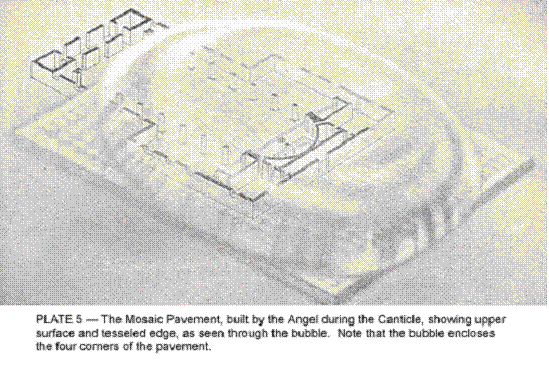
While the words which we sing bear their part in the preparation of our minds, the Angel of the Eucharist is working busily, yet with graceful ease, utilizing both the forms made by the music of the canticle, and the outrush caused by our feelings of love and devotion as we sing it. With this material he lays the floor or foundation of his edifice, following first the lower part of the tenuous bubble blown by the asperges, and then turning to the east and extending his floor away behind the Altar, till he has produced a pavement double the size of that upon which the congregation stand. (See Plate 5.) His work is conditioned by the number of the people present, and the amount and type of vivified matter with which their enthusiasm supplies him.
If the church be full, he usually follows its ground-plan as an outline for his pavement; if it be only half-full, he does not necessarily include the whole space, but may very likely bring his flooring to an end just behind the rearmost member of his congregation. Whatever may be its extension westward from the Altar, he always carries it equally far in the opposite direction behind the Altar, which invariably marks the central point of the completed form. If sufficient material is supplied, he often broadens his edifice northward and southward, in which case it occasionally becomes cruciform, though more often square, and approximating closely to the basilica shape already mentioned.
The depth of the foundation depends upon the material available; at a well-attended High Celebration the pavement may be as much as a yard in thickness, its upper surface coinciding with the floor of the church. Its design is always the same—a mosaic of blue and crimson blocks set diagonally, so as to present the appearance of lozenges of diamonds. where, at the edges, the thickness of the pavement is seen, it exhibits a tessellated border of alternate triangles of the same colours, suggesting that the blocks used in its construction are not cubes, but pyramids. (See Plate 6.) The crimson and blue are expressive of love and devotion respectively, and the hues vary according to the character of these emotions. Usually we get deep rich colours; but where the congregation includes many instructed and unselfish people, radiant and delicate tints of azure and rose may be seen.
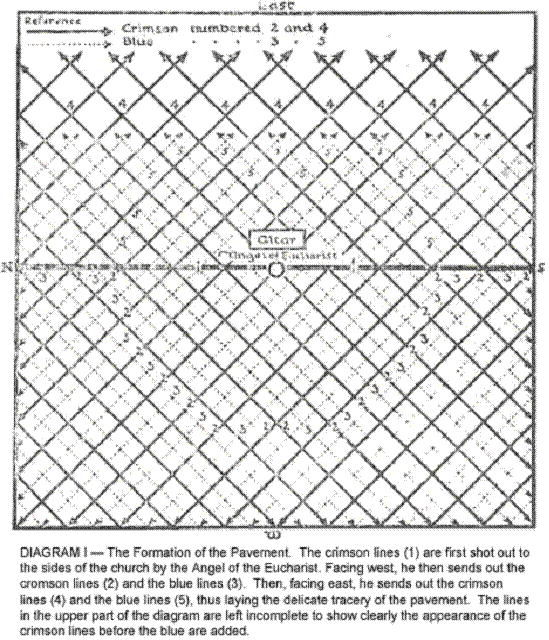
The Angel begins by extending his arms sideways and pouring out through them a current of love which makes a crimson line on each side from where he stands to the wall of the church. Sweeping his arms slowly forward, he causes a number of parallel lines to shoot out from the side of the original, like the teeth of a comb, except that they are inclined towards the centre of the church, so that they cross one another to make the diagonal pattern. (See Diagram 1.) Another similar movement throws out a blue current of devotion, which fills the spaces left by the crimson of love. then he turns to the east and repeats these movements so as to make a similar pavement for that part of the eucharistic form which is outside the church.
These first movements produce a tenuous cobweb-like chequering, and veritable ghost of a floor, so light and diaphanous that it could not be held together except within the bubble which has pushed back the chaos of jarring vibrations which would have shattered its delicacy. but the floor rapidly solidifies as the verses of the canticle peal out, and it is interesting to notice that, where the verses are sung antiphonally, the Angel diverts the alternating outrush of sound, and employs it to mark the diagonal lines which carve his flooring material into diamonds, or rather pyramids. (See Plate 6.) At a Low Celebration the edifice is often but small, and the colouring of the pavement dull; but the pattern is always preserved.
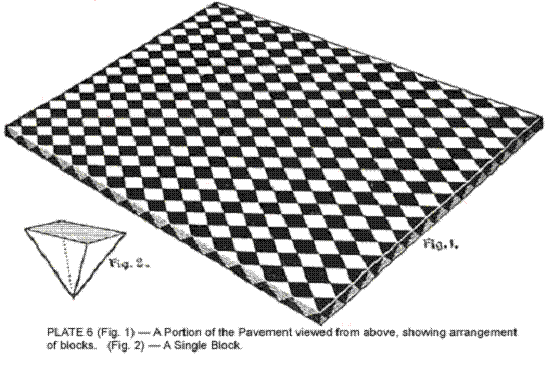
It must be understood that a Low Celebration is perfectly effective in calling down the divine force and spreading it abroad over the neighbourhood, though naturally the power at a High Celebration is in various ways far greater. The ceremony is surrounded with glory and beauty, which are intended to stir up the hearts and minds of the people and make them more receptive. Then the attendance is usually much larger—a factor which is of great importance. The consecration and the quality of the radiation coming from the sacred Host are of course the same in every case; but if there be more who feel devotion, the quantity of radiation will be greater, because an additional amount of that divine force is called into play by that extra devotion.
I feel it to be of the greatest importance that we should realize that this divine force is a reality—a definite, scientific, fact. this spiritual force, which is oftentimes spoken of as the grace of God, is just as definite as is steam or electricity or any other of the great forces of nature. It works in matter somewhat higher than does electricity, and it is not evident to the physical eye in its results, but nevertheless it is as real in every way, and indeed is much more powerful, in that it works rather upon the soul, the mind, the emotions in man than merely upon his physical body. Truly in this most holy Eucharist it is brought down even to the physical level for us—so great is the care of our Lord for His people, so anxious is He that we should have every help that we are able to receive.
Its outpouring is a scientifically measurable thing; not measurable perhaps by physical-plane methods, but capable of measurement and comparison with other outpourings in higher worlds. Its distribution takes place under precisely the same divine laws as does a radiation on this plane, allowing for certain differences caused by the more rapid vibrations of matter in a higher state.
For example, the playing of the force invoked at the ceremony of the Eucharist may be compared not inaptly to the flowing of a current of electricity. The voltage of a current running through a wire remaining constant, the amount of light obtained depends upon the number of lamps turned on. If we imagine that the current flowing in the wire comes from an inexhaustible source and can meet any demands upon it, it is evident that we are free to add any number of lamps, and we shall thereby gain a blaze of light.
In the Service of the Eucharist each person who co-operates intelligently resembles a lamp, and with the addition of each such person the channel for the flow of the current becomes wider and fuller. A small congregation of fifty people, each one of whom understands the purpose of the Service and knows exactly what each part is planned to do, can send out as much light over the surrounding district as a large but ignorant congregation of many thousands gathered together in some great cathedral. The size of the assembly unquestionably does help, because as more people are sending up their devotion there is more width in the channel; but when to devotion is added intelligence and the will to serve, the result is enormously greater.
When a spire of devotion shoots up from a congregation the height and brilliance of it marks the intensity of the devotion, while its diameter indicates the quantity of the emotion. A broad but short and barrel-like spire, somewhat dull in colour, would show that a great mass of rather ignorant devotion had been felt, not keenly but rather as a matter of custom. If the people are stirred with a really deep, strong feeling, a great spire of brilliant blue rushes upward over their heads, and in such a case the down-pouring in response is in exact proportion to the upward rush. The object of a Church Service is to make a channel through which the divine force can flow. The greater the number of people who attend, the more enthusiastic and devotional they are, the greater is the channel for divine power. In this sense it is a Service of God, because by gathering together we form a greater and better channel for His love and blessing, which He is ever yearning to shed over the world.
We may ask: "But why can He not pour that out for Himself always?" He does do so; but remember that He works, as we also must work, along the line of least resistance. He floods the higher worlds with spiritual power, but to bring that spiritual power down here to our physical brains and astral bodies would be an exertion of force which would not be justified by the results produced, if He had to do the whole thing Himself. But if we co-operate and do the lower part of this work by making ourselves channels for that down-pouring, then at once it does become worth while to pour forth that force. People are not necessarily fulfilling the whole duty of the earnest Christian merely by sitting in their seats and enjoying the uplift of the ceremony. If they wish they can greatly augment the power of the Service and enlarge the sphere of its influence.
It should not be for ourselves but for the sake of others that we join such an organization as the Church, which exists to do good. It is of course true that we receive great benefit in so joining, but the less we think about the benefit that we are receiving, and the more we think about the help we are able to give, the better for ourselves and the organization to which we belong. People should come to the Service because they wish to be helpful. Those who come regularly regardless of the weather, and throw themselves heartily into the Service, are the people who make the Eucharist a living force. This is especially true when they have studied the ritual carefully and are therefore in a position intelligently to co-operate with the celebrant.
When a celebrant happens to be sensitive, and has behind him a congregation who are working with him, he can usually feel the force generated by their thought swirling up behind and around him like a strong wind. When it comes it gives the curious electrical feeling which may sometimes be noted when in the midst of a great crowd swayed by some strong emotion. The celebrant, however, is like the captain of a ship or the conductor of an orchestra, and just as a captain must not lose his head when his passengers become stirred with excitement, so must the celebrant retain full control of his emotions in order to use this helpful force generated by the congregation. He must not only direct the forces, but must watch exactly what is being done by his lieutenants, so that if someone does not do the right thing at the right time, he may supply the deficiency immediately by throwing in additional force and helping in any way possible.
Again, at a High Celebration we have the almost incalculable advantage of the use of music. We have already said that the ordered vibrations of sound vivify vast volumes of matter, and so provide the Angel of the Eucharist with much magnificent material for his structure; but there is far more than that, though it is difficult to find words to describe it, and this is not the place for a lengthy disquisition on so recondite a subject. Let us put it that the earth is a great intelligence, and that music is one of her faculties—that when we play or sing we are helping the earth to express herself; furthermore that music is a sort of entity or congeries of entities, and that when we use it we are bringing into play an entirely new set of forces, another side of Nature, and associating with us in our work a host of great Music-Angels. We cannot turn aside to give details here; but even so slight a hint will afford a passing glimpse along a mighty vista—enough to show that there is excellent reason for introducing music into our Services whenever it is in any way possible.
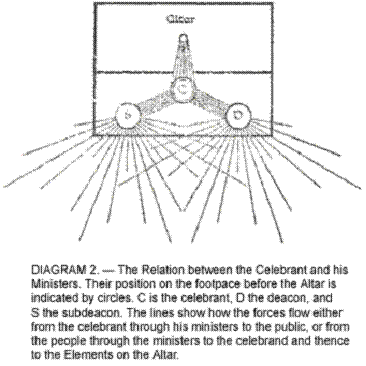
These considerations apply also to a Missa Cantata; but at a High Celebration we have in addition the aid of the deacon and subdeacon, who make a triangle with the celebrant, and for the time act as extensions of his consciousness; relieving him of some aspects of his work, and leaving him free to concentrate his energies. Some of the forces employed radiate through them, and are intensified by their presence and their action. It is their business to act as intermediaries, both in the collection and distribution of energy—a task which is thereby more easily and efficiently performed. (Diagram 2.)
To make their function clear we may use the analogy of the human body. If the celebrant is compared to the brain, then the deacon and subdeacon are ganglia having certain tracts under their charge; the brain of course directs the ganglia, but there are things which they can do without the brain. Originally, in the early Church, the deacon and subdeacon represented the men and women respectively, because the deacon stood on the right of the Priest, that is to say, on the epistle side where the men sat, and gathered up all the devotion from the men and prepared it for the use of the Priest, whereas the subdeacon did the same for the ladies. there are still some churches in which the sexes are separated, but I do not know that there is any special advantage in it, except that, if the numbers are at all equal, it produces a pleasing effect in antiphonal singing.
The rush of devotion, aspiration, love and worship form the congregation pours upon the Priest in a flood of diverse vibrations, and it is no easy task to reduce them all to a kind of common denominator, so that they may conveniently be forwarded. The deacon and subdeacon may receive these from the people, and to a large extent sift and combine them as they pass through into the hands of the Priest, thus saving him much trouble.
For the shortened from of the Holy Eucharist we have chosen a canticle which refers more directly to the work which the Angel is doing in laying the foundation of his edifice. It is preceded by an invitation from the Priest, who says:
Brethren, let us now lay the foundation of our Temple.
Antiphon.
Christ is our foundation.
And our chief corner-stone.
We are no more strangers and foreigners: but fellow-citizens with the saints and of the household of God;
And are built upon the foundation of the apostles and prophets: Jesus Christ Himself being the chief corner-stone:
In whom all the building fitly framed together: groweth into a holy temple in the Lord;
In whom ye also are builded together; for an habitation of God through the Spirit.
Except the Lord build the house: their labour is but lost that built it.
The foundation of God standeth sure, having his seal: let every one that nameth the Name of Christ depart from iniquity.
Antiphon.
Christ is our foundation.
And our chief corner-stone.
Note< The colon in the middle of each line of the canticle marks a change of direction of the alternating diagonal currents, which make the blue and crimson tessellated pavement over which our edifice is to be built. Thus, if, during the first part of the verse, the lines had been running between the south-west and the north-east corners, during the second half they would flow between the south-east and north-west. but during each half, the power might run backwards and forwards several times—depending on the number of beats in the rhythmic metre of the particular half-verse. The Gloria at the end, finishes off the pavement, planes off the edges, and leaves all tidy. The mention of the Three Persons of the Trinity makes the three lights at each person's point of entry glow afresh.
|
ROMAN |
LIBERAL |
|
V.
R. Who made heaven and earth. The corresponding versicles and responses follow the Absolution.
|
P. C. Who hath made heaven and earth. P. Turn us again, O Lord, and quicken us. C. That Thy people may rejoice in Thee. P. Trust ye in the Lord for ever. C. For our Rock of Ages is the Lord. |
We now come to a further stage of our preparation for the great work we are about to undertake. We have endeavoured to purify the mental atmosphere by casting out wandering thoughts, and to bring ourselves into the attitude of strength, peace, and joy, which is needed if we are to do our work well. Certain mechanical difficulties may, however, still remain in our way; we must try to remove these also. But that can be expeditiously achieved only by means of special help from without, and so we proceed to apply the method designed by Christ for His Church—that of confession and absolution.
The versicles which introduce this portion of the Service are intended to induce a frame of mind which will facilitate the action of this plan. First we acknowledge that it is only by divine power that this speedy result can be obtained (for here again Name is equivalent to Power), but we remind ourselves that to the almighty Creator of heaven and earth this rapid change is a simple matter. And so we sign ourselves with the sign of the cross that by its action we may bring ourselves closer to Him. Because we have somewhat slipped away from Him, from the attitude of utter love, peace, comprehension and unity, and so are to that extent restricted as channels of spiritual force, we ask in the words: "Turn us again, O Lord, and quicken us," that He bring us again to the path of right endeavour, and that He vivify us with His radiant life. Without this renewed life we cannot experience the deep joy which is necessary if we are to take full advantage of the Sacrifice which is to follow.
Then to emphasize our utter confidence in His power and goodwill, we say: "Trust ye in the Lord for ever; for our Rock of Ages is the Lord." The very possibility of rapid readjustment depends upon our absolute conviction that it can be done. If we are in doubt on that matter, that very doubt erects a barrier, and prevents the free action of the force. The divine power is ready, but we must open our hearts. Let us then examine the system of rectification by confession and absolution, and see how it works.
|
ROMAN |
LIBERAL |
|
P. I confess to almighty God, to blessed Mary every a virgin, to blessed Michael the archangel, to blessed John the Baptise, to the holy apostles Peter and Paul, to all the saints, and to you, brethren, that I have sinned exceedingly, in thought, word, and deed; through my fault, through my fault, through my most grievous fault. Therefore I beseech the blessed Mary, ever a virgin, blessed Michael the archangel, blessed John the Baptist, the holy apostles Peter and Paul, all the saints, and you brethren, to pray to the Lord our God for me. S. May almighty God have mercy upon thee, forgive thee thy sins, and bring thee to life everlasting. S. I confess to almighty God, etc P. May almighty God, etc. |
All. O Lord, thou hast created man to be immortal, and made him to be an image of Thine own eternity: yet often we forger the glory of our heritage, and wander from the path which leads to righteousness. But Thou, O Lord, hast made us for Thyself, and our hearts are ever restless till they find their rest in thee. Look with the eyes of Thy love upon our manifold imperfections, and pardon all our shortcomings, that we may be filled with the brightness of the everlasting light, and become the unspotted mirror of Thy power and the image of Thy power and the image of Thy goodness. Through Christ our Lord. Amen
|
The form employed in the Roman Church begins with the word Confiteor, "I confess"; hence the name. The purpose of this confession is to help the people to self-recollectedness, and to bring them into that attitude of mind which is necessary if they are to be assisted by the absolution that follows immediately after. The wording of the Confiteor used in the Liberal Catholic ritual is to a certain extent original, and (as will be seen) it differs widely in tone from that used by the Roman or Anglican Churches. The Roman confession: "I have sinned exceedingly, in thought, word and deed; through my fault, through my fault, through my most grievous fault"; the Anglican remark: "There is no health in us," which, however, does not occur in the Service for Holy Communion, but in Matins and Evensong and other similar statements, are exaggerations, and do not represent what a normal person really feels. No sane and rational man ever feels actually that he is altogether evil, and to put such words into his mouth either turns him into a hypocrite, or gives him an entirely misleading conception of human nature.
This constant reiteration of the inherent wickedness of the human heart probably arose in early Christianity as a reaction against certain excesses which marred the civilizations in the midst of which that faith took root. The greatest of the civilizations with which the new religion had to deal were those of Greece and Egypt. Both of these were eminently same and reasonable. The Greek, for example worshipped beauty, and was full of the joy of life. He was well aware that there were higher planes and lower planes, heaven and earth, but he maintained that God made the lower as well as the higher, and that while we are in the lower He intends us to make the best of it and to enjoy life to the utmost, so long as we do our duty to God and to our fellow-men.
As these ancient and wonderful civilizations decayed, undoubtedly excesses arose, and in the seeking for beauty the good was sometimes forgotten. These excesses were abhorrent to the early Christians, and, setting up the ideal of asceticism, they swung to the opposite extreme in their thinking, and condemned as evil everything pertaining to the world and to physical life.
Such exaggerations are unwholesome and unnecessary as the Lord Buddha taught long ago, the Middle Path of reason is always the safest, and undue asceticism on the one hand is just as dangerous and unnatural as undue indulgence on the other; and hence we have carefully avoided in the wording of the confession any statements to which we could not honestly subscribe. We have used the words of St. Augustine, who said that God made us for Himself, and our hearts therefore are ever restless until they find their rest in Him. Whenever we fall away from that which we know to be right, as we all do more or less through carelessness or forgetfulness, we are uncomfortable until things are put right again, because we know that we have made a mistake. We are always unhappy when we wander from the path, even though we may not realize the cause of the unhappiness.
We say that He created man in His own image—the image of His own eternity, a beautiful thought taken from the Wisdom of Solomon (ii, 23). Since we are thus a reproduction of Him, we ought always to keep close to Him, in the full light of His power and His love; but on account of our ignorance and our error we shut ourselves away from Him. The purpose of the confession is to remove the mental attitude which shuts us away, and to substitute in its stead an open and receptive condition of the whole man, so that the light of God may enter. The confession does not directly affect the eucharistic edifice which we are building, though it is an important factor in preparing us to build it. Let us see how the absolution which follows it achieves it results.
Note Here for the first time the congregation are speaking together with the celebrant, so perhaps it is a good place to point our that all through the Service, whenever all thus join in, no individual should raise his voice above that of the officiating Priest in such a way as to attempt to alter the speed, emphasis, or intonation with which the part of the Service in question is being said. Apart from the propriety of the matter, there is a very good reason for this. The material with which we are building our form is simply matter which is vivified by the vibrations of the people's emotions and the outpouring in response to these. It is, therefore, the rhythm and swing of the whole, which is harmonized into one by the Angel, that is the very substance of its existence—the first pre-requisite for a form at all. Now the Priest in charge is the physical-plane center for harmonizing these vibrations and welding them into one by giving them a definite note. Being this physical-plane centre, he will best appreciate the rhythm suited to the particular day of the calendar and the congregation with which he is working, and will then interpret it in terms of his own, with which the angel will co-operate. Thus the celebrant and Angel will be working together, establishing a strong regular vibration, with which our edifice may be constructed. But if there be all sorts of extraneous influences, setting up different beats of their own, which sound above the central one, there will be a jarring of cross-currents which will neutralize each other, so leaving but little rhythm for vivifying our building material. There must be a leader and the celebrant must be that leader.
We find that during the first two clauses of the Confiteor there is a fine outpouring of very delicately coloured and spiritualized influence over the people. As the Confession proceeds, this sinks into them and helps to bring them into the required attitude, which is that of a mind firmly set on living-up to a higher ideal. As this acts upon them, their love streams up to the Embodiment of all true ideals, and so renders them fit for the absolution.
The Priest rises, goes up to the Altar, turns towards the people, and pronounces the absolution.
|
ROMAN |
LIBERAL |
|
May the almighty and merciful Lord grant us pardon,
|
God the Father, God the Son, God the Holy Ghost, bless |
|
V. Thou shalt turn again, O God, and quicken us. R. And thy people shall rejoice in thee. V. Show unto us, O Lord, the mercy. R. And grant us thy salvation. V. O Lord, hear my prayer. R. And let my cry come unto thee.
|
The corresponding versicles and responses precede the Confiteor.
|
|
V.The Lord be with you. R.And with thy spirit. P.Take away from us our iniquities, we beseech thee, O Lord, that we may be worthy to enter with clean minds into the holy of holies. Through Christ our Lord.Amen.
We beseech thee, O Lord, by the
merits of thy saints whose relics are here, and of all the saints, that
thou wouldst vouchsafe to forgive me all my sins. |
The corresponding Minor Benediction precedes the Introit.
|
To understand the effect of absolution we must first explain that the ideas usually associated with the forgiveness of sin are wholly false and misleading. The common conception seems to be that God, having made man and therefore knowing his capacities and exactly what he is likely to do under any circumstances, nevertheless turns His back upon him and is offended with him whenever he does what a calculation of averages would lead us to expect from the ordinary man. It is the same confusion that perpetually confronts the inquirer into Christianity. If Christians would only drop the primitive Jewish notion of a jealous and vengeful tribal deity, and accept the teaching of their leader, Christ, most of these misconceptions would immediately disappear.
I am quite sure that many thoughtful Christians are much better than their creed, and do not really in their hearts hold so low an opinion of the Deity as their words seem to imply. there is much truth in the saying of the late colonel Ingersoll that "man makes his God in his own image"; as man evolves, his conception of God becomes truer and nobler; as he gradually outgrows his coarser vices, he ceases to attribute them to his God, and looks back upon the savage taboo-ethic of his forefathers as crude and blasphemous. I suppose we may concede that the theory that God is angry when man blunders, that He needs to be placated and supplicated to forgive, is a coarse and materialistic way of stating a certain law of Nature; but it is open to the terribly serious objection that it gives the man an altogether wrong and degrading conception of God, and makes it impossible for him to adopt towards his Deity the only attitude which renders progress practicable for him.
No one in his senses could suppose that God cherishes animosity against His people. The whole idea that a person who has done wrong needs to be forgiven should be put altogether out of our minds, because to say that God has to forgive a man, implies that if he were not forgiven God would hold a grudge against that man. That is a thing which no one has a right to say about the Divine Father. God holds no grudge against any man. On the contrary He is always waiting to help, just as the sun is always shining. The sun is not holding a grudge against us when a passing cloud shuts away his light and warmth. The sunlight is always there, and all we need do is to wait for the passing of the cloud.
The God who has hung our solar system in space, and has poured His own life into it that we and His other creatures might come into being, superintends the progress of that tremendous Experiment with benevolent, paternal interests. He knows far more about us than we ourselves can know; He understands our strength and our weakness, and he could no more be angry with us than we can be angry with a flower in our garden. But He watches our growth, and puts various aids in our way; perhaps it pleases Him when we understand and take advantage of them, but even if we do not, the support of His helping hand is never far from us, else we should speedily cease to be.
It is the attention of God which keeps His system in existence; if for one moment He withdrew it, it would instantly be resolved into the bubbles of which it is built. And this attention shows itself down here on lower planes as a force, or rather a number of forces. It is difficult to put these conceptions into words without hopelessly materializing them; yet it is better to over-materialize them than to be altogether ignorant of their beauty and their glory.
Let us try to make clear what really happens when a man commits what is commonly called a sin. Sin is anything that is against the current of evolution. If a man intentionally does something to hold back evolution, either his own or that of somebody else, then emphatically he is doing wrong. But I doubt whether a man ever does evil for evil's sake, except perhaps in very rare cases, such as the German atrocities, many of which were committed deliberately, cold-blooded and to order, with the avowed object of terrifying non-combatants into submission by an exhibition if inhuman cruelty.
Usually what is called sin arises from one of two things: either a man is ignorant and makes mistakes, or he is careless and selfish and not sufficiently attentive to the consequences of his acts. If a man really understood fully what he was doing when he sinned, he would not do it. Much wrong-doing comes from avarice, from the desire for money. That is because misers do not know any better; to them money is of first importance. A vast amount of harm comes from animal passion. Once more, sensualists are ignorant and selfish, and do not really understand the harm they are doing to others and to themselves. The way to banish evil is to increase wisdom, as the Lord Buddha preached in India two thousand five hundred years ago.
Let us accept, then, the definition of a sin or transgression as any thought, word or act which is not in harmony with God's Will for man—that is, evolution. Instead of progression it is transgression, not a movement forward with the evolutionary force, but across the line of its flow. That divine Will acts as a steady pressure upward and onward, and actually does produce in higher matter (even down to the etheric level) a sort of tension which can be described in words only as a tendency towards movement in a definite direction— the flowing of a spiritual stream. When a man's thoughts, words and actions are good, he lays himself more fully open to this influence; he is permeated by it and carried along by it.
When he does or thinks evil, he wrenches himself away from the direction of this spiritual current, and thereby sets up a definite strain in etheric, astral and mental matter, so that he is no longer in harmony with nature, no longer a helping but a hindering force, a snag in the river of life. This strain, or cross-twist, almost entirely arrests his progress for the time, and renders it impossible for him to profit by all the impulses of good influence which are constantly rushing along the current of the stream of which we have spoken. Before he can do any real good for himself or anyone else, he must straighten out that distortion and come into harmony with nature, and so be once more fully amenable to good influence and able to take advantage of the many and valuable aids which are so lavishly provided for him.
The various vehicles of man are not really separated in space, for the finer types of matter always interpenetrate the grosser. But looked at from below they give the impression of being one above the other, and also of being joined by innumerable fine wires or lines of fire. Every action which works against evolution puts an unequal strain on these—twists and entangles them. When a man goes badly wrong in any way the confusion becomes such that communication between the higher and lower bodies is seriously impeded; he is no longer his real self, and only the lower side of his character is able to manifest itself fully.
It must be clearly understood that in the long, slow course of evolution the natural forces are perfectly capable of righting this unfortunate condition of affairs. The steady pressure of the current will presently wear away the obstacle, but a period of many months or even years may elapse before the readjustment is fully effected, though earnest effort on the man's own part will somewhat shorten this period. But even then there is a certain tendency for the distortion to reassert itself.
It is therefore obviously to the man's interest that he should discover some more rapid method of regaining uniformity. Such a method the Church provides, for the power of straightening out this tangle in higher matter is one of those specially conferred upon a priest at ordination. The Christ Himself spoke of that power in the plainest words, though people usually shirk them or try to explain them away, just because they have encumbered their minds with the idea of an emotional forgiveness, and cannot understand that we have to deal with a straightforward scientific process.
But the Priest cannot perform this wonderful miracle of healing alone; he needs the co-operation of his patient. No one can force a man into harmony if he is persistently striving for disharmony; it is only "If we confess our sins" that "He is faithful and just to forgive us our sins, and to cleanse us from all unrighteousness". It is requisite that the candidate be anxious to rise above the imperfections of his nature, and to live the higher life. At all her principal Services, the Church provides a form of general confession to be recited by her people, and a form of absolution to be pronounced by the Priest; and if any man in the congregation is truly sorry for some slip or mistake which he has made, and earnestly anxious to put himself once more in full accord with the evolutionary current, there is no doubt that the divine force which flows through the Priest when he pronounces the absolution does rush through that man's higher vehicles, combs out the entanglement, and straightens the twisted lines until he is once more in perfect harmony with God's will.
The Priest pours out the absolving force over his congregation, and does not know upon whom or in what direction it is taking effect; but if an individual comes to him privately and tells him exactly what is wrong, he has perhaps a certain advantage in being able to concentrate the whole of the force just where it is most needed. Also, quite apart from the power conferred upon him, the Priest can often from his experience offer very useful advice.
But let no one suppose that the public absolution given to the whole flock is in any way less effective than private absolution, if the desire for rectification on the part of the wrong-doer is equally earnest and sincere. As has been said, in the slow process of time the distortion must come straight, under the influence of the ordinary evolutionary forces; and no doubt this procedure would be hastened by the strong desire of the patient for readjustment. The action of the Priest in the matter is merely what is commonly called a "means of grace"—that is to say, a little help on the road of evolution provided by the Christ for His followers.
In the Liberal Catholic Church auricular confession is entirely optional, and is not required as a preliminary to the reception of Holy Communion. Its frequent and systematic practice is not encouraged, since it is felt that under such conditions the detailed confession is apt to become a matter of routine, and its spiritual value in the life of the individual thereby defeated. For all ordinary purposes the general confession in the Holy Eucharist should suffice.
It must be clearly understood that the effect of absolution is strictly limited to the correction of the distortion above described. It reopens certain channels which have been to a large extent closed by evil thought or action; but it in no way counteracts the physical consequences of that action, nor does it obviate the necessity of restitution where wrong has been done.
A man who steals, for example, puts himself in the wrong in three separate ways: he has broken the divine law of love and justice, and has thereby cut himself off from full and free communication with the higher side of nature; he has broken the laws of his country; and he has wronged the individual from whom he stole. If he fully comprehends the mistake that he has made, and is genuinely anxious to correct it, the Priest's absolution will straighten out for him the etheric, astral and mental entanglement which was produced by his action, or rather by the mental attitude which made that action possible; but it does not relieve him from the legal penalty of that action, nor from the duty of instantly and fully restoring what he has stolen.
Intoxication is a temptation to men at a low stage of development; one who succumbs to it is undoubtedly sadly in need of the help of absolution to remove the barriers which he has erected between himself and the sunlight of God's grace; but by yielding he has also weakened his will and injured his physical health, and he must not expect that absolution will either strengthen the one or restore the other. The Sacrament puts the man right with God; but it does not relieve his from the responsibility for his acts, nor in any way affect their physical consequences.
It is a spiritual process, a loosening from the bondage of sin, a process of at-one-ment with the Higher Self, a restoration of the inner harmony of being which is distributed by wrong-doing, so that the man can make a fresh effort towards righteousness, fortified by the uninterrupted flow of the divine power within him. A man cannot escape the consequences of his misdeeds, though he can neutralize them by sowing fresh causes of a righteous kind. "Be not deceived; God is not mocked: for whatsoever a man soweth, that shall he also reap."
Note When the celebrant makes the first cross, the blessing of the Lord, which flows into them to some extent, puts all their bodies into order and straightens things out in the personality. As he recites the words "the Lord in His loving kindness look down upon you and be gracious unto you," the Priest is working at the level where the Lord looks down upon us as a unity—the buddhic plane—where we receive His Graciousness in so generous a measure. Here the celebrant is one with his congregation, and at this high level, having tried to draw them all up into himself, he pours a rush of force down into their lower vehicles, that a take the image of their higher selves (already made brighter and truer reflections of the Great Self by the outpouring in the Confiteor and at the first blessing in the absolution) and, through their points of entry, stamps this down upon the personality, thereby not only affecting that personality, but also clearing the channel connecting it with the Greater Self. The power of God stimulates the Divine Image within each of us to impress Itself more definitely on the personality, and in forcing itself down it clears out any kinks in the connection channel between the lower and higher selves—between the individual and God. Thus the Life of the Logos—the evolutionary stream—can again flow smoothly through the man. He is no longer a snag in the stream, because he has been put right in his relation with his Maker.
This is a wonderful help, but remember that the absolution goes no further than this. It is not well to use the expression that the man is forgiven or pardoned because God is never in such an attitude towards us that we could speak of His needing to change it from offence to pardon. He made us what we are, and He is not angry with us because we are still in the lower stages of our evolution. To speak of anger in Him is a very gross misunderstanding; indeed, such a supposition is in truth a blasphemy.
A better way to put it is to say that, as we have tipped the balance one way, it will swing back again, and we must bear the consequences of our act. The absolution cannot negate the law of cause and effect. What it can and does do is to straighten out the confusion for us, and give us strength which we may use to go on and do better ,thereby setting in motion other causes for good, which may neutralize or mitigate the result of our misdeeds. This is the only kind of penitence which is of any use; contrition and remorse are really in themselves only additional wrong, and are often excuses for turning our thoughts entirely upon ourselves, in the belief that we are doing it for higher purposes. Thus we waste energy which should be spent in His service, and often harm the people around us; for the vibrations which we send out in this condition are very likely to produce depression, selfishness and irritability in others. No one has any right to do this; it is in reality an anti-social form of self-indulgence and therefore in itself a crime.
Next comes the beautiful ceremony of the censing of the Altar, which requires a few words of explanation. It comes down to us from the early days of the Church, and is mentioned by Origen himself. The use of incense is full of significance. It is at the same time symbolic, honorific and purificatory. It ascends before God, as a symbol of the prayers and devotion of the people; but also it spreads through the church as a symbol of the sweet savour of the blessing of God. It is offered as a mark of respect, as it was in many of the older religions; but it is also used with a definite idea of purification, and so the Priest pours into it a holy influence with the intention that wherever its scent may penetrate, wherever the smallest particle of that which has been blessed may pass, it shall bear with it a sense of peace and purity, and shall chase away all inharmonious thoughts and feelings
Even apart from the blessing, its influence is good, for it is carefully compounded from certain gums, the undulation-rate of which harmonizes perfectly with spiritual and devotional vibrations, but is distinctly hostile to almost all others. The magnetization may merely intensify its natural characteristics, or may add to it other special oscillations, but in any case its use in connection with religious ceremonies is always desirable. The scent of sandalwood has many of the same properties; and the scent of pure attar of roses, though utterly different in character, has also a good effect.
More than a hundred varieties of incense are known, and each of the ingredients employed has its own special influence on the higher bodies of man. There is a science of perfumes, and evil powers as well as good may be invoked by such means. Nearly all the incenses prepared for church use contain a large proportion of benzoin and olibanum, as experience has shown that these are both pleasing and effective. Benzoin is almost savagely ascetic and purifying; it deals trenchantly with all the grosser forms of impure thought, and is excellent for use in a great cathedral crowded with somewhat undeveloped individual. For smaller assemblies of less bucolic minds it needs a large admixture of other elements to produce the best results. Olibanum is the special incense of devotion; its fragrance tends strongly to awaken that feeling in those who are at all capable of it, and to deepen and intensify it where it already exists. A judicious mixture of these two gums is found satisfactory in practice, so it is frequently employed as a basis or central stock, to which other less important flavourings may be added.
When the thurifer and the boat-bearer approach, the celebrant ladles some incense into the censer, and solemnly blesses it, saying: "Be thou blessed by Him in whose honour thou shalt be burned." If a Bishop be present, it is better that he should bless it, as he can put a little additional power into it which is not at the command of the Priest. While blessing the incense, the best intention to hold in mind is that it may clear the way, may pierce through and polarize everything with which it comes into contact. The thought which I myself hold in mind while blessing incense is that it may "make straight the way of the Lord."
It has been asked whether it would not be possible to bless the whole boat of incense before hand, instead of merely that which is used to charge the censer. It would not be nearly so effective, because incense does not retain the full magnetism for an indefinite period, as a precious stone would. It is better then to bless each time that portion of incense which has just been placed upon the glowing charcoal, for in that way the magnetism is impressed upon it at the moment of its melting, when it can penetrate most thoroughly, and so the best effect is obtained.
After this is done the celebrant proceeds to the censing of the Altar. By so doing he seeks to permeate the whole Altar and the atmosphere round it with high and holy influence, and to carry to higher planes the preparatory process which has already been performed for the etherical level at the Asperges. The Altar is going to be the centre of a tremendous radiation, and it is necessary so to prepare it that it will not drain away any of the forces which it should transmit. If it were not censed, a certain proportion of the force which comes at the time of the Consecration would be spent in getting the particles of the Altar into order for this transmission, in order that the force might be properly distributed. The plan of censing the Altar is good, since it spreads the magnetism very fully and accurately through the Altar itself and everywhere upon it.
The middle line of the Altar, upon which are placed the Host and the Cross, is the direction down which the force of the Consecration will flow, and it is therefore necessary first of all to cense that and clear the way.
We have adopted with slight modifications the Roman order in the censing, but we give nine swings to the cross, arranged in groups of three, which is better for the purpose than the three double swings of the Roman Church. In that act we show the highest honour in our power to all that the cross typifies—the Christ Himself and the great Sacrifice which brought forth the universe. Also this nine-fold swing has a special and beautiful significance, for it symbolizes the offering to the Triune God of the threefold man whom He has made in His own image; it shows that we dedicate "ourselves, our souls and bodies" (which is the Christian phrase for what students call the Monad, the ego and the personality) to each Person of the Blessed Trinity in turn. As the Priest performs this action, each member of the congregation should mentally make this total surrender in his own case, thereby awakening within himself all that as yet can be aroused in each of these departments, and preparing himself to take part in the Kyrie later. As the Priest takes the censer from the deacon he turns and genuflects, saying silently: "To the Father I dedicate (as he swings the censer three times) (1) spirit, (2) soul, (3) bodies"; then there is a momentary pause, and in that pause before the second set of swings he says to himself: "To the Son I dedicate (as he makes the three swings) spirit, soul, bodies"; and then as he pauses before the third set of swings he says silently: "To the Holy Ghost I dedicate (as he makes the swings) spirit, soul, bodies." Then he genuflects and turns to the candlesticks on the southern or Epistle side of the Altar and censes each one with a single swing of the censer (Diagram 8), which not only magnetizes each candle, but also that portion of the surface of the Altar covered by the sweep of the censer. In doing this, the Priest should think in turn of each of the seven Rays, which are represented by the six candles and the cross—or, perhaps more accurately, the light before the cross, which may be regarded as a kind of extension of it.
Since this is emphatically a religion of the Christ, the Head of the second Ray, and the Latin cross is His especial symbol, the Altar-cross represents to us the second Ray, and in swinging the censer towards it, we are worshipping the Holy Trinity "through Christ our Lord," as we say so often in our prayers. The first candle censed (the nearest to the cross on the southern side) represents the first Ray; the next represents the fourth, and the outside candle the fifth Ray. On the gospel side the candle nearest to the cross denotes the seventh Ray (that now becoming dominant in the world), the next stands for the third, and the last for the sixth Ray. The assignment of the candles to these particular Rays is in harmony with the arrangement of the jewels in the Altar-stone which is advocated in Part III, and the relation between them will be made clear by Diagram 8.
In censing each candle, the Priest should think of the Ray with which it is associated, offering worship to God along that particular line, and the people also should have in mind the same thought as far as they are able. This means what is really a kind of double thought—a resolve to try to develop within oneself the quality specially belonging to that Ray, and at the same time to dedicate to God's service whatever one possesses of that quality. For our present purpose the characteristics of the Rays, and the aspirations that we should offer, may be expressed as follows:
|
|
"I will be strong, brave, persevering in His service." |
|
|
" I will attain that intuitional wisdom which can be developed only through perfect love." |
|
|
"I will try to gain the power of saying and doing just the right thing at the right moment—of meeting each man on his own ground, in order to help him more efficiently." |
|
|
"So far as I can, I will bring beauty and harmony into my life and surroundings that they may be more worthy of Him; I will learn to see beauty in all Nature, that so I may server Him better." |
|
|
"I will gain knowledge and accuracy, that I may devote to them to His work." |
|
|
"I will unfold within myself the mighty power of devotion, that through it I may bring others to Him." |
|
|
"I will so order and arrange my service of God along the lines which He has prescribes, that I may be able fully to take advantage of the loving help which His holy Angels are always waiting to render." |
It is obviously impossible to think all this within the time occupied by a single swing of the censer, so it may be suggested that when the Priest genuflects after having censed the cross, he should say to himself: "for His service I will unfold within myself" (as he censes the candles in order) "(1) Strength, (4) Harmony, (5) Knowledge."
Next he censes the southern corner of the Altar, both below and above (Diagram 3), and in doing so he should take care to reach well round the side. During this and the next operation he holds firmly the thought: "May His strength make a sure shield for His grace. " Then the edge and top of the Altar are censed, including any vases standing upon it. As he genuflects on reaching the middle point, he thinks again: "for His service I will unfold within myself" (as he censes the candles) "(7) Order, (3) Adaptability, (6) Devotion." Then, as he deals with the northern or Gospel corner, edge and top in a similar manner, he returns to the previous idea of making so strong a swirl of force that nothing can interfere with it, using the same words as on the southern side, and holding that thought as he censes the lower part of the Altar on both sides. when there are only two candles, as at private celebrations, the Priest should cense each candle three times, holding the same thoughts as directed above.

In this way the whole Altar is surrounded by a shell of powerful magnetism, which produces an effect upon its material, and that of the objects upon it, which is not unlike the magnetization of an iron rod. By this same action the block of either surrounding the Altar is separated off from the rest; it does not join for the time being in the general etheric circulation; being especially polarized, it remains like an eddy—- still an elastic body, though held apart for a while in the neighbourhood of the Altar, until in the second censing it is further extended. If we think of the Host as one pole of a magnet (the other pole of which is the Christ Himself), then this etheric eddy is the magnetic field surrounding it. Just as the space within the eucharistic edifice is for the time being walled in from the outer world, so is the magnetic field round the Altar temporarily walled in from the church in turn—a Holy of Holies within the Temple. To change the simile—if the church, or rather the eucharistic edifice, be imaged as a power-house, the etheric eddy round the Altar is the dynamo, and the celebrant the engineer in charge. As a sign that he is so set apart and associated with this innermost sanctum, he, and he alone, is also censed at this stage.
Here we meet another of the many advantages of High over the ordinary Low Celebration. It will be readily understood that it is desirable to reserve this magnetic field exclusively for the reception and storage of the force from on high, and to have as little as possible of any other action than that going on within it. It is the business of the celebrant, who is necessarily inside the reserved area, to receive the contributions of force generated by the devotion and gratitude of his people, and speed them on their upward way. but they are of very varied quality and power, and they need harmonizing, co-ordinating, purifying, often even to a considerable extent transmuting, before he can employ them to the best possible advantage, and weld them into such a stream as will evoke every ounce of power that they can draw down from the illimitable divine storehouse.
This work of sorting, arranging and filtering absorbs a good deal of the celebrant's energy (even though he maybe unconscious of it) and inevitably creates friction and disturbance within the etheric field. All this is avoided at a High Celebration, because, as I have already said, the contributions of the people flow through the deacon and the subdeacon; the straining and sorting is done by them outside the casket, and they deliver the steady, purified streams of force to the celebrant, who is thus enabled to maintain inside the shell a far higher level of efficiency. Indeed, it is only by this expedient that it is feasible to deal at all satisfactorily with the bewilderingly miscellaneous output of a large and enthusiastic congregation. (Diagram2)
In considering the many benefits which we gain from the use of incense, we must not overlook the aid of the special orders of Angels and nature-spirits which work by its means. The Angels of the Incense are of two quite distinct types—neither of them readily comprehensible except by those who have devoted much study to such subjects. Such investigators know that there are Angels of Music—great beings who express themselves in music just as we express ourselves in words—to whom an arpeggio is a greeting, a fugue a conversation, an oratortio an oration. There are Angels of Colour, who express themselves by kaleidoscopic changes of glowing hues, by coruscations and scintillations of rainbow light. So also are there Angels who live in and express themselves by what to us are perfumes and fragrances—though to use such words seems to degrade, to materialize the exquisite emanations in which they revel so joyously. A subdivision of that type includes the Angels of the Incense, who are drawn by its vibrations and find pleasure in utilizing its possibilities.
There is also another kind to whom the title of Angel is less appropriate. They are equally graceful and beautiful in their way, but in reality they belong to the kingdom of the elves or nature-spirits. In appearance they resemble the child-angels of Titian or Michael Angelo, except that they have no wings. They do not express themselves by means of perfumes, but they live by and on such emanations, and so are always to be found where fragrance is being disseminated. There are many varieties, some feeding upon coarse and loathsome odours, and others only upon those which are delicate and refined. Among them are a few types which are especially attracted by the smell of incense, and are always to be found where it is burnt. When we cense the Altar and thus create a magnetic field, we enclose within it a number of these delightful little elves, and they absorb a great deal of the energy which is accumulated there, and become valuable agents in its distribution at the proper time.
Incense is valuable to our Service in so many different ways that it is eminently desirable to take advantage of its remarkable qualities whenever possible. When he can, each Priest should keep a small censer in his own private oratory, and use it at his daily Celebration. The Maronite Church of Mount Lebanon always uses incense both at Low and High Celebration, and we of the Liberal Catholic Church follow its example in this matter as far as possible.
Note Besides its honorific and purificatory uses, the censing is of the greatest value in that it calls down the powers of the Rays though their representative candles, as each in turn is censed. Let us examine the colours of the different outpourings. It is not asserted that these are the colours of the Rays, for it would require a very competent clairvoyant to arrive at these with any certainty. The difficulties in the way are great, for various reasons. It seems likely that each Ray has a fundamental colour which can be attributed to it, but this is overlaid by many others. There is perhaps some arrangement by which they correspond with the colours of the spectrum, and they probably modify their colours accordingly to the needs of the world at the moment, which depend on cyclic changes.
There are many other considerations each of which has its effect; it is like the adjustment of a many-ringer letter-lock; if we once understood the Word—the regulating Principle—we should probably find it clear enough, but from our present position, not know that Word, and seeing only the involved immensity of the number of possible considerations, it merely raises bewilderment. However, we can give the colours outpoured at the censing without touching the question of the absolute colours of the Rays.
With the first triple swing to the central cross and picture, we have a fine outflow of white which spreads itself all over the Altar. It also stimulates the jewels in the Altar-stone to vigorous activity, so that they share in this white outpouring. It may be only the diamond, the first-Ray jewel, which emits this colour, but I am inclined to think it is the result of the combined colours of all the Rays, which, like the colours of the spectrum, may all be subsumed into pure white. This is of a different nature from the dazzling and intensely positive first-Ray blaze; this is just simple whiteness which does not strike out like lightning, but pours out like milk, and glows with a sweet softness which is yet very firm. I believe it was with the intention of imitation this that the instructions were given that on the Altar should be spread a "fair linen cloth". The next three swings induce a similar outrush of blue, from the Christ; and the last set brings down the crimson of the Holy Spirit. The swing to the first-Ray candle brings down a great jet of power which rushes straight down the candle and out on to the Altar, spreading out in the shape of the letter V. At the same time it sets up great activity in the first-Ray jewel of the Altar-stone, which pours matter of the same colour all over the Altar. The stream from the candle runs strongly for a few moments, and then the colour is covered over by the whiteness of the "fair linen cloth". Still, however, a certain amount remains visible through this white material, but it looks as though what filtered through were of a high octave of colour, it is so delicate and refined.
The colours which come down each of the candles have several layers to them. the first Ray has a thin pencil of intensely bright gold, which is surrounded by the wonderful and shining silvery electric blue, which is so often seen in connection with this Ray. The surface of this outpouring is covered with silver sparkles, which it is continually shooting off with a hissing noise. Many are given off with what almost approaches a crackling sound, as the stream reaches the edge of the Altar and falls down the Altar like an orphrey, stained with these wonderful colours as they glow beneath the whiteness of the Altar covering. All the outpourings from the other five candlesticks run in a manner precisely similar to this, except that their colours are different, and from their relative positions, their V-shaped paths also differ slightly.
The next swing of the censer is towards the fourth-Ray candles. This has its core of a curious indescribable colour which approaches most nearly to a sort of translucent magenta pink—a strong colour, but with a very delicate shell tint. The pink itself shades off by imperceptible degrees into an opalescent aqua-toned aura. The body of the power is a splendid mingling of dark blue and green like a peacock's breast; and on the surface we see the same colour as at the heart, except that there are only flecks of the magenta and much more of the opalescent effect. The contrast of the magenta, seen against the dark ever-changing rush of mingling deep blues and greens seems to make this curious cloud-like halo of opalescence look almost like a beautiful Êsthetic grey, but when one looks closely, one sees that there are many soft colours in it which gleam out as the ever-restless stream throws them more to the surface, and that the greyishness is only the result of the contrast between the strong almost metallic sheen of the darker colours, and the gentle aura of this odd pink. Possibly some of the colours of this Ray's power are due to its long association with Egypt. They may also have to do with its position as the central or balancing position between the two sets of three on either side of it. It is thought by some that, whereas in the three fold cycle of evolution the first three Rays characterize the first part of the cycle, and the fifth, sixth and seventh Rays its last part, the fourth Ray dominates the whole of the middle cycle. I am far from convinced of this, but if it were so, it would account for the many colours and curious blends in this outpouring, as it would have to suit itself to many more periods than the other Rays.
The next candle to be censed is that of the fifth Ray, which produces a down-pouring with a centre of a rich apricot red—there is orange in it and Martian red—and a surrounding body of a beautiful and singularly pure yellow. On the surface we have tiny flecks of the central colour, the apricot.
The two swings round the side consolidate the protective wall which the whole of this censing is building round the Altar, and the next three swings draw a further rush of power from the candles—naturally in the reverse order this time—which we have just been censing. This part of the censing is specially intended to make a further impression of each of the Ray powers where they have coloured the Altar as they rushed over the edge to make their orphreys down the front.
The celebrant now censes the candles on the Gospel side of the Altar, beginning with that nearest the centre, that of the seventh Ray. This down-pouring is silver in the middle, a specially gleaming, living silver which differs from the first-Ray silver in that the latter looks more like the actual metal surrounded by white fire; while the former is more like a stream of mercury which seems to exhale other tints as though it reflected them. This has a more human and a softer feeling than the first-Ray power which is so intensely positive—strong as a line of lightning. Around this core, the seventh-Ray outpouring is a marvellous transparent amethyst—a regal colour which makes the heart sing and speaks of the splendour of sunsets shining into stormy tropic seas; but the dark blue of those restless waters at or after dusk, is also there, and the flash of moonlit wavelets is suggested by the myriad flecks of silver which, as with the first-Ray influence, dance off its surface.
The next, the third-Ray candle emits a fine sky blue and emerald, which suggest the colours of certain blue and green opals—like shallow sea water over a sandy bottom when the sun shines through it.
The last candle is the channel for the sixth-Ray force, which in the centre is pure Martian red—very strong and fiery—the colour that inspires martyrs. The main volume of the outpouring, that which surrounds this central jet, is the most lovely rosy crimson—the tenderest and purest carnation shade—really quite indescribable. Perhaps the nearest one can come to it in physical colours is seen in certain very fine rockets; but even this is the poorest and most faded reproduction of the pure beauty of this higher colour. The Martian red shows itself again in surface flecks.
Fireworks provide the nearest likeness on the physical plane to astral colours; but even these cannot give a true idea of what seems almost a paradoxical mixture of the utmost vigour and intensity of colour with the most transparently diaphanous and intensity of colour with the most transparently diaphanous and delicate pearly effects. These combine with an ever-changing, ever-restless and glistening sheen to produce an appearance of life which suggests that the colours are the expressions of a living entity, whose moods are never the same from moment to moment.
The next part of the censing is like that which was done on the Epistle side of the Altar; and then follow six circular swings—three on each side—along the bottom part of the Altar frontal. These draw down the power represented by the particular candle in from of which each swing is made, and so intensify the Altar orphreys.
With each outrush from the candles, the corresponding Ray jewel has sent a flood of the same power over the whole Altar, which, though it has disappeared under the white covering, yet definitely leaves its magnetism. Each outrush from the various candles quickly spreads itself till it touches the paths of its two neighbouring outpourings; so that practically the whole of the top of the Altar is covered by these colours, which (unlike those that come from the more general and diffuse effect of the Altar-stone jewels) do not altogether vanish beneath the white covering, but remain to glimmer through it like twinkling stars between wind-tossed palm leaves. Similarly, the front of the Altar is left all covered with these bands of half hidden colours which still seem living beneath the luminous white.
Thus, for the clairvoyant, the censing is a very beautiful ceremony, the Altar being alive with these amazingly vivid colours, and each candle like a small sun of the hue—for not only are the candles like pipes for the down-rush, but they themselves, around the flames and the places where the Ray jewels are set in them, are fairly bursting with radiations of light and glory, making a real fire or Altar lights.
All this has separated off the Altar from the rest of the church, in order that special powers may be generated within it. The celebrant is to some extent included in this magnetized field when the deacon now censes him. I say "to some extent included," for the celebrant is at no point permitted to touch the Altar, because, if he should do so, power which had accumulated within it would flow out into him. If he were fully part of this magnetic field, he and the Altar would be equally charged, and it would therefore not matter whether he touched it or not. But as it does matter, he is clearly only "to some extent included" in the charged area.
His vestments have absorbed a good deal from the outpourings during the censing of the Altar, and now that he is himself censed, he is charged with much more power. This is what he shares with the people in the Minor Benediction which immediately follows.
|
|
LIBERAL |
|
|
P. The Lord be with you. C. And with thy spirit. |
By the recitation of the second of these Minor Benedictions the Priest collects from the congregation such force as may have been generated by their feeling of gratitude for the absolution. Also by it the people are brought into harmony with the Priest as closely as possible, and he endeavours to share with them as far as he can the wonderful electrification which he has received during the ceremony of the censing. The magnetic field, the insulated space, is being more and more highly charged, and by this action the Priest projects some of that force over his congregation; and the ready response of its members links them closely with him, so that their vibrations are raised to a higher level. The strings of the higher consciousness are tightened and tuned.
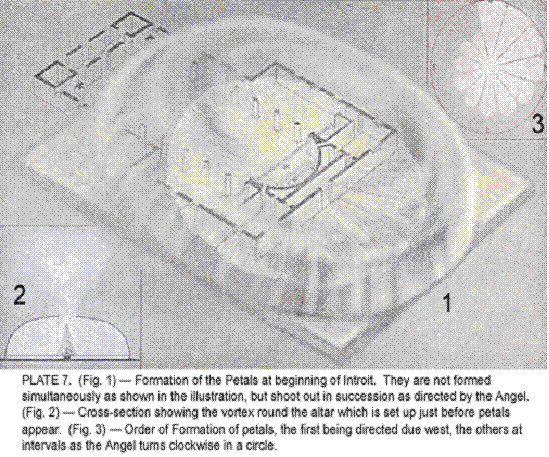
The rectification achieved by the absolution has made this tuning feasible, so that the people can now be drawn together far more intimately than would have been possible before, just as a bundle of straight rods can be bound together more closely than could a heap of bent, irregular branches. Each man had his own twists and angles; these have now to a large extent been straightened out, and there is now at least an approach to parallelism, and therefore a capacity for psychic collaboration in the construction of the eucharistic edifice by the beautiful act of worship called the Introit. In the shortened form of the Eucharist, the place of the Minor Benediction before the Introit is taken by a special reference to the work which we are now undertaking. The Priest sings: "With praise and with prayer shall our Temple be built." And the people reply: "To God alone be the glory."
|
ROMAN |
LIBERAL |
|
The Introit varies. That which follows is of Trinity Sunday. |
|
|
Blessed be the holy Trinity and undivided Unity: we will give glory to him, because he hath shown his mercy to us. |
O Lord our God, how excellent is Thy Name in all the world! Glory be to the Father, and to the Son, and to the Holy Ghost. As it was in the beginning, is now, and ever shall be, world without end. Amen.
Blessed be the Holy Trinity, the undivided Unity, eternal, immortal, invisible, to whom be honour and glory for ever and ever. Amen. |
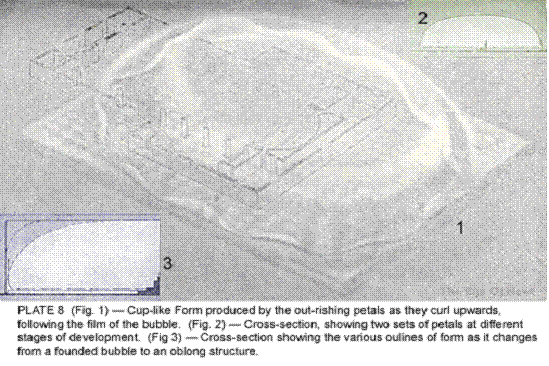
The Introit is in essence a further acknowledgement and invocation of the might and splendour of the Name which is above every name; and remember always that this in reality synonymous with the Power which is above every power. For its central feature is the verse: "O Lord our God, how excellent is Thy Name in all the world." The rest of the Introit consists of the usual Gloria Patri added to this, and a magnificent antiphon which precedes and follows it. It would not be easy to invent a finer tribute of praise, and it is eminently effective in providing material for the walls and roof of the edifice. The vivified matter pours out in great waves over the mosaic pavement, flooding it and curving upward at its edges, following (as far as the church is concerned) the shape of the bubble blown by the Asperges, but reduplicating that shape on the eastern side of the Altar also.
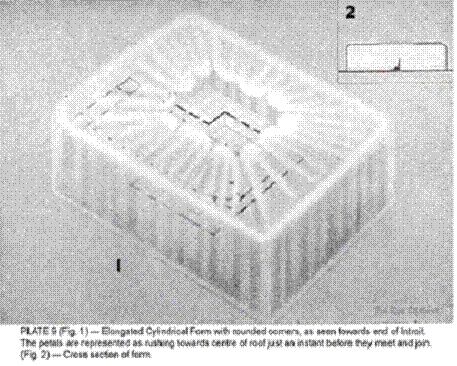
By the sign of the cross at the beginning each person opens himself fully to the influence of the electrification, and then under that wonderful stimulus pours himself out in love, devotion and worship. The first rush of this force welling up from the congregation to the Altar makes a huge vortex round it (Plate 7), into which the divine response to the devotional feeling comes down in a torrent; but the Angel of the Eucharist quickly spreads this abroad and flattens it down, so that it rushes in all directions along the pavement and circles up the walls, bearing a curious resemblance to a rapidly-growing dup-like flower (Plate 8). Each phrase of the Introit sends out a fresh wave, and the rising material soon bends over again into a roof, so that the edifice at this stage looks like an enormous cylindrical bag, all its corners and edges being rounded (Plate 9).
The Angel, superbly capable, stands in the middle by the Altar, deftly spraying out force in all directions with wondrous ease and accuracy, thereby quickly pressing out the curves into corners, until we have an oblong building (Plate 10). The colours are still chiefly crimson and blue, as in the pavement, though sometimes blending into purple with occasional touches of gold. The material is at first thicker near the bottom of the walls, and therefore darker in hue; the upper part, being lighter and thinner, shows lovely delicate shades of rose and azure of indescribable luminosity, but as the uprush continues the whole erection becomes firmer and less tenuous.
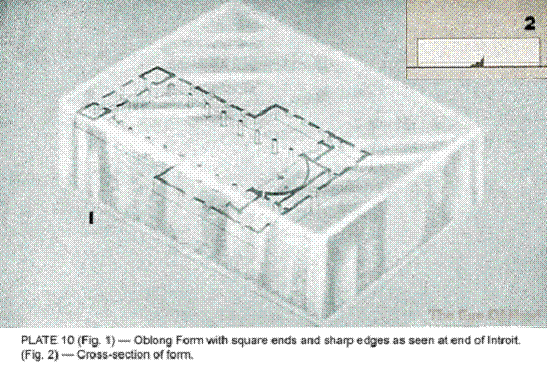
In the Roman Missal the Introit is constantly changed, according to the season. We have thought it well to avoid this, and have followed in preference the custom of the Greek Church, which does not alter its Services in this way. We find that the many Intro its of the Roman Church are by no means all equally effective in producing the necessary material for the edifice, so it seems desirable to take the best of them, very slightly modifying it; and an even more important consideration is that the people join much more readily and heartily in words which are thoroughly familiar to them. When they know what is coming they are able to put their thought into what they are saying instead of having to consider how to fit the words to the music; so if we want really enthusiastic and whole-hearted co-operation from those who are not highly trained in singing, it is obvious that a large part of the ritual must be unchanging, that they may learn it by heart.
Note The Roman usage here prescribes that the celebrant and his assistants shall stand in a semicircle formation. This is useful, as it helps in setting up the whirl of power which rushes up to the centre line, and there induces the down-pouring with which the Angel builds the walls and roof of the edifice. The swirl is on the positive side because of the strength and stability of the outpouring on that side. This part of the Service provides a beautiful spectacle for the clairvoyant. The great flower-like splash of outrushing power spreads in all directions over the rich crimson and blue of the pavement, which is distinctly seen below the transparent, opalescent colours of the outrushing material. the effect is rendered doubly impressive by the light of the central downrush appearing to be reflected on the spreading outflow, the ripples of which are thereby all touched to gold as a pool on some great mountain-top—a lagoon, grass-ringed, like a bright sapphire set among emeralds—which at the same instant feels the first breath of morning and catches the largesse of its scattered gold.
As the walls quickly rise around one, one looks out as on to a fairy world, seen, as it is, through the wonderful blue and crimson, gold and lilac of the shining and diaphanous structure.
|
ROMAN |
LIBERAL |
|
Kyrie, eleison. Kyrie, eleison. Kyrie, eleison. Christe, eleison. Christe, eleison. Christe, eleison. Kyrie, eleison. Kyrie, eleison. Kyrie, eleison. |
Kyrie, eleison. Kyrie, eleison. Kyrie, eleison. Christe, eleison. Christe, eleison. Christe, eleison. Kyrie, eleison. Kyrie, eleison. Kyrie, eleison. |
These are the only words of its original language now remaining in our Liturgy. The phrase Kyrie eleison is usually translated: "Lord, have mercy upon us"—a rendering which brings in the false and unworthy idea that God is angry with us and that we must ask for mercy, and is entirely consistent with the cringing attitude to which we have before referred as so disastrous to true devotion. It is true that the Greek verb evleevw is susceptible of that meaning when used as expressing the petition of a prisoner to a judge; but that it has another and more natural signification is shown by the use which we make of the English word "eleemosynary," which is derived from it. That brings out the idea of freely giving, giving as alms; so that a far more appropriate equivalent to Kyrie eleison is: "Lord, give Thyself to us," or "Lord, pour Thyself forth." One Christian scholar translates it: "Lord, be kind to us." But could our heavenly Father ever be otherwise than kind?
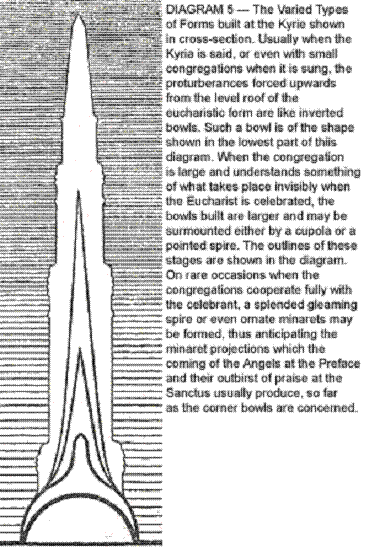
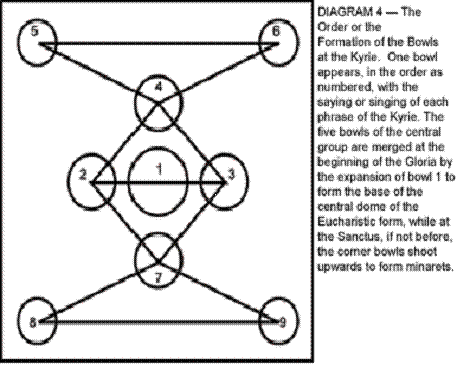
The prayer is really pre-Christian, for it is in effect a translation of one addressed in the Egyptian Mysteries to the Sun-God Ra, asking him to shine upon his people with his beneficent and life-giving ray—not with that which is burning or destructive. When we realize the true intention of the celebration of the Eucharist—when we understand that a veritable continuation of the great Sacrifice is about to take place—we see at once how eminently suitable is such a prayer, as this, and how skillfully designed is the curious form in which it is cast.
For this ninefold invocation corresponds to the ninefold offering of spirit, soul and bodies at the censing; that opened up the man at those three levels, and the response which comes to this appeal fills the opened vessels. As he sings the first petition, the worshipper, reaching up with all his strength towards the All-Father, and trying to realize his absolute unity with Him, should think: "I am a spark of Thee, the Living Flame; O Father, pour Thyself forth into and through Thy spark." Holding the same realization, as he sings the second, he will feel: "Father, flood thou my soul, that through it other souls may be nourished." And at the third: "Father, my bodies are Thine; use Thou them to Thy glory." At the fourth, fifth and sixth recitations, he will repeat these thoughts substituting the realization of the Son for that of the Father; and in the third series he will offer the same petitions to God the Holy Ghost. Yet in all this he must not ask anything as for himself alone, nor take pride in being chosen as a separate vessel for God's grace, but must rather know himself as one among the brethren, a soldier among comrades.
When a congregation understands this scheme of invocation and carries it out efficiently, remarkable results are produced in the eucharistic edifice. A splendid group of spires is thrown up from its roof, following a beautiful and suggestive order in their arrangement (Diagram 4). the first identification of the spirit with the All-Father shoots upward a fine central spire; the second and third petitions project similar, but slightly smaller, spires to the north and south of it. The fourth produces a spire to the east of that in the centre, while the fifth and sixth result in smaller spires in the north-eastern and sough-eastern corners of the roof, making a triangle with the fourth. The seventh appeal throws up a spire west of the centre, thus completing the group of four which surrounds the first and largest in a diamond shape, while the eighth and ninth occupy the north-western and south-western corners and make a triangle with the seventh. This arrangement will be easily followed by the aid of the illustration.
Only a well-practised congregation can throw up this forest of spires; earlier efforts will produce low dome-like inverted bowls (Plate 11), just like those on the roof of the Church of San Giovanni degli Eremiti at Palermo (Plate 12); but the arrangement is always the same. At times with a specially trained and devoted congregation splendid minarets are formed by the uprush of force. A bowl is formed when the force is weak, a minaret when it is strong (Diagram 5).
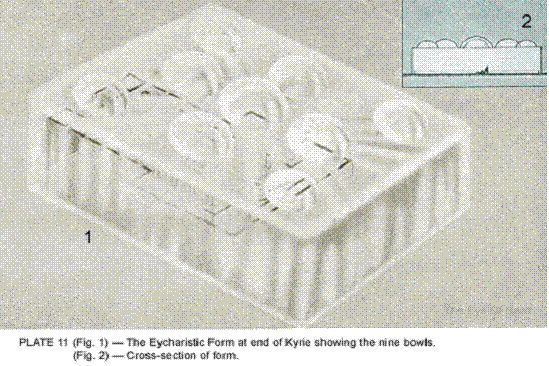
In the Roman Service these bowl-like shapes often sink back again and become depressions in the roof instead of rising above it. This is due to the ideas of fear and self-abasement which so often accompany the misunderstanding caused by unworthy mistranslation of the Greek words. When we think of ourselves as miserable sinners and continually plead with God for mercy, the effect upon the edifice is striking, for re-entrant curves and hollows take the place of swelling domes and flashing spires. To worship God with fear and trembling is, from the hidden side of things, to shut away from ourselves much of the down-rush of His love which would sweep through us if we would only learn to trust Him utterly as a loving Father.
In the Roman churches one often sees fine uprushes of devotion from individuals, but it is rare to find a combination of intelligent devotion from a number of people, so that the result resembles more a few scattered scaffold poles than a minaret. Sometimes the people provide great rolling clouds of devotion, but it is generally vague and unintelligent, so that even when it can be used in the construction of the edifice, it leaves all the work of the building entirely to the Angel. It is important that each person present should think strongly, not of himself, but of acting as part of a unit. In this way the force is his devotion, instead of thrusting itself through the roof of the edifice like a rod, assists in raising and swelling the domes or minarets.
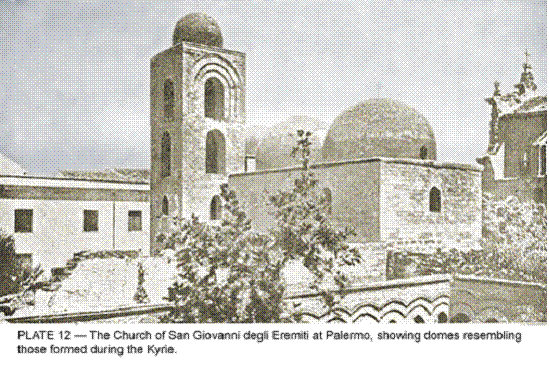
In the eucharist Service of the Church of England the effect of the Kyrie has been almost entirely lost by the lamentable introduction into that Service of the Mosaic commandments. The nine Kyries are interspersed among them, a tenth being added after the last, which is supposed to be addressed to the Three Persons collectively. The Kyrie is specially intended to lead up to the Gloria in Excelsis, and fit the people worthily and usefully to join in that most beautiful act of praise and worship; but the so-called reformers, blankly ignorant of all this, have widely divorced them, putting one at the beginning and the other at the end of the Service. The Kyries in this Service cannot of course erect spires or cupolas, as they should; for as yet there is absolutely no building of any sort, nor has any Angel been invoked, except in the case of those few Churches which, though using the Anglican Liturgy, supplement its deficiencies by interpolating the principal features of the Roman rite.
|
ROMAN |
LIBERAL |
|
Omitted during Passion and Holy Weeks. |
|
|
Glory to God in the highest, and on earth peace to men of good will. We praise thee, we bless thee, we adore thee, we glorify thee. We give thee thanks for thy great glory. O Lord God, heavenly King, God the Father almighty. |
Glory be to God in the highest, and on earth peace to men of good-will. We praise Thee, we bless Thee, we worship Thee, we glorify Thee; we give thanks to Thee for Thy great glory, O Lord God, Heavenly King, God the Father Almighty. |
|
O Lord Jesus Christ, the only-begotten Son. O Lord God, Lamb of God, Son of the Father, who takes away the sins of the world have mercy upon us. Who takes away the sins of the world, receive our prayer. Who sittest at the right hand of the Father, have mercy upon us. |
O Lord Christ, alone-born of the Father; O Lord God, Indwelling Light, Son of the Father, whose wisdom mightily and sweetly ordereth all things, pour forth Thy love; Thou whose strength upholdeth and sustaineth all creation, receive our prayer; Thou whose beauty shineth through the whole universe, unveil Thy glory. |
|
For thou only art holy. Thou only are Lord. Thou only, O Jesus Christ, art most high, together with the Holy Ghost,
|
For Thou only art holy; Thou only art the Lord; Thou only, O Christ, with the Holy Ghost, |
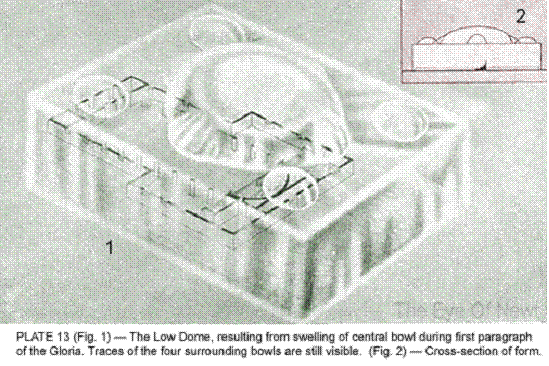
The Gloria in Excelsis (as given in the Roman or Anglican prayer-books, is a translation of an early Greek hymn. The first certain mention of it is in an order given by Pope Telesphorus in the year 128. There is considerable variation among the older forms of it which have survived, and some if its less defensible features are absent from the earlier versions. For some centuries it was sung only when a Bishop celebrated; then a Priest was allowed to use it on Easter Day only; and finally, about the twelfth century, its general use in all festival Masses was permitted.
We have adopted the translation of the first and last of its three paragraphs as it stands in the English communion Service, except for the phrase "goodwill towards men," which, while perhaps more picturesque as a sentiment, is indefensible as a rendering of the generally accepted text of the original Greek, and obscures the significant issue that only those can have peace who are animated by goodwill towards their fellows. Certain modifications have been introduced into the second paragraph. We have corrected the translation of the word monogehvz as "only-begotten," substituting what we find to be its real meaning, "alone-born"—that is to say, born from one parent alone, and not from a syzygy or pair, as have been all other created beings. We have deleted the misleading phrase "have mercy upon us," replacing it by others more in harmony with the spirit of this glorious hymn. Instead of a reference to the sins of the world, we have quoted from another ritual the noble description of the Holy Trinity as Wisdom, Strength and Beauty.
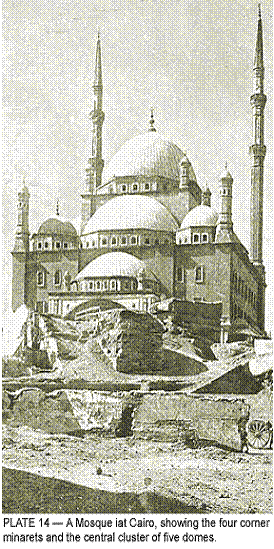
In singing this both Priest and people cannot do better than follow the actual words as closely as possible, trying to feel them and mean them to the uttermost. For just as in the Asperges we were principally dealing with etheric material, so in all this part of the Service have we been chiefly engaged in the vivification of astral matter, though unquestionably strong vibrations of intuitional wisdom are also aroused in all who are capable of them.
The effect of the Gloria in Excelsis upon the eucharistic edifice is most striking. Each of its three parts contributes definitely to the building. As we sing the first paragraph the central spire produced by the singing of the first Kyrie swells and expands until it blends with the four surrounding spires to form a great central dome (Plate 13).
This dome is low in proportion to its diameter, and is not yet exactly circular at the base, as it still at this stage shows traces of the four smaller domes or spires which it has absorbed. The form at this stage is curiously suggested by the Mosque at Cairo, shown in Plate 14. With the singing of the second paragraph this great flattened dome rounds itself out, and a lofty and exquisitely proportioned cupola swells out of its top. Lastly, in the third part a lantern-like erection shoots out from the cupola, the whole now forming a structure of three stages, something like the dome of the Capitol at Washington although the details are different (Plate 15). Finally, when the people cross themselves while singing the last few words, a rosy cross forms above their heads and floats up into the lantern-like part of the edifice.
Considering the important part which this magnificent hymn plays in the building of the form, the Roman custom of omitting it and the Creed at what some people are pleased to call penitential seasons is much to be deprecated.
Note The three verses of this magnificent hymn are addressed to the Three persons of the Trinity, so that the base of the central erection is consecrated to the Father, the middle part to the Son, and the lantern-like erection on the top, formed by the last verse, is sacred to the Holy Spirit. This part of the Service is always rather a fine colour display; and the central dome is still further enriched by the Collects, which add distinctive colours for the various festivals commemorated, and further consolidate it.
|
ROMAN |
LIBERAL |
|
V. The Lord be with you. R. And with thy spirit. |
P. The Lord by with you. C. And with thy spirit . |
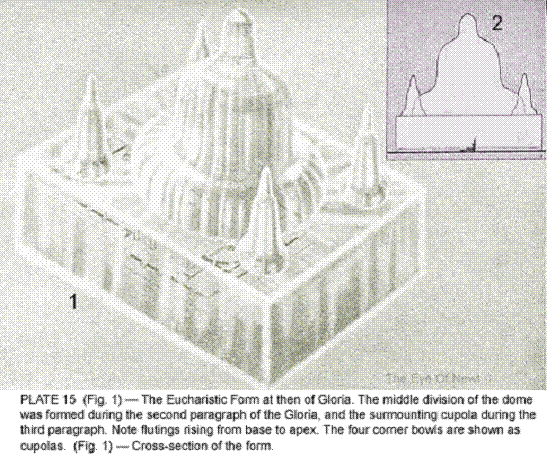
At the end of the Gloria in Excelsis, when the people are specially exalted by the noble words which they have just uttered, and are therefore in a more sensitive and receptive frame of mind, once more the Priest turns to them and endeavours by means of the Minor Benediction to pour into them something of his own enthusiasm. their ready response draws them into closer union with him, and also puts into his hands all the force which they have been generating.
|
ROMAN |
LIBERAL |
|
The Collect varies. That which follows is or Trinity Sunday. |
|
|
Almighty, everlasting God, who hast granted that in confessing the true faith thy servants should acknowledge the glory of the eternal Trinity and in the power of the divine majesty should also worship unity: grant that by steadfastness in the same faith we may evermore be defended from all harm. Through our Lord. |
Almighty God, unto whom all hearts be open, all desires known, and from whom no secrets are hid; cleanse the thoughts of our hearts by the inspiration of Thy Holy Spirit, that we may perfectly love Thee, and worthily magnify Thy holy Name. Through Christ our Lord. Amen. |
|
Here follow any additional Collects, after which the Epistle is read. |
Here fellows the Collect of the Day, after which the Epistle is read. |
The devotion and love of the people have now been thoroughly aroused by the splendid acts of worship and invocation in which they have participated, and in consequence the building of the eucharistic edifice has been completed so far as its astral portions are concerned. It is now desired to arouse the mental enthusiasm of the congregation, with the result that matter of the mental level may also by woven into our erection. This is done by reading to the people the Epistle and Gospel and by calling upon them to join in the recitation of the Creed. But first are said certain prayers called Collects, of which in our revised Liturgy one is used invariably, but the others change with the calendar.
These brief and comprehensive prayers have been used in the Church from the earliest periods. The name applied to them is of great antiquity, but of obscure origin. Liturgiologists have though that they were so called merely because they were used in the public congregation or collection of the people; or from the fact of many petitions being collected together in them into a brief summary; or because they collect together the ideas comprehended in the Epistle and Gospel of the day, and weave them into a prayer. Again, there is a suggestion that in earlier days the Priest "collected" the wishes of his congregation, and incorporated them in his extempore prayer. Another theory which has been widely supported is founded upon the fact that in ancient times when the Service called a station was held, it was the custom for the clergy and people to meet first at another church, and then go together in procession to that at which the Eucharist was to be said. Before they started from the first church a short prayer was said, called Oratio ad collectam, and from this custom that prayer itself came to be denominated the Collect. However this may be, such prayers are found in all known Liturgies.
Our first Collect, which is unchanging, is a prayer of the early Church called the Collect for Purity, which immediately follows the Paternoster in the opening of the Communion Service of the Church of England. Its earnest aspiration for purity of thought is especially appropriate here, when we are just about to supply the mental material necessary for the eucharistic edifice; and the petition that we may be filled with perfect love and may worthily praise God's holy Name touches precisely the right note, and gives us the clue to exactly the attitude of mind which we must maintain of we are rightly to do Him service.
In selecting the Collects for Sundays and holy-days we have in many cases used those from the Book of Common Prayer of the Church of England, which in turn have usually been chosen from those of the ancient Liturgy; but we have consistently eliminated all passages exhibiting a cringing or faithless spirit, and have striven to keep ever before the minds of our members the thought of the love and the glory of God, and the supreme joy of unselfish service.
In regard to commemorations we follow the ordinary custom of our Church. When two festivals concur, we use the Service of the more important of the two, and in addition recite the Collect of the other, in order that our people may not overlook it.
In the early days of the Church it seems to have been the custom to read a number of lessons at this point of the Service, the amount being limited only by the time at their disposal; we find the direction that the Bishop or Priest shall give a signal when he thinks that enough has been read. At a later period this surfeit of lessons was reduced to three, called the Prophecy, the Epistle and the Gospel; later still, the first of these disappears, and we find only the Epistle and the Gospel, as we have them now, though a trace of the compression still remains in the fact that what is called the Epistle is sometimes taken from the books of the Prophets. The intention clearly is to offer to the people some definite instruction; for we must not forget that in early days there were no printed books, so that teaching could be given only orally. In relation to the edifice, the object of these readings is to arouse the intellectual faculties of the congregation by giving them food for thought, so that mental as well as astral material may be provided.
In selecting readings for the Epistle we have sometimes chosen lections different from those used either by the Roman or Anglican branches of the Church. We have not felt constrained to take any particular passage in its entirety, since, if we did so, we should in many cases be obliged to read quite unsuitable and unedifying passages. Instead of invariably selecting consecutive verses, therefore, we have often chosen only such as express some lofty and stimulating thought, omitting others which have no connection with the subject in hand, or approach it from a point of view inconsistent with a firm faith in God's love and wisdom.
Critics will naturally accuse us of accepting that in the Scripture which suits our purpose, and ignoring or rejecting the rest. We are in no way concerned to rebut such an accusation, for that is exactly what every author or speaker does; in quoting from a book he takes that which illustrates the point which he happens to be making, and avoids whatever has no reference to it. In the Liberal Catholic Church we leave our members absolutely free in all matters of belief, so if any of them wish to hold to the theory of the verbal inspiration of the English translation of the Scriptures, they are quite at liberty to do so.
To the writer that book is one among many other volumes of the Sacred Lore, which have been revered and studied by holy men of various religions through the ages—volumes, all of them, containing gems of truth set in the frame of beautiful and poetical words, illuminating and helpful for all time; but also all of them including much which is untrue or of merely temporary and local interest. To regard any such book as infallible is to run counter to truth, to reason and to history, for it is easily demonstrable that they all contain many inaccuracies; and there is nearly all of them much exceedingly objectionable matter. But all that is no reason why we should not cull from them whatever we find to be encouraging, instructive and uplifting.
At the end of the Epistle the servers, choir and congregation say or sing: "Thanks be to God."
Note
We now pass on to the more mental part of the service. Hitherto we have been building with astral matter, but not we commence to function on the next higher plane. The Epistle is partly mental and partly astral, the Gradual rather more mental, the Gospel, almost completely so, and the Creed largely higher mental.
Because of the well-known fact that all things on a lower plane have their counterparts on higher planes students sometimes fail to see the necessity of building in mental matter, where it must already exist as a necessary concomitant to the making of the astral form. But it must not be forgotten that it is on the plane on which a thing is created that it has its most real existence, and a form built up by scintillating mental matter such as is supplied by the Creed, is a much more living thing than the mere after-effect of what was largely an astral effort, such as that which has, up to this point, been the building force.
The Epistle outpouring begins when the Angel, who stands in the centre of the Altar, pours down much higher astral and lower mental matter through the three ministrants. This is worked up by the congregation, and is then returned, vibrating at a slightly reduced rate, but much larger in volume.
Here there are two alternative positions which are taken by the three officiants. Sometimes they stand with the celebrant in the centre nearest the Altar, and the deacon and subdeacon each one stage nearer the people, making a line which gradually slopes away from the centre, so that the deacon is well over to the Epistle side. In this case the subdeacon faces the congregation in order to read to them, but the other two face north. With this formation, there is much power flowing back from the congregation through the three officiating Priests, and the deacon and the celebrant have their left or negative sides towards the people for receiving this, and their right or positive sides towards the Angel, for handing it on to him. Of course, there is at the same time a continuous and concentrated stream flowing from the Angel down through the three of them, but not only is this smaller in volume than the stream which comes in from the people, but also it flows straight through without any difficulty, whereas the larger quantity has to be sorted, sifted and purified; therefore the main work is one of receiving material from the body of the church, and we are not so concentrated on what comes in from beyond the Altar, as that will take care if itself. Hence the negative side is turned not towards the east, but to the west.
The alternative arrangement is that the deacon should stand just behind the subdeacon, so that a line drawn from the celebrant to the deacon, and thence to the subdeacon, would not be a straight line, but would make two sides of a triangle, the third side the hypotenuse, being made by the direct line from the celebrant to the subdeacon. With this formation, the celebrant often faces west just as does the subdeacon, though the deacon still looks north. Some of the lines of force between the Epistles and the officiant flow directly from one to the other, and some via the deacon—thus making the triangle in lines of light. With this arrangement, the flow of force is mostly outwards— the celebrant being directly towards his congregation and after being swirled round and worked up for somewhat longer, it is poured in again during the gradual. Each scheme seems to work well, and from the occult point of view there is not much to influence one's choice. It has been thought that the triangle, being a living symbol, would act as a great channel, but this form of magic—making connections in this way with the archetypes—belongs more to the Egyptian form of ceremonial, and is not needed so much in the Christian scheme, where we have the Host which seems to make all necessary connections. Moreover, at this particular part of the Service there is no special call for such a channel.
Whichever plan be adopted, the celebrant should remain in the centre of the Altar, as he, like the Angel, has to gather forces from both sides of the Altar to send down and out through his assistants.
The Epistle is not accompanied by the same tremendous outrush as the Gospel, nor has it the same mechanical arrangements connected with it, but, it is, nevertheless, a definite outpouring, and naturally, as it is a part of the Bible which is read, it is in touch with the body of thought behind that Volume of the Sacred Lore.
|
ROMAN |
LIBERAL |
|
The Gradual varies. That which follows is of Trinity Sunday.
|
The Gradual varies only on Christmas, Easter, Ascension Whitsunday and Trinity Sunday; also on Festivals of our Lady or of the Angels. That which follows is used throughout the rest of the year |
|
Blessed are thou, O Lord who beholdest the depths, and sitteth upon the cherubim. Blessed are thou, O Lord, in the firmament of heaven and worthy of praise for ever. Alleluia, alleluia. Blessed art thou. O Lord God of our fathers, and worthy of praise for ever. Alleluia.
|
He that loveth wisdom loveth life and they that seek her early shall be filled with joy. Teach me, O Lord, the way of Thy statutes: and I shall keep it unto the end. Give me understanding, and I shall keep Thy law: yea, I shall keep it with my whole heart. The path of the just is as the shining light: shining more and more onto the perfect day. |
The Gradual is one of the oldest parts of the Service, and is so called from the Latin word Gradus, a step, because it was sung from the lowest step of the ambon or rostrum form which the Epistle and Gospel were chanted. In the days of many lessons there was always a psalm sung after each; this which is called the Gradual came originally between the Prophecy and the Epistle, while the word "Alleluia," many times repeated, was sung just before the Gospel to express the thankfulness of the people for the good news which it brought to them.
The habit arose of prolonging the last syllable of that word, and making it wander up and down over many notes (not infrequently extending to three or four hundred, and in one case at least reaching to as many as seven hundred!), this vague inarticulate noise being somehow supposed to symbolize the inexpressible joy of the Saints in heaven. As some rudimentary musical sense slowly developed among the early Christians, it occurred to them that it would be better to substitute a hymn for this curious meandering; and when that was done the hymn was called a Sequence, because it followed the Alleluia.
On occasions when it was desired to give a mournful air to the Service, as in Lent or at funerals, they substituted for the Alleluia a psalm to which they gave the name of Tract, because it was sung straight through (in uno tractu) and not in alternate verses. The Tract and Sequence are still to be found in the Roman Liturgy, but we have thought it unnecessary to perpetuate them, as a large number of small passages which are constantly changing cause confusion, and make it more difficult for the congregation to follow the Service. For the same reason we use one Gradual all the year round, except for those great festivals for which Proper Prefaces are appointed.
As in this part of the Service we are concentrating on the vivification of mental matter for the edifice, the Gradual advocates the love of wisdom, and explains the need of instruction in order that real progress may be made—that we may thereby grow in understanding, and so become a steadily increasing light and help to the world. The Angel of the Eucharist uses the matter given to him by the singing of the Gradual for the strengthening and enriching of his edifice, and especially for the division of each of its four walls into panels by the erection of half-pillars.
At a Low Celebration, when the Gradual is omitted, columns and decorations do not appear, though there is usually a faint indication of the panels. Naturally the form made at the Low Celebration is not only much smaller than that of a full musical Service, but also in every way plainer and less ornate. Another factor which makes a good deal of difference in the form is the intelligent co-operation of the Priest. In the Churches where this branch of the subject is not studied, all the work of designing and building the edifice falls entirely upon the Angel of the Eucharist (or, when he is not invoked, upon the Directing Angel); he can and does make the labour far easier by supplying material exactly when and where it is wanted.
Note
At this point the subdeacon stands in the middle, on the lowest step, or else, in the Roman working, over on the Epistle side, waiting for the candle-bearers to come and form the procession with the book of the Gospels. In either case, he leaves the way open for a direct connection between the deacon and congregation by which the deacon receives the mental matter now being vivified by them without its coming through the subdeacon, who represents the emotional side of things. He hands this on to the celebrant, who passes it on, and then the response comes back, again in terms of mental matter, which all helps to prepare the deacon for the distinctly mental outpouring of the Gospel.
The deacon represents the more mental side of things, and his side of the Altar is that which in the Ray influences is predominantly masculine; it is on his side that we have the scientific ruling Rays. The subdeacon's side of the Altar represents more the emotional approach, and has the Ray of devotion on it. This is the more negative or feminine side, and it was at one time the custom for the women in the church to sit on the subdeacon's side, and the men on the deacon's side. An interesting exception to this is found in the curious old Sarum rite, where this was reversed.
Meanwhile the subdeacon has been receiving all the people's emotions, which, after transmuting them, he discharges. Some of this goes up to the celebrant, and much goes out to his left and straight up. this the Angel uses for the decoration of the walls of the form, and I am inclined to think that he reserves this for decorating the western half, and uses that which passes through the celebrant for the eastern half. The subdeacon also has certain lines going from his to the deacon, and it looks as though he were giving the deacon the benefit of some of the higher emotions which are more specially stimulating to the mind, before passing them on.
|
ROMAN |
ROMAN |
|
Cleanse my heart and my lips. O God almighty, who didst cleanse the lips of the prophet Isaias with a live coal: vouchsafe of thy gracious mercy so to cleanse me that I may meetly proclaim thy holy gospel. Through Christ our Lord. Amen.
Pray, Lord, a blessing. May the Lord be in my heart and on my lips, that so I may meetly and fitly proclaim his gospel. Amen. |
Cleanse my heart and my lips, O God, who by the hand of Thy Seraph didst cleanse the lips of prophet Isaiah with a burning coal from Thine Altar, and in Thy loving kindness so purify me that I may worthily proclaim Thy holy gospel. Through Christ our Lord. R. Amen.
May the Lord by in my heart and on my lips, that through my heart the love of God may shine forth, and through my lips His power be made manifest. R. Amen. |
This prayer is said as above at a Low celebration or Missa Cantata only. At a High Celebration the first part is repeated by the deacon, who then kneels before the celebrant (or before the Bishop if present) and the latter recites the second part of the aspiration, substituting the word, "thy" for "my". It is a fervent wish on the part of the reader that he may be so purified as to do his work properly and to be a suitable cannel for the power which is to be poured forth; and a very real response is received through the blessing of the celebrant or the Bishop, who thereby bestows upon him a portion of the electrification which was produced at the censing, and includes him temporarily within the magnetic field, thus admitting him to the Holy of Holies in order to do this special piece of work.
The deacon's prayer that his heart and lips may be cleansed directs his own attention to these centres, i.e., the heart and throat, and so stimulates them. This renders them more receptive to the power which is about to be poured into them by the celebrant. Because the work done in connection with the Gospel is mainly on the mental plane, the deacon's brain centres must also receive attention, and therefore the centre at the pituitary body is similarly made to glow. A further effect of the prayer is seen on the people, who, if they have been following what the deacon has been saying, have had the same centres in themselves quickened. This is not only the result of following him, but is also due to the direct effect which he is able to produce on them as a result of the connection made between himself and the people at the Gradual, so that when his own centres are brought into activity, the corresponding chakras in the people are affected in the same way.
The deacon should bear in mind that, as it was he who gathered in all the people's "mental aspiration," it is he who is to hand on to them the power which comes down as a response to this. He is thus an intermediary for the people, and, like an agent in physical-plane matters, he must remember their interests. In short, he must not forget that he is to be "cleansed" merely for the sake of his duty to the people, and is therefore representing or speaking for them as well as for himself. There will be two results from his recollecting this; the link between himself and the people will be stronger, and he will be able to do much more when reading the Gospel, and also the people's centres will have been much better prepared for the Gospel outpouring. However, the result on both the deacon and people is but slight during the prayer; it is only at the celebrant's response that anything definite is noticed.
With the words "May the Lord be in thy heart," a beautiful golden stream is poured out which largely affects the deacon's heart, and when the celebrant says: "and on thy lips," a gleaming silver flashes out which is chiefly attracted to his throat-centre. At the words, "that through thy heart the love of God may shine forth," the deacon is surrounded by a beautiful cloud of rose-colour, with a glowing nucleus at the chakra in the breast. The clause: "and through thy lips His power be made manifest," sends a stream of the wonderful pale blue power of the first Ray—which is always sparkling with flashing silver—into the deacon at the throat. By means of the Minor Benediction, he immediately shares this blessing with the people and receives their response, thus completing his link with them. The effect on the congregation of this close harmony is largely in stimulating its members mentally; the awakening of their centres is only a secondary consideration, useful inasmuch as it helps in quickening the faculty of receiving and understanding; therefore, in all this preparation for the Gospel, the deacon should have in mind the general enlivening of the power of comprehending and assimilating, rather than be concentrating too much on the people's centres.
To make this point clear, it will be well to see how the outpourings of colour affect the deacon. The heart centre has to do especially with the expression of the nobler emotions, and there is a direct connection between the upper astral and the buddhic, or intuitional levels. Now the golden power which is first poured on to the deacon's heart is buddhic, and thus stimulates the intuitional side of the higher powers of understanding. The pink of affection, which is later concentrated in the deacon's heart, ensures that the Gospel shall be interpreted in the spirit of pure love—the astral sensation which is most akin to anything buddhic—which on the higher planes is not only love, but wisdom, the right understanding of things.
The throat, being the centre through which we have a direct touch with the higher astral levels—where we find the loftiest and the most buddhic form of love—is, for this reason, also vivified. But is not only for the sake of that higher touch that this chakra is quickened, but also because we are about to hear a reading—to listen—and the throat is the physical receiver for astral sounds. But in the case of the deacon there is yet another reason for this. The silvery electric blue of the first-Ray powers are given to him in order that as the words pass his lips—the lips are an extension of the throat chakra—they may receive the most powerful possible impetus.
It will be seen that all that happens to the particular centres is only of subsidiary importance to the necessity of awakening the faculties of comprehension and understanding—and, in the deacon, the power of delivery. Thus it is sufficient if these general ideas be borne in mind by the deacon, and he simply thinks of the quickening of these things in the congregation, as well as in himself, during his prayer for purification.
This is a principle which apples throughout all ceremonial. It is always better to try to get the central idea, the dominant purpose of a prayer or a paragraph, and hold this firmly in mind, rather than to be distracted by each individual sentence. If this be done, each separate clause goes to build up a strong clear-cut thought-form, which then discharges itself with great effect; whereas, of the piece of ritual be done without this forceful conception of its direction and intention—if the mind simply passes on from sentence to sentence—the form produced is markedly less clear-cut and tends to look wooly, which renders it much less effective; and this is so, however clear the thought may be about the individual sentences. The reason is that the gripping of the central idea involves the use of the synthesizing powers of the higher mind, and so brings down much more of the individual.
|
ROMAN |
LIBERAL |
|
V. The Lord be with you. R. And with thy spirit. |
P. The Lord by with you. C. And with thy spirit . |
Immediately the deacon turns and shares this private benediction with the people (except that of course he cannot include them within the field), and is placed closely en rapport with them by their ready and earnest reply. Their aspiration should of course be that their hearts may be so cleansed from lower emotions that they may be able worthily to receive the teaching and profit by it.
|
ROMAN |
LIBERAL |
|
The Priest announces the portion of Gospel to the read, making the sign of the cross on the book with his right thumb. |
The Priest announces the portion of Gospel to the read, making the sign of the cross on the book with his right thumb. |
|
|
C.Glory be to thee, O Lord. |
|
He reads the gospel. |
He censes the thrice and reads the gospel. |
|
R.Praise be to thee, O Christ. |
C.Praise be to thee, O Christ. |
|
The Priest kisses the book, saying: By the words of the gospel may our sins be blotted out. |
|
The gospel has always been regarded as the most important of the readings. Since it was supposed to contain the words of Christ Himself, or the account of some incident in His earthly life. From this point of view the book in which it was written was surrounded with the greatest reverence; it was censed and kissed by the reader, and attended by acolytes with candles. We are now well aware that historically most of these reasons for special respect have no existence; many critics think that these books are for the most part not the work of those to whom they are attributed, that many of the words which they assign to the Christ were probably never spoken by Him, and that in any case they were not intended by their writers to be taken as an account of historical facts, but merely as the casting of the great eternal facts of human progress into the form of an allegory, just as was done in other great mystery-dramas by the ancients. This was perfectly understood by the great Gnostic doctors of the early Church, though forgotten, with so much else, when the dark ages of ignorance and barbarism descended upon the world.
Origen, the most brilliant and learned of all the ecclesiastical Fathers, teaches that "the Gnostic or sage no longer needs the crucified Christ. The eternal or spiritual gospel which is his possession shows clearly all things concerning the Son of God Himself, both the mysteries shown by His words and the things of which His acts were the symbols. It is not so much that Origen denies or doubts the truth of the gospel history, but he feels that events which happened only once can be of no importance, and regards the life, death and resurrection of the Christ as only one manifestation of a universal law, which was really enacted, not in this fleeting world of shadows, but in the eternal counsels of the Most High. He considers that those who are thoroughly convinced of the universal truth revealed by the Incarnation and the Atonement need trouble themselves no more about their particular manifestations in time." (Christian Mysticism, by Dean Inge, p. 89.)
Origen speaks plainly with regard to the difference between the ignorant faith of the undeveloped multitude and the higher and reasonable faith which is founded upon definite knowledge. He draws a distinction between the popular irrational faith which leads to what he calls somatic Christianity (that is to say, the merely physical form of the religion) and the spiritual Christianity offered by the Gnosis or Wisdom. He makes it perfectly clear that by somatic Christianity he means that faith which is based on the alleged Gospel history. Of a teaching founded upon this narrative he says: "What better method could be devised to assist the masses?"
It is clear therefore that the actual book of the gospels can hardly be regarded as worthy of exaggerated respect, for there are unquestionably other volumes in which the Sacred Lore is set forth more accurately and far less allegorically. But the reverence with which we still continue to greet it is paid to it as a symbol. We bow to the Altar-cross and cense it, not that we worship that particular Nehushtan, but because it is the recognized symbol of the Christ and of His mighty Sacrifice; we salute our national flag, not that that piece of bunting is superior to any other, but for the sake of the glorious ideal of which it is intended to remind us.
Just so the book of the Gospels is the Christian presentation of the Ancient Wisdom, the Gnosis, the Truth that makes us free; it holds for us the same position as the Dhamma, or Law of Life, does among the Buddhists. Therefore we pay it reverence, therefore we thank the Christ for it, however imperfectly this special manifestation of it may represent His teaching. Some Altar-crosses are of wood, some of brass, some of gold, yet we bow alike to all; some flags may be only painted cotton, yet the symbol is the same.
The three signs of the cross which we are directed to make before the reading of the gospel typify the dedication of mind, lips and heart to the work of spreading the truth, and are also intended to open the three centres at the forehead, the throat and the breast to the influence which is about to be poured out. The book becomes a centre of force, surrounded by a sort of cocoon of reverential and grateful thought, and so it is the appointed channel for the outflow which is meant to stimulate our mental faculties, and help us in our contribution of material at that level to the building of the edifice. The first cross made over the book by the deacon is intended to unlock the door of the treasure-house—to turn on the tap, as it were; and the other three made by the people open them up to the inflow.
A special effort is made to provide a good radiating centre; the subdeacon holds the book, and an acolyte with a candle stands on each side of him; the volume is censed, and the thurifer remains in the immediate neighbourhood during the reading; so that the vibration of light and the permeation of the perfume are both utilized to assist in spreading various aspects of the influence.
The use of the thumb in making the sign of the cross corresponds to a pugnal pass in meserism; this and the corresponding place in the Roman Last Gospel are the only cases in which it is prescribed in the Service of the Eucharist, but it occurs in the offices for Baptism and Confirmation, and its use is recognized in the Roman Service for the consecration of a Bishop at the anointing of his hands, where reference is made to "the laying on of this consecrated hand or thumb". It seems to be employed when a small but powerful stream of force is required, as for the opening of centres.
When the reading of the Gospel is finished the deacon turns to the celebrant and censes him, thereby returning to him whatever remains unused of the force which was supplied at the Munda Cor Meum, that it may be utilized in the work of the Service. During the reading, the members of the congregation should follow attentively, trying always to understand the inner as well as the outer meaning; and when at the end all join in singing: "Praise be to Thee, O Christ," they should realize that they are voicing their gratitude not only for what has just been read, but for the great gift of the Ancient Wisdom, the knowledge which brings life and light to all.
Note
Having then completed his link with the people by the Minor Benediction, the deacon passes over to the Gospel side to give to the people in his reading the power which he has received from the celebrant's blessing. He begins by touching the book with his left hand and, while announcing the Gospel, with the right hand—particularly using the thumb—he makes the sign of the cross over the place where the piece of Scripture for the day commences. Connected with all this ceremony of reading the Gospel, there is quite an elaborate piece of magic, and to understand it, we must make a digression.
Every piece of literature of wide reputation, like every well known piece of music, has a body of thought about it, which comes together and makes a huge thought-form. This has happened with the Gospels, but with them there is an additional factor—the devotion which is attached to people's thoughts about them. On the higher levels, no useful power is ever wasted—and strong devotion is a very useful power which always obtains it response—therefore we have to consider all the devotional thought connected with these sacred writings. This is managed by a special Angel who works through the Gospel thought-form, receiving, handing on and responding to the people's devotion with the efficiency of a business house dealing with its orders.
In this connection we may note some points about the thought-forms behind the various Liturgies. That behind the Roman Liturgy gives a wonderful sense of antiquity and ripeness. Its tones are mellowed like those of a picture by an old master, and its atmosphere gives one the same sort of delightful sensation as does the fragrance of a rare old wine. To a large extent, its power seems to come from the dignity lent by the richness of matured tradition. But, though it is strong and very beautiful, it has some dirty, dark-coloured and brownish patches in it.
The Liturgy of the Eastern Church has a delightful feeling which is refreshingly different from our Western Liturgies, but is rather odd and very vague—not at all clear in outline or idea. The thought-form behind the Anglican Prayer Book is largely spoiled by being so broken up by the numberless different usages and divisions in that branch of the Church. This produces an odd effect like a house with a number of different storeys and divisions, or a filing cabinet full of pigeon-holes, but rather disordered. The atmosphere of many of its compartments makes one feel somehow rather straight-laced; but its great beauty of language and quite dignified sense of reserve combine to sound a note of stately beauty and spiritual refinement.
The body of thought behind our own Liturgy is conspicuous by reason of its amazingly brilliant colours. A thing of this sort, when new, is apt to have a bright and hard appearance, but to prevent this and at the same time to give it power the Christ has endowed it with a wonderful life of it own, which enables us to obtain the effect of long tradition in a short time, so that, though new, its colours are yet very lovely. This act of grace is made possible only by the fact that we have cut out all depressing or falsely humiliating passages from our Liturgy. This same fact makes it possible for us to attain, in any quite new church of ours, the same influence in a few months which it usually takes centuries to establish—which can therefore generally be found only in an old cathedral. Another factor is that we are slightly in touch with the Roman Liturgy-form, and this helps in producing this effect of mellowness and prevents our own Liturgy-form from becoming too hard and glittering. Having to some extent followed the beautiful language of the Anglican Prayer Book, our thought form is not without a touch of its chaste refinement.
But the Anglicans have lost much by their exclusion of what is contemptuously styled Mariolatry. It may be said that the Roman Church makes too much of the cult of the Blessed Virgin, and this accusation is supported by the fact that the Roman Liturgy-form has in it a large "sticky" patch of sex-emotion, which is the direct result of this. Of course that is not the only result of all the wonderful devotion to our Lady: There is a far larger patch of amazingly lovely coloured thought and feeling towards her; but it must be remembered that the particular power of the Christian religion is intended to flow along masculine channels, and therefore the observation of a certain moderation along this line—such as we make in the Liberal Catholic Church—seems to work best and keeps things much freer from sex sentimentality.
All these thought-forms are the storehouses of immense power, and the Angels in charge of them have a scheme for distributing this power in the most useful way possible, always drawing on that particular part which is needed. The scheme which is adopted for the Gospel-form is as follows.
The Angel in charge of them naturally has a conception, a thought-form, of all the contents of the Gospels, and each part is seen in his thought-image as a different colour, shade or colour-combination. There is nothing strange in this, for whenever we think of different things we make thoughts of different colours. The wonderful part is that the Angel is able to see all his long cinematograph-file of varying pigments simultaneously, which means that he is able to hold in his mind a complete notion, inclusive of the entire contents of the Gospels. Occultists say of the Christ that He can see in a moment just what are the contents of any book by thus resolving the ideas and sentences into their different hues, and then glancing at the colour scheme so made.
Now in each church where it is read, the devotional thought with which the Gospel is surrounded and the ceremonial in connection with its reading are used to build a thought-form which is invested with a certain sort of mechanical life. It becomes a kind of automatic clockwork-like elemental.
When then the deacon touches the book of the Gospels with his left hand a current of what seems mainly etheric force runs out of his hand and starts this clockwork. This automaton is in connection with, and is as it were an outpost of, the Angel in charge of the great body of thought behind the Gospels, so that as soon as the machinery is set in motion the link with the Angel behind the Gospel-form is established. The sign of the cross which the deacon makes over the place where the gospel of the day commences (it is important for the efficient working of the magic that the cross should be made exactly at the place where the first word begins, as otherwise the elemental does not give a clear idea of the place of commencement to the Angel) and the announcement of the place from which it is taken cause this semi-conscious machine to send information up to the Angel of the Gospels as to what particular part is going to be read. The Angel's conception of this part is like a section of what, for the sake of giving a clear idea of the matter, we have described as a cinematograph-film of colour combinations. His reply to the elemental is to send down a parti-coloured ray, which looks as though it were the result of placing his section of film before a magic lantern.
As soon as this variegated ray of power flows into the mechanism, part of it runs into the deacon's left hand. The deacon next places his left hand on his breast and then, while saying: "Glory be to Thee, O Lord," he makes with his thumb the sign of the cross over his forehead, lips and heart. These crosses further open the centres which he is going to use during the Gospel, and indicate the line down which the power which was poured into him at the Munda Cor Meum will flow as it comes down from his brain, bearing the impress of his perception of the meaning of what he is reading. This stream of force will flow out though the breast and via the deacon's hands, as they are held palm to palm in front of him, into the mechanism around the book of the Gospels. But it will be remembered that after the deacon had received into his left hand a sample of the variegated ray which the Angel of the Gospels sends down into the artificial elemental around the book, he, the deacon, placed his left hand on his heart. This transfers a sample of this ray from the book to the deacon's breast. As he reads, this sample of a representation of the film, or slide, will be drawn across his breast, so that the stream of power flowing our of his heart will change in harmony with, and be coloured exactly according to, the colour of the Angel's idea of the particular part of the Gospel he is reading. Now we see the real purpose of our clockwork-elemental, for, at the same time as this stream of power form the deacon flows into the mechanism, a similarly-coloured stream of tremendous power is flashing down from the Angel, and this enormously amplifies what the deacon pours in, and sends the ideas of the message out through the clockwork on to the congregation in great blinding flashes of light which beat upon them and produce an effect altogether out of proportion to the nobility of the ideas of the subject-matter being read.
For the sake of a clear understanding of what happened with this stream of force, we have traced it out till we have seen its purpose, but without explaining certain other matters which we must, therefore, now go back and consider.
The first thing we have omitted is the sentence: "Glory be to Thee, O Lord," which everybody recited while making the three crosses over forehead, lips and breast. All praise to God—God on the throne as distinguished from God Incarnate—tends to rise, and as the symbol of God the Unmanifested, God the Father, is the head (the head being the special seat of the representation of the First Person of the Trinity in the Spirit of man) it is from the top of the head that this outpouring of devotion comes. As it flows up and through this part, it combs up the petals of the chakra through which it must there pass—the Brahmarandhra or Sahasrara. This gives an appearance of white plumes of fire above the heads of the congregation and makes them specially receptive to the Gospel out-pouring. The celebrant stands facing the deacon and pours power into him. The combing up of his Brahmarandhra centre has made the deacon more open to receive this outpouring, which, if the celebrant be a Bishop, is made stronger by the use of the crosier.
Note that both the cross over the book of the Gospels and the crosses over the forehead, lips and breast, are made with the thumb. the stream of magnetism which flows from the thumb is ideal when something small and concentrated is needed. The use of the pugnal stream of force is well known in mesmerism.
The next thing that takes place is the honouring of the book of the Gospels by the procession in which the subdeacon bears it across the chancel, attended by two acolytes with candles; and then later by the censing. This is all done for the sake of building up and strengthening our artificial elemental—making a great glow of light around the book of the Gospels. The Roman scheme is that the deacon shall cense the book with two swings to the centre, two to the right and two to the left. Some of our clergy have reversed the order of the swings to the left and right; but because it has always been customary to do it in a certain way, the extension of the Angel's consciousness is the artificial elemental seems to expect it, and there is the slightest perceptible jar when one does not conform to the regular order. Moreover, it seems a pity that a new Church should break away from any of the beautiful old traditional workings unless there is some good reason for it. There may well be some reason for censing the right side first, just as we cense the right side of the Altar first; and as we have not changed this latter custom, why should we change the former? It seems logical to cense the right side of the Altar first, as that is the positive, masculine side, and these ceremonies are intended for male bodies, and therefore for masculine forces; and it is quite possible that there is a similar reason for censing the right side of the book of the Gospels first.
All this ceremony around the book and the elemental tends to associate them very strongly, and it is better when possible to use a special book of the gospels, thereby keeping the elemental in permanent physical incarnation in a strongly magnetized vehicle. Anything which tends to strengthen the individuality and make distinctions between the various parts of the consciousness of this elemental is good. This is the whole idea behind illuminating books which, whether with Missals or book of the Gospels, makes them enormously more efficient. The pigments of the illuminating tend to fit into and associate themselves with the various hues in the bodies of thought and with the Angel's coloured "film" of thought behind these books. Any sort of coloured printing helps in this way, quite apart from its value in giving individuality to the elemental formed by the association of the life of all the molecules in the book. This elemental is not to be confused with the clockwork-elemental which we have just been discussing, which, so far as we know, is confined to churches, whereas every book has a separate life of its own, wherever it may be, and the book of the Gospels has this in addition to the gentleman of the clockwork, though these two tend to integrate. We always give more individuality to a book by binding it nicely; and it should not be forgotten that books have a certain half-consciousness of their own, just as a great engine or a violin has—in the same way as we have physical, astral, and mental elementals, which are nothing but the conglomeration life of all the particles of each of the bodies coalescing into a unity. With books this is, as it were, ensouled by the thoughts and feelings which we put into them when reading them, so that a book may finally come to be a strong and decided consciousness. Also, over and above all this, each book is an expression, an outpost of the author's idea in writing it, and so has his thought-force behind it—to say nothing of all the thoughts and feelings of all the people who have ever read it.
Thus a book is invaluable for a sensitive person as a means of getting into touch with a trend of thought, as (even if it is not a well-known work, which adds enormously to its power) one can get into direct touch with the author through it, just as in practical occultism a photograph is often used to find a dead person. (All pictures are directly connected with their originals. Whence the Red Indian's fear of being photographed.) Once having touched the author's mind, one can easily get into the general trend of thought on the subject, as he, the author, must have been in touch with it in order to write about it. books are therefore definite entities; but we can greatly add to their individualities by all such means as illustration and decoration—by thought and ceremonial. We should therefore do well to make the most of our book of the Gospels, if we would make it a really efficient channel. We see this possibility with books most fully exploited in the Eastern Church, where the book is usually bound in metal, which is of course, ideal for holding magnetism. The constant kissing and veneration of their volumes magnetizes them to such an extent that they become very effective channels, as may be seen when the book is solemnly brought outside the chancel gates (being carried as we carry the monstrance) and is then used to give a benediction. The sign of the cross is made with it—again much as we do with the monstrance; and quite a strong blessing is thus outpoured. A similar result produced by their Ikons; and when one sees the people in a Russian church go in and make their devotions before these, duly kissing them one may observe in every case that, however much a matter of form it has become, there is always a definite result on each person. The individual, as opposed to collective, worship resembles each man's puga in the East, where also they have this special attention given to images. The Eastern Church has retained this touch with the East, and it is only in the most westernized part of the Church—the most lower mental part of it, the so-called protestant branch—that we find the great help of magnetized symbols and representations of higher things entirely abandoned. In its extreme form, this use if images is a scheme which is admirably adapted to the half-Eastern Russian type, but naturally it is entirely unsuited to our civilization, where it would be hard to find such blind observance of a custom of that particular sort. Still we can and do make good use of certain symbols of the book of the Gospels somewhat in this way.
Having finished the Gospel, the deacon turns back to where he commenced reading, and places his hand, palm downwards, at the exact place where the text begins. Again it is important to indicate just the right place, as we are not dealing with a particularly intelligent being, but with a more or less automatic mechanism. This action does two things. First of all, it stops the inflow of any further force from the Angel; and secondly, it takes the variegated material which still remains in the automaton (remember this material is the Angel's perception of the meaning of the Gospels) and condenses it into a thought-form containing the gist or substance of what has been read. This is them sent out over the people like a sort of bombshell which, in exploding, forces the important part of the outpouring into their minds. Going back from the end to the beginning in this way, makes a kind of rÈsumÈ or prÈcis of the whole thing. If the deacon had touched the Gospel at the end, instead of at the beginning, the effect would have been to turn all the force back into himself with a shock, instead of out over the congregation. Also it would have stopped the inflowing power from the Angel with rather a jerk.
All this having been duly done, the people say: "Praise be to thee, O Christ." As this praise is not directed to God in His high heaven, but to Christ "Who . . .came down from heaven, and was made man," it does not rise, but rushes straight towards the deacon, as it is he who is conducting this particular part of the ceremony. Then, as he turns to return to the celebrant any force which may be left over from what was given him at the Munda Cor Meum, he also includes this new power from the people.
If there be a sermon it follows here. Before beginning it, the preacher should turn towards the Altar and, making the sign of the cross over himself, intone the ancient words of power—the invocation: "In the Name of the Father, and of the Son, and of the Holy Ghost," to which all the people should respond "Amen". After concluding what he has to say, he should again turn towards the Altar, and, signing himself once more, should intone the ascription: "And now to God the Father, God the Son, and God the Holy Ghost, Three Persons in One God, be ascribed all honour, praise, majesty and dominion, now and for evermore." And the people should respond as before. The sermon is in no way a necessary part of the Service, and its insertion or omission is left entirely to the discretion of the Priest. It should in no case occupy more than fifteen minutes in delivery.
|
ROMAN |
LIBERAL |
|
Omitted on certain days. |
|
|
I believe in one God, the Father almighty, maker of heaven and earth, and of all things visible and invisible. |
I believe in one God, the Father Almighty, Maker of heaven and earth, and of all things visible and invisible. |
|
And in one Lord Jesus Christ, the only-begotten Son of God, born of the Father before all ages; God of God, light of light, true God of true God; begotten not made; con-substantial with the Father; by whom all things were made. Who for us men, and for our salvation, came down from heaven and was made man. He was incarnate by the Holy Ghost, of the Virgin Mary; and was made man. He was crucified also for us, suffered under Pontius Pilate, and was buried. And the third day he rose again according to the scrip- tures; and ascended into heaven. He sitteth at the right hand of the Father; and he shall come again with glory to judge the living and the dead; and his kingdom shall have no end. |
And in one Lord, Jesus Christ, the alone-born Son of God, begotten of His Father before all ages; God of God, Light of Light, Very God of Very God, begotten, not made, being of one Substance with the Father, by whom all things were made, who for us men and for our salvation came down from heaven and was incarnated of the Holy Ghost and the Virgin Mary, and was made man. And was crucified also for us, under Pontius Pilate He suffered, and was buried. And the third day He rose again according to the Scriptures and ascended into heaven, and sitteth on the right hand of the Father. And He shall come again with glory to judge both the quick and the dead: Whose Kingdom shall have no end. |
|
And in the Holy Ghost, the
Lord and giver of life, who proceedeth from the Father and the Son, who
together with the Father and the Son is adored and glorified; who spoke by
the prophets. And one holy catholic and apostolic church. I confess one
baptism for the remission of sins. And I await the resurrection of the dead,
and the
|
And we believe in the Holy
Ghost, the Lord, the Giver of Life, who proceedeth from the Father and the
Son, who with the Father and the Son together is worshipped and glorified,
who spake by the prophets. And we believe one holy catholic and apostolic
Church. We acknowledge one baptism for the remission of sins. And we look for
the resurrection of the dead
|
The recitation or singing of the Creed plays a specially important part in the work of the eucharistic Celebration—a part whose importance increases with the intellectual capacity of the congregation. For just as an outpouring of astral matter has been evoked by the great ascriptions of praise, and the lower mental matter has been added by the consideration of the Epistle and Gospel, so now is a higher effort to be aroused by the more abstract thought involved in the endeavour to grasp the great truths put before us in the Creed. The forces of the emotional and mental bodies have already been enlisted; at this point whatever may be developed in each man of the far higher causal vehicle is also brought into play. The extent to which that can be done depends upon how far the man comprehends the real inner meaning of the words which he uses; the conceptions involved are so magnificent and far-reaching that it is only by patient study and gradual assimilation that man can hope to make them part of himself.
In the Liberal Catholic Church we place no restriction whatever on the faith of our members, as I have already said, so if there be any who prefer to accept the quasi-historical interpretation of the Creed, they are quite free to do so, while at the same time we are ready to give what we believe to be its spiritual meaning to those who are able to grasp it, and it will be found in another book of this series. Here we are concerned only with the effect which it produces upon the eucharistic edifice, which is that it permeates it with a splendid golden glow of higher mental matter, far finer and more radiant than any that has been contributed before. The form of the Creed given above is that commonly used by the whole Western Church. It is not (thought it is often supposed to be) the Creed of the council of NicÊa, but the amended form accepted by the Council of Constantinople in the year 381. In the shorter form of the Service several substitutes are offered—the so-called Apostles' Creed, the original form of the Nicene Creed, and an Act of Faith which, though older than any of them, is clearer in its expression of the inner meaning. Still shorter forms are offered for our selection in the Offices for Prime and Complin.
During the recitation of the Creed, as at the Gloria Patri and the doxologies of all hymns, it has been from the earliest days of the Church the universal custom to turn towards the Altar, which usually means (or ought to mean) turning towards the east. This custom of facing towards the rising sun, the fountain of light, is pre-Christian, and is inherited from the ancient sun-worship. In our Services it means always a special endeavour to pour force outward and upward—a direct ascription of glory to God, in which the whole congregation joins, and a recognition of Christ as the true Grand Orient, the Sun of Righteousness, who rises in the east to enlighten, employ and instruct the world.
Note
We now come to the Creed, the last great act in this part of the ceremony; and here we should make definite use of our causal and other faculties. The triad of Atma, Buddhi and Manas comes in, in its capacity as a reflection of the Monad. In order to understand this touch with the Monad, we must realize that the Creed is not just what it appears to be—a statement of narrow dogma—but that it is a magnificent allegory, a wonderful symbol of the entire life-process of the universe—the primal outflow of the creative Life and its final assumption into the bosom of the Father when it has been perfected by experience. (I am here speaking of it as though it has a beginning and an end; this is only true for a single part of it, when we look at that part from the point of view of an act taking place in time; but to do this is misleading, unless we realize that really the process is eternal and outside of time.) This whole continuous cycle is the Life of God, and is, therefore, completely existent in Him; but as each Monad is an exact projection of Him—is made in His Image—therefore all this exists in its entirety in every one of these divine Sparks of the Celestial Flame; so that each one of us has this archetype of all creation in his highest and truest self, which is, because of this, a complete and self-sufficient entity, containing all things within itself. There would be no mystery in this, if we could realize the perfect unity which exists between the Monad and God—a hypostatic union which makes one consciousness and not a duality—one Life, not two. Thus this spirit in man has all things in himself, because he is so absolutely at one with Him who is all things. This is how it is that, by reciting the Creed and so making this symbol of the cycle of all things, we put ourselves into touch with the nearest epitome, or representative of this, which is for each of us his own Monad. Thus we are here employing not only our personalities and Egos; the whole of our being is taking a part in Christ's service and so is being renewed, or, to some extent, reconstructed after the Pattern of the Perfect Man—perfect, that is, for this evolution, which has as its goal the union of the bodies and soul with the Spirit of one who has become an Adept. Later, when we offer "ourselves, our souls and bodies," it is in this capacity, as reconstructed after this pattern of perfection—for each man the pattern being his own spirit or monad—which reconstruction is achieved by this epiphany of the highest in us.
In completing the renewal of ourselves, we also complete the building of the eucharistic edifice for this part of the Service— finish it, in so far as we are able to do so unaided. Later we have the aid of the Angels—beings who are themselves more highly developed than we are, and belong to a higher evolution, so that they must have a more lofty goal or standard of perfection after which, as an example, they can remodel themselves. When we are joined by these beings at the Tersarctus the form is made much more beautiful, for it is made perfect as judged by the Angels, who have a higher scale of valuation, because they are themselves better representatives of their own higher natures and can therefore do things more perfectly than we. Before this, we have at the end of the Creed an edifice which is structurally complete and architecturally beautiful. The Gloria and the Collects had finished this part of the work as far as the astral level; and now the Epistle, the Gospel and the Creed have built in the mental matter. Thus, having completed the building work, we are free to pass on to the next stage of the Eucharist. But before actually doing this let us consider exactly what happen during the Creed.
For the full comprehension of the Creed, we must realize that it, like the Gospels and Liturgies, has behind it a tremendous body of thought which is similarly ensouled by a great Angel. By retaining in our Liturgy this Creed we have kept an important link with the rest of Christ's Church and done much to preserve our integral unity as a definite part of the body corporate—a link which will enable us to fire the other members of this great body with that new life which we draw from the inspiration of the living Christ. At the same time it will preserve in our own Church the beauty of the tradition—so well kept by the orthodox branches— of the message delivered, the impetus given in Palestine.
Let us now examine it in detail. For full efficiency in the Holy Eucharist perfect co-operation and team-work are needed, so that anything which tends to strengthen this is a good thing. For this reason it is better to begin our statement with the words "We believe," than with the more usual "I believe". The former wording sends up through the celebrant a body of strongly vivified matter which is of much value for our building operations; the latter form tends to shoot up a number of little individual jets, which make tiny projections in the roof of the structure, as though one were poking it with a stick. This shows the necessity for us to work as a whole and all pull together as one man; for this reason the importance of forgetting ourselves and our own petty worries and individual devotions cannot be over-emphasized. The Eucharist is a service in the literal sense of the word, and as it is done to the glory of God we are in honour bound to attend to the business in hand and to do it to the best of our ability; and it can only be so done when we forget ourselves. The particular troubles and joys of each of our personalities should be put aside on entering the church. There need not be any conscious striving and straining to stimulate feeling; but we should lose ourselves in the thought of Christ's service, and so work with ease and spontaneity, in perfect harmony and co-operation with the rest of the congregation, with which we are united through our free and naturally outpoured love to the Master who is equally in all of us. That should be our attitude—spontaneous co-operation united in a common devotion—an attitude entirely foreign to that which continually thinks: "I must make a great effort," "I am enjoying this very much," "I am being greatly helped."
Furthermore, our Church especially refrains from imposing upon its members any particular form of belief. A Creed to us is not a test of orthodoxy, but a general statement of principles to which most of us assent; so it seems better to say that we as a Church hold certain opinions, rather than to put into the mouth of each individual an assertion that he accepts various dogmas as to which, or some of which, he may still be preserving an open mind.
If we turn to examine the colouring produced by the different parts of the Creed, we shall find that the first paragraph is chiefly white, with touches of gold and the first-Ray silvery electric blue; all these are colours usually connected with the first Ray, and are, therefore, what one might expect in this part of the Creed, which refers to the Ruling Power, God the Father.
The dominant colour of the second paragraph is blue, but there are many other colours—rose, lilac and green being noticeable. At the opening words: "And in one Lord Jesus Christ," there is a wonderful flash of rose and the peculiar light sky-blue of the Christ, after which it is mainly yellow till the words: "Who for us men and for our salvation." This yellow, however, should not be confused with that limpid stream of effulgent yellow light which, on the higher mental level, runs all through the Creed with ever-swelling volume, as it gathers itself up for the glorious outpouring at the climax. The yellow evoked by this particular part seems to come from a different source and to be separate from the main stream. With the phrase last quoted, the colour changes to blue and lilac. The genuflection at this point serves not only to impress the moment more vividly on the minds of the congregation, but is a dramatic representation of the truth—merely another means of expressing it, parallel to the method of speaking it. Thus here we have this fact commemorated or symbolized in two ways, and so receive a double down-pouring. This is the principle behind all ceremonial, which combines action with speech.
At the words: "And was made man," there comes a wonderful pink with an opalescent white light which seems to be a glow from the buddhic golden-yellow inspiration of hope. "And was crucified" makes a heavy blue and green, but still we see the glowing yellow of hope mingled with a higher green. As we repeat: "and ascended into heaven," we have some more splendid amaranth; after this, it grows yellow again. With the words: "And He shall come again," a lovely rosy hue, as of gratitude, suffuses the whole.
Just as the first and second paragraphs were respectively white and blue as to their underlying colours, so this last paragraph is largely the wonderful red of the Holy Ghost—a sort of roseate crimson, with much cerise and touches of a strong Martian red in it. All these colours of the higher planes are very hard to express in terms of physical pigments, as they are so much more living than anything we know down here; they are always scintillating and flashing with a hundred changing coruscations which produce a composite effect.
At the mention of the word "Father" in the clause: "Who proceedeth from the Father and the Son," there is a flash of the first-Ray white fire with its touch of silver and blue; and at the word "Son" a lovely rose and blue. At the second reference to the Father and the Son in the clause: "Who with the Father and the Son together is worshipped," we see flashes of the same colours. The dominant red shades off into green at the mention of the Holy Catholic Church. The fine orange of confidence, confidence in the Way, the Path of Initiation, which is typified by baptism, and the blue of devotion, of thanksgiving, are both visible during the reference to the "Baptism for the remission of sins".
The two final phrases: "the resurrection of the dead and the life of the world to come," make a splendid blaze of blue and gold—the fine blue of pure devotional praise and the blazing gold of the joy and hope, the unbounded, enthusiastic life of the buddhic plane. This buddhic gold is a wonderful colour, which from a higher lever seems mingled with the rose of perfect love and understanding. As on the buddhic plane all is united in oneness, so this special quality of the buddhic plane is many qualities united in one, and it may come down and show itself in different individuals in varying colours, according to which interpretation of it the person is best able to make, or according to the particular side of it which at the moment happens to be expressing itself through him; that is to say, according to which of the nobler feelings he may be experiencing. This gold of the buddhic bliss, or ecstasy, may therefore represent many things which on the lower levels appear to be quite distinct.
The wonderful lambent yellow—that underlying stream of colour which appears to take its rise in the higher mental level, and runs all through the Creed—pours itself out towards the end in a magnificent burst, as it is mingled with the lightning-flashes of a power that comes from the vivification of the reflections of the Monad. In the case of a Bishop, this blazes on to his crosier— which is already very active and in strong sympathetic vibration with the Angel of the Eucharist—and is there magnified and sent out with colossal force and wonderful brilliance, as it adds itself to and strengthens the higher mental stream of yellow. This enthusiasm, still rushing out during the following Minor Benediction, makes an effective link between the celebrant and people.
The sign of the cross at the end vivifies on the mental level the cross in the lantern of the dome; also, as it is itself a creed, it serves to materialize the effect of the whole Creed, from the causal body down to the lower bodies of both the celebrant and congregation. This tends to bring the lower bodies into harmony with the higher, and so make easier the work of the Angel who is also pouring out force which will impress the substance of the Creed upon the congregation. Thus, signing themselves with the cross tends to render everybody more open and receptive to the higher influences. The sign of the cross is an epitome of Christian belief, and of the universal life-process. The line drawn from the head to the solar plexus signifies cosmically the descent of Spirit into matter—mystically, God became man. The touching of the left shoulder (the left side always being held to mean darkness, ignorance or evil) signifies the descent into hell—cosmically, experience of evil; in the ceremony of Initiation, this is the time passed in the underworld, symbolized in certain rites by lowering the neophyte into a tomb. The passing to the right shoulder refers to the Ascension to the right hand of the Father, the return of the soul to God, and in the ceremony of Initiation, the awakening of the newly-initiated on the third day.
The Act of Faith which we use in the shorter form of the Eucharist has wonderfully brilliant and flashing colours, but does not seem to make the same touch with the Monad which the Nicene Creed achieves on account of its being a symbol of the Threefold God, and the Incarnation and Ascension—the entire life-process of the universe which is complete in the Monad. Nor does the shorter form make the same link with the other Churches by sharing with them the touch with that body of thought and with the ensouling Angel behind the Nicene symbol. Amongst others, these considerations would probably weigh the balance in favour of the longer statement of the faith where one had a congregation well educated as to the higher and allegorical meaning of this wonderful presentation of the faith, especially of one had to deal with philosophical, intellectual, or mystical people; but where one has simpler folk who would not grasp its high metaphysical conceptions, or strangers who would attach the ordinary grossly materialized ideas to the Nicene Creed, the shorter form is probably preferable. This form will also probably suit better the direct, scientific occultist; whereas the other will appeal more to the mystic type.
|
ROMAN |
LIBERAL |
|
V. The Lord be with you. R. And with thy spirit. |
P. The Lord by with you. C. And with thy spirit . |
The Priest probably understands more fully than his people the glorious doctrines set forth in the Creed; having studies them more deeply, they must mean much more to him. Hence his intellectual enthusiasm should be greater than theirs, and it is this that he tries to share with them in the Minor Benediction which immediately follows. In their reply they pour out through him all the force which has been aroused within them, and with this the Angel of the Eucharist completes his structure so far as the three lower planes are concerned.
|
ROMAN |
LIBERAL |
|
The Offertory varies. That which follows is of Trinity Sunday. |
|
|
Blessed be God the Father, and the only-begotten Son of God, and also the Holy Spirit; because he has shown his mercy to us. |
From the rising up of the sun, even unto the going down of the same, the Lord's Name shall be magnified; and in every place incense shall be offered unto His Name, and a pure offering. There shall be heard in this place the voice of joy and the voice of gladness, the voice of them that shall bring the sacrifice of praise into the house of the Lord. |
We now come to the Offertorium, the object of which is to give the people an opportunity of a practical physical-plane expression of the feelings that have been aroused by the previous part of the Service, so that the joy of giving, of making an offering may be added to all that has gone before.
The only offering now made is money, but in ancient times each person brought what he could spare from his household store, the food being afterwards used for the sustenance of the clergy and distributed among the poor. A little later corn, wine and oil were the customary gifts; later still, bread and wind only, from which was taken what was required for the Eucharist, the remainder being still given to the poor. But whatever was brought by the congregation was always first solemnly offered to God by the Priest; and the words of that dedication still remain in our Service, as will immediately be seen, though now the elements which are to be employed in the Sacrament have also to do duty as symbolical offerings.
|
ROMAN |
LIBERAL |
|
The Priest offers the host. |
The Priest offers the host. |
|
Receive, O holy Father, almighty, God, this spotless host, which I, thine unworthy servant, do offer unto thee, my God, living and true, for mine own countless sins, transgressions, and failings, and for all here present, as also for all faithful Christians, living or dead; that it may avail both me and them unto health for life ever- lasting. Amen. |
We adore Thee, O God, who art the source of all life and goodness, and with true and thankful hearts we offer unto Thee of Thine own life-giving gifts bestowed upon us, Thou who are the giver of all. |
|
Making a cross with the paten the Priest puts the host on the corporal. |
Making a cross with the paten the Priest puts the host on the corporal. |
|
He blesses the water to be mixed in the chalice, saying: |
He pours wine and a little water into the chalice, saying: |
|
O God, who in a marvellous manner didst create and ennoble man's being, and in a manner still more marvellous didst renew it; grant that through the mystical union of the water and wine we may become companions of the Godhead of our Lord Jesus Christ, thy Son, even as he vouchsafed to share with us our human nature; who liveth and reigneth with thee in the unity of the Holy Ghost, one God, world without end. Amen. |
According to immemorial custom, O Lord, we now mix water with this wine, praying Thee that we may ever- more abide in Christ and He in us. |
|
He offers the chalice |
He offers the chalice |
|
We offer unto thee, O Lord, the chalice of salvation, beseeching thee in thy mercy that it may rise up as a sweet savour before thy divine majesty for our own salvation and for that of the whole world. Amen. |
We offer unto Thee, O Lord this chalice with joy and gladness; may the worship which we offer ascend before thy Divine Majesty as a sacrifice, pure and acceptable in Thy sight. Through Christ our Lord. R Amen. |
|
Making a cross with the chalice the Priest puts it on the corporal. |
Making a cross with the chalice the Priest puts it on the corporal. |
|
In a humble spirit and a
contrite heart may we be received by thee, O Lord; and may our sacrifice so
be offered up in thy sight that it may be pleasing to thee, O Lord God. Come,
thou who makest holy, almighty and everlasting God; and
|
|
The bread and wine are here presented merely as symbolical of the offerings of the people—not as the mystical Host and Chalice of the Sacrament, but as samples of God's gifts to man, which are joyously and thankfully dedicated by the sign of the cross to His service. this is stated still more clearly in the shorter form by the insertion of the words "this token". The paten is laid aside by placing it under the corporal, because that of which it is a symbol does not enter into our consideration at this period.
It is the custom to use wafers of unleavened wheaten bread for the Eucharist, since Christ undoubtedly used unleavened Paschal bread at the institution of the rite, because unleavened wafer bread is purer, and because of the greater convenience of the wafer shape for the purpose of administration. But this has been laid down that such wheaten bread as is ordinarily eaten suffices to fulfil the conditions of the Sacrament, so long as it is the best procurable. If the bread is not made of wheaten flour, or is mixed with flour of another kind in such quantities that it cannot be called wheat bread, it may not be used.
There is little doubt that at the Last Supper, Christ used the unfermented wine which men usually drank at that period—what we should now call grape-juice; and it is practically certain that it was mixed with water, because that was the invariable habit of the time. It is of course best to follow His example; but if the proper article be not procurable, ordinary wine will suffice, so long as it is made from the juice of the grape and is unadulterated; substitutes made from other fruits, such as elderberry or currant wine, are not permissible under any circumstances. The mixing of water with wine is not necessary to the actual validity of the Sacrament, but it is needed for the perfection of the symbolism, as will later be seen. Care is taken to remove any drops of water which may adhere to the sides of the chalice, because if there were any water not mingled with wine the symbolism would be inaccurate.
The ruling which I have given above is that binding upon our Liberal Catholic Priests; but there has been much discussion among theologians as to these sacred elements, and the most diverse views have been held. Unleavened bread is used by the Roman Church, but leavened bread in the Eastern Church, except among the Maronites, the Armenians, and in the churches of Jerusalem and Alexandria. Some Anglican writers seem to hold that unfermented wine is not valid matter for the Sacrament; the Roman Church holds that it is valid, but that to use it is a grievous offence, even though the Christ Himself set the example!
It is better to adhere as closely as possible to the scheme of the Sacrament as it has been given to us; all divergencies from the prescribed plan cause more trouble to the Angels engaged in the work, and so decrease the amount of force which can be radiated. A certain outpouring takes place; if our arrangements are perfect, almost the whole of this can be distributed among the purposes for which the Eucharist is offered. But if we do our part clumsily, a good deal of that force is wasted in repairing our errors, and so less good is done.
Note
This part of the Eucharist is the commencement of a new chapter. Up till now we have all been actively busy in supplying material for the building of our temple. The Angel has been drawing much on the people's devotion and it has all been pouring up through the deacon and subdeacon into the celebrant, who have to transmute whatever they can of the sentimental feeling, some of which is always present. Such transmutation always involves a certain amount of strain for the celebrant and now he is released from that, as he no longer has to be so closely linked with the people as to be able to make their feelings suitable for building into the form. Therefore, the very close link which till now has been necessary is no longer needed. This link was the net which the celebrant threw out over the people at the beginning of the Service, and then vivified with each Minor Benediction. This net is now gently wafted up by the aspiration of the people as they join in thought in the Offertorium, and is built into the form. The colours of this and the following parts are noticeable for their beautiful clarity, as they begin to gather on the Altar and lie like strewn flowers round the elements which are about to be offered. The change of tone due to the different attitude—as we have no longer to pour out material for the form, but are resting for a moment in sweet and gentle aspiration—seems to have this beautiful effect of giving soft clarity and limpid luminosity to the colours.
With the words "We adore Thee, O God, " as the celebrant raises the paten to the level of his breast, the offering and aspiration of the people stream up through his heart centre to the oblation, and flood the Altar with rose and gold. As he raises the paten, he draws up power from the Altar-stone—a peculiar looking yellow material, which needs some explanation. It is considered necessary that the Altar, if not built of stone, should at least have a marble slab just where the sacred vessels stand—the reason being that the stone makes a circuit with the ground. This is why we have so many Altars built of stone, which has its foundation in, and therefore direct touch with, the earth; however, the stone slab serves quite well. The life of the earth as a whole, the Earth-Spirit, takes a definite part in the Eucharist; especially does it join in the sacrifice at this point, where we are offering the bread and wine in their capacity as symbols of the first fruits of the earth; and in order that the life of the earth may have a vehicle of expression, that Nature may also take part in the sacrifice made of the products of her bosom, and may be duly represented, the slab of real stone is needed.
Having offered the bread, before putting it down, the celebrant makes the sign of the cross with the paten and wafer over the Altar. This makes a little swirl which later is the basis of a larger vortex made by the censing, which in turn is the basis for a great cup in which we make our offering of praise. This first tiny nucleus begins to draw together some of the coloured material which comes up on to the Altar during this part of the Service from the aspiration of the people. The censing completes this process.
The same phenomena accompany the offering of the wine except that instead of gold and rose, we have a deeper rose and violet-blue. The blue is due to the presence of water in the chalice. As the celebrant offered the paten, he held it on a level with his breast and drew largely on the heart-centre of the people up through his own heart. With the offering of the chalice, he holds it at the level of his eyes and draws from the centres in the people's heads up through his own head-centres, thus lifting up their consciousness from one chakra to another. But though the force comes out from these places, all the chakras which are at all awakened are adding their quota; it is only that the heads and hearts are the points through which the force and consciousness are concentrated and pouring out.
This part of the Service intensifies the colours round the Altar, and so is a preparation for the censing which now follows.
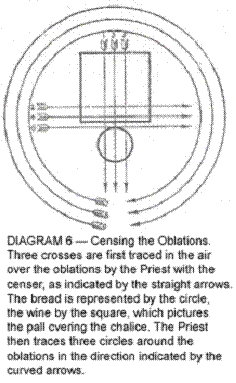
At this point in the ancient ritual a change took place. The corn and wine which had been offered to God by the people were laid aside, and the elements to be used in the Eucharist were brought to the Altar. As we make the bread and wine serve both purposes, we mark the change in the symbolism by a solemn censing, which sets them apart from all common use, and forms around them yet another of those useful shells or vortices which we so often employ in religious ceremonies, Thrice the celebrant makes the sign of the cross over them with the censer. (Diagram 6), blessing them and linking them with himself as he says silently: "I link these oblations with me, spirit, soul and bodies." In the previous offering, the elements typified our possessions, showing that all that we have we hold at God's disposal; now they are to be more intimately linked with us, for they are to symbolize all that we are, and this also we lay at His feet.
Then the celebrant draws three rings round the sacred substances (Diagram 6), isolating them from all outer influences, that they may be charged only with the magnetism which we are about to offer. As he inscribes the circles he says silently: "and I shield them in the Name of the Father, the Son and the Holy Ghost." From the inner standpoint we find it more suitable to make these three circles from left to right instead of drawing two of them backwards, as is done in the Roman rite; the latter method causes unnecessary disturbance, and sets up in the ether something resembling a choppy sea rather than the steady vortex which is required.
This done, the celebrant repeats the censing of the Altar as before, holding the same thought as then, but with a yet wider application, for now not only the celebrant but the whole congregation is to be drawn into a close and mystic communion. The magnetic field which was previously formed round the Altar is now to be extended to include the whole church, while a new inner treasure-chamber is formed round the sacred elements. It is important that the celebrant should concentrate his attention exclusively on what he is doing and on the thoughts appropriate to each movement, so it is better that he should not have to recite a prayer while he is swinging the censer, as is directed in the Roman rite, but should say it as soon as he has concluded the motions. Standing for a moment at the centre of the Altar, and holding the smoking censer up towards the cross at the level of his breast, he prays:
|
ROMAN |
LIBERAL |
|
He says at High Mass, while censing the offerings: |
He censes the offerings and Altar and then says: |
|
Let this incense which thou hast blessed, rise before thee, O Lord, and let thy mercy come down upon us. |
As this incense rises before Thee, O Lord, so let our prayer be set forth in Thy sight. Let Thy holy Angels encompass Thy people and breathe forth upon them the spirit of Thy blessing. |
|
He censes the altar, saying |
|
|
Let my prayer, O Lord, be set forth as incense in thy sight; and the lifting up of my hands as the evening sacrifice. Set a watch, O Lord, before my mouth, and a door round about my lips lest my heart incline to evil words, to seek excuses in sin. |
|
This prayer naturally refers to the Angels of the Incense, who have been previously described, and it is a most beautiful sight to see them swoop down the church shedding their influence over the congregation, carrying with them the essence of the perfume and sending it surging out in great waves as they pass. The chief purpose of their effort is expressed in the words used by the Priest as he returns the censer:
|
ROMAN |
LIBERAL |
|
He returns the censor saying: |
He returns the censor saying: |
|
May the Lord enkindly within us the fire of his love, and the flame of everlasting charity. Amen. |
May the Lord enkindly within us the fire of His love and the flame of everlasting charity. |
Then the clerics, choir and people are censed in the order of dignity. There is a threefold object in this: first, to show respect to them, as is evidenced by the variation in the number of swings given; second, to include them all within the magnetic field; third, to evoke whatever latent power of love and devotion there is in each, that he may take his full share in the great work which is about to be done. The act of censing establishes a condition of rapport, of synchronous vibration, which may be utilized to expedite the flow of force either outward or inward. For example, of a Bishop be present at the Service, his is censed immediately after the celebrant, but with nine swings instead of six.
This is not only a recognition of his office, and an inclusion of him within the magnetized field; it is also an opportunity for him to pour out into that field the spiritual energy of which he is a living battery. A Bishop lives in a condition of perpetual radiation of force, and any sensitive person who approaches him will at once be aware of this. This is happening always without any special volition on his part, but whenever he chooses he can gather together this force and project it upon any desired object. When he walks in procession, he is communicating it in this way to the congregation; and when the incense is offered to him, through its influence he at once floods the magnetic field with the power entrusted to him. Each Priest who is censed should in the same way give as well as receive; he also has his link with the Lord, though it differs from that of the Bishop, as will be explained when we deal with the Sacrament of Holy Orders; therefore he, too has his quota of blessing to add to the general store.
Note
The three crosses which the celebrant makes over the elements with the thurible are accompanied by the thought: "Now, in aspirations, I link myself, my soul and body, with these offerings" and, as he makes the three circular swings: "I surround and protect them with the power of the Father and of the Son and of the Holy Ghost." This collects all the colours of the people's aspirational thought, which has accumulated on the Altar during the Offertorium and with the three circular swings of the censer, a casket round the sacred vessels is completed, which is built on the basis of the swirls set up by making the sign of the cross over the Altar with the paten and wafer, and then later with the chalice, immediately after offering them.
The rest of the censing is precisely similar in all its movements to the first censing of the Altar, so it need not be again described.
At the prayer: "Let Thy holy Angels encompass Thy people, and breathe forth upon them the spirit of Thy blessing," the Angels of the incense rush out over the congregation and extend the influence of the magnetic field, hitherto kept to the Altar, to include the whole church, but this is more definitely completed and brought down to the physical level by the censing, first of the clergy and then of the congregation. This is possible at this point, as the people are now raised to a pitch at which they can benefit by it; also, it is no longer necessary to have the Altar fenced off for the sake of guarding the elements, as these are now shielded by the casket round them.
The censing and the prayer: "May the Lord enkindle within us the fire of His Love and the flame of everlasting charity," have sent some of the fire-elemental essence—the earth power manifesting through the element of fire—coursing all through the celebrant, and so he has been purified by fire. Now comes the Lavabo, and we have similar purification by water and the beautiful pastel-blue force of this element runs all through the celebrant. It is thus, purified by fire and water—the two great cleansing agents—that he continues the Service and enters into its holier part.
|
ROMAN |
LIBERAL |
|
I will wash my hands among the innocent; and will compass thine altar, O Lord. |
I will wash my hands in innocence, O Lord: and so will I go to Thine Altar. |
|
That I may hear the voice of praise, and tell of all thy wondrous works. |
That I may show the voice of thanksgiving: and tell of all Thy wondrous works. |
|
O Lord I have loved the beauty of thy house, and the place where thy glory dwelleth. |
Lord, I have loved the habitation of Thy house: and the place where Thine honour dwelleth. |
|
Take not away my soul with the wicked, nor my life with men of blood. |
|
|
In whose hands are iniquities: their right hand is filled with gifts. |
|
|
But I have walked in mine innocence: redeem me, and have mercy on me. |
|
|
My foot hath stood in the right way: in the churches I will bless thee, O Lord. |
My foot standeth right: I will praise the Lord in the congregations. |
|
Glory be to the Father, and to the Son, and to the Holy Ghost. As it was in the beginning, is now and ever shall be, world without end. Amen. |
Glory be to the Father, and to the Son, and to the Holy Ghost. As it was in the beginning, is now, and ever shall be: world without end. Amen. |
|
|
|
|
Receive, O holy Trinity, this offering which we make to thee in remembrance of the passion, resurrection, and ascension of our Lord Jesus Christ, and in honour of blessed Mary, ever virgin, of blessed John the Baptist, of the holy apostles Peter and Paul, of these, and of all the saints: that it may avail to their honour and our salvation; and that they whose memory we keep on earth may vouchsafe to make inter- cession for us in heaven. Through the same Christ our Lord Amen. |
The corresponding prayer follows the Orate Fratres. |
The purpose of the Lavabo is to cleanse the hands of any little particles of dust which may have adhered to them after touching the burse, the veil and the censer. Naturally there is also associated with it the idea of a final and utter purification of thought and feeling before entering upon the Canon, the most sacred part of the Service. The word Lavabo is just the Latin for the first three words of the accompanying psalm, but as these verses have no special effect upon the Service, they are omitted in our shortened form, which is, however, fuller and more explanatory in the next sentence than its predecessor.
|
ROMAN |
LIBERAL |
|
V. Brethern, pray that my sacrifice and yours may be accept- able to God the Father almighty. |
V. Brethern, pray that my sacrifice and yours may be accept- able to God the Father Almighty. |
|
R. May the Lord receive the sacrifice at thy hands, to the praise and glory of his own name, to our own benefit and to that of all his holy church. |
C. May the Lord receive the sacrifice at thy hands, and sanctify our lives in His service. |
In the shorter form of the eucharistic Service the following words have been inserted as part of the Orate Fratres:
Brethern, we have built a Temple for the distribution of Christ's power; let us now prepare a channel for its reception; and to that end pray ye that my sacrifice, etc.
The people having been drawn by the censing into the holy circle, the Priest now calls upon them to join him in the sacrifice which he is about to offer, and by their heart felt response they put into his hands for disposal all the enthusiasm and good resolutions evoked during the censing of the Altar, which he at once proceeds to offer in the following prayer:
|
ROMAN |
LIBERAL |
|
The corresponding prayer precedes the Orate Fratres. |
We lay before Thee, O Lord,
these Thy creatures of bread and wine, in
|
|
Secrets. The Secrets vary. That which follows is of Trinity Sunday. |
|
|
Receive favourably, O Lord, we beseech thee, these victims which we consecrate to thee: grant that they may avail us for help for evermore. Through our Lord. |
No corresponding prayers are used in the Liberal Catholic Liturgy. |
The special object of this prayer is as usual stated more clearly in our shortened form for the Eucharist, where it appears as follows:
We lay before Thee, O Lord, these Thy creatures of
bread and wine, in
 token of
our sacrifice of praise and thanksgiving; for here we offer and present unto
Thee ourselves, our souls and bodies to be a holy and continual sacrifice unto
Thee. May our strength be spent in Thy service, and our love poured forth upon
Thy people, Thou who livest for ever and ever. R. Amen.
token of
our sacrifice of praise and thanksgiving; for here we offer and present unto
Thee ourselves, our souls and bodies to be a holy and continual sacrifice unto
Thee. May our strength be spent in Thy service, and our love poured forth upon
Thy people, Thou who livest for ever and ever. R. Amen.
The Priest offered himself wholly at the time of the censing, but now he is about to make the same solemn oblation on behalf of his people. To this end he links them mystically with the bread and wine by a strong effort of his will, as he makes the sign of the cross, and pours into those elements the whole tremendous force which he has gathered from his congregation, so that these may be not only symbols of the oblation of "ourselves, our souls and bodies," but actually the mystical channels of that sacrifice. As he does this he testifies that all their efforts are inspired by the one desire to do that work for which God has sent them into the world.
We must here guard against a common and most unfortunate misunderstanding. When ignorant Christians invented the crude and philosophically impossible heaven-and-hell theory, they took the Christ's beautiful phrase "the kingdom of heaven" as equivalent to their strange idea of paradise, and supposed that when He spoke of the difficulty of attaining it He meant that the majority of people would be cast into their flagrantly ridiculous Hell. "The kingdom of heaven" is a synonym for the Great White Brotherhood, the Communion of Saints; and so when we say that we offer ourselves in order that we may gain the kingdom we are making no selfish effort after personal "salvation," but are promising to devote our lives to the object for which we are sent here—the attainment of adeptship or saintship, the destiny prepared from the beginning for those who are strong enough to reach it. A fuller explanation of this will be found in a later volume, together with a note upon the real meaning of the words "through Jesus Christ our Lord," so constantly used by thousands who have no conception of their true signification. The mystical body is of course the Church.
Note
The celebrant has linked himself with the elements by the three crosses made over them with the censer. He is about to make a link through his own connection with the people. As he turns toward the people, he again throws out a sort of net over them, which goes out with the motion of the circular thrown net of an Indian fisherman. This is in order to draw them closer to himself by gathering in all their praise. He turns back to the Altar by the right, instead of in the usual way, in order to make a complete circle and draw in the net with the same motion with which he flung it out. If he were to turn back in the ordinary way, it would not wind in the net properly. As it is brought in and he commences the following prayer, he draws the people's aspiration, which he has thus gathered, into himself and then, still with the same motion, he spins the material of the net up on to the tip of the casket containing the elements, so that it makes there a vortex, or cup, built on the basis of the swirl made by the three circular swings of the censer. Immediately the colours of the people's aspirations (which lay on the Altar like flowers till they were gathered into the casket by the censing of the oblations) begin to be swept up and gathered into the substance of the net, and so with this the cup is built. It is worthy of notice that, although the casket forms the basis of this vortex, it is like a chamber at the bottom of the cup, but quite separated from it by the lid which was made by the three crosses of the censer. The elements are still surrounded and safely shielded.
A moment after the making of this cup, the celebrant makes the sign of the cross over the bread and wine, which links the people, through himself, with the elements, for the purpose of using these as channels for the second offering, the offering of "ourselves, our souls and bodies". As soon as this link is made—which happens when the celebrant makes the cross at the words "in token" in the beautiful prayer beginning: "We lay before Thee, O Lord, these Thy creatures of bread and wine in token of our sacrifice of praise and thanksgiving"—the aspiration which he gathered in the Orate Fratres begins to pour up through the wafer and the contents of the chalice into the cup. Of course, all the grossest part of the people's less spiritual emotions and thoughts are excluded from this. As he drew in the net, all the dross, the less noble part of their feelings, came to the surface like scum which was immediately swept away by a cleansing current which is always kept running by the Angels. As the people's devotion continues to flow up into the Priest, it is similarly cleansed and then passes through him and the oblations, and thence into the cup, which is, therefore, being continually filled from the bottom. The material with which we fill it is vibrating at an exceedingly high rate; it glows intensely, and is covered with a curious appearance of effervescent foam, not unlike that which may be seen upon champagne. The nature-force also flows in, but as this is so much heavier, it remains at the bottom.
THE CANON
The Canon is so called because it is the most sacred and invariable part of the Service, laid down strictly according to rule which must be carefully followed. We have done our part; we have built our edifice, we have put ourselves absolutely at God's disposal; now we await with sincere faith the answer from on high, the response to our effort, which will do what we ourselves cannot do. We are about to raise the traditional call to the angelic hosts, to which for two thousands years they have been accustomed to respond; and in order to do this reverently and worthily we must put ourselves into the proper attitude of mind.
|
ROMAN |
LIBERAL |
|
V. The Lord be with you. R. And with thy spirit. |
P. The Lord by with you. C. And with thy spirit . |
To help us in this the Priest takes advantage of the additional link which has just been made with his people when they joined him in offering themselves to the Lord, and he tries to strengthen them and draw them together still more closely for the perfect performance of this beautiful invocation. From this point onwards, until after the Consecration, nothing is allowed to interfere with the sacrificial action of the Priest; the wondrous and beautiful magic of the Eucharist moves on its way through all its stages, and it is only after the pouring out of that stupendous influence upon the whole surrounding district, and just before his own personal communion, that the Priest in the Salutation of Peace once more draws his people to him by this Minor Benediction.
Note
Here follows the first Minor Benediction, since the absorption of the net, along which the force of the officials had been conveyed to and from the congregation. But we see that since the magnetic field of the Altar has been extended to include the whole church, the power flashes out and back though this charged atmosphere with great rapidity and brilliance.
|
ROMAN |
LIBERAL |
|
V. Lift up your hearts. R. We have lifted them up unto the Lord. V. Let us give thinks unto the Lord our God. R. It is meet and just. |
V. Lift up your hearts. R. We lift them up unto the Lord. V. Let us give thinks unto the Lord our God. R. It is meet and right so to do. |
The name Sursum Corda applied to these versicles and their responses, is, as usual, the Latin form of the first of them; "Lift up your hearts." Originally intended as a preparation for the great invocation, it has now through long usage become practically part of the invocation itself. The adjuration to lift up our hearts is clearly a call upon us to gather together all our energies at the high level of devotion and enthusiasm to which they have just been raised, and direct them along the line indicated in the second versicle—that of intense gratitude to God expressed in the highest form of worship of which we are capable.
It is with our hearts filled with these feelings that we are to follow, with strong intention, the words now to be sung by the Priest. There is an additional and most beautiful meaning in that second versicle of which we must not lose sight. "Let us give thanks" is in Greek ενχαριστησομεν, "let us offer the Eucharist"; so here at the beginning of the Canon in these words the Priest calls upon his people to join with him in that greatest of all acts of worship, and it is with regard to that that they agree with him when they reply that it is meet and right so to do.
For these versicles and their responses there is a traditional melody, which has been used ever since the Church was founded, and may well have been prescribed either by our Lord Himself at its foundation, or shortly after it by some of those who understood the effect of sound upon the inner world. As has been said, certain central ideas of the ritual only were given in the beginning, and round those unchanging ideas celebrants grouped extempore prayers; but for those definite points that were from the very first unvarying formulÊ, the exact meaning of which is still preserved, although they have been translated from one language to another.
This is one of those primary formulÊ, and the same tone or tune has been used for it from those earliest days, except for certain slight modifications which mark the usage of different localities; and it is just as efficient when wedded to English words as it used to be when their corresponding phrases were chanted in Latin or Greek. The Angel of the Eucharist seizes at the same time the lovely music-form and the mental force put forth by the celebrant, and sends them sweeping down the church with a splendid gesture of supreme command, and as the response of the people comes swirling back like a great rush of living fire, he whirls it all upward in a mighty souring flame, which fills the dome of the eucharistic edifice and streams upwards through the lantern into space. The second versicle and its response send up a second impulse of like nature, and the floating rosy cross gleams forth with blinding light for those whose eyes can see. And through the channel thus made the celebrant sends upward the words appointed from of old.
Note The first of these versicles sends a wave of power down into the nave which, with the response, then rushes back and swirls up into the central dome of the form. As it whirls itself aloft, it continues the sides of the cup until its brim just touches the bottom rim of the dome, so that from this point down to the Altar we have a sort of inverted dome. This first versicle and response seems to call out a general response from all the bodies, but specially from the astral. The next one seems to stress the higher mental side, but is also general in character. It has the effect of further consolidating the newly-made upper part of the cup, as the power whirls up and flashes out through the top of the form.
|
ROMAN |
LIBERAL |
|
The Preface is variable. That which follows is used at Trinity and on those Sundays throughout the year which have not a proper preface. |
The Preface does not change except that at Christmas, Easter, Ascension, Whitsunday and Trinity, and also on Festivals of Our Lady and of the Angels, a Proper Preface is inserted between the two paragraphs of that which follows: |
|
It is truly meet and just, right and availing unto salvation that we should at all times and in all places give thanks unto thee, O Lord, Father almighty, everlast- ing God: who with thine only- begotten Son and the Holy Ghost art one God, one Lord; not in the oneness of a single person, but in the Trinity of one substance. For that which we believe from thy revelation concerning thy glory, that same we believe of thy Son, that same of the Holy Ghost, with- out difference, or separation. So that in confessing the true and everlasting Godhead, we shall adore distinction in persons, oneness in being, and equality in majesty; which angels and archangels, the cherubim too and the seraphim do praise; day by day they cease not to cry out, saying, as with one voice. |
It is very meet, right, and our bounden duty, that we should at all times and in all places give thanks unto Thee, O Lord, holy Father, almighty, everlast- ing God. Therefore, with Angels and Archangels, with Thrones, Dom- inations, Princedoms, Virtues, Powers, with Cherubim and Seraphim, and with all the company of heaven, we laud and magnify Thy glorious Name, evermore praising Thee and saying: |
First the Priest emphatically takes up and endorses the response of the congregation, reiterating that it is indeed our duty at all times and in all places to offer this holy sacrifice of praise and thanksgiving; and therefore he proceeds to call to his aid the angelic hosts to enable him to do it, exercising therein one of the powers conferred upon him by the link with higher spheres which was made at his Ordination. On certain great festivals what is called a Proper Preface is inserted reciting the reason of the festival. This form of words is also part of the invocation, for it calls upon the Angel placed in charge of the special force outpoured on that particular occasion. In this part of the Service we follow exactly the ritual of the Anglican Church (which is substantially that of the Roman), except that we add the names of some Orders of the Angels which are omitted by them.
This is not the place for a detailed disquisition upon the heavenly hosts, but a few words of general explanation are desirable. The Angels form one of the kingdoms of nature, standing above humanity in the same way as man stands above the animals. There are at least as many types of Angels as there are races of men, and in each type there are many grades of power, of intellect and of general development, so that altogether we find hundreds of varieties. The idea so often held by the ignorant that these mighty hosts of glorious spirits exist chiefly to dance attendance upon man is merely the fruit of the amazing self-centredness of the human race, of which the geocentric theory was so striking an example. The Angels exist, as do men, to glorify God and to enjoy Him for ever; and the appointed method of such glorification is first by self-unfoldment (which men call evolution) and secondly by service. This service is of very many kinds, and only a few of them bring the Angels into contact with human beings—mainly in connection with religious ceremonies.
Angels have been divided into nine Orders; the names used for them in Scripture are given in the Liturgy. Of these, seven correspond to the great Rays of which the solar system is composed, and two may be called cosmic, as they are common to some other systems. A definite department of work is assigned to each Order, and representatives of each are invoked at every Eucharist, to take charge of anything which comes within the limits of their department. The method of angelic evolution being, as I have said, largely by service, a ceremony such as the Eucharist offers for them a remarkably good opportunity, and they are not slow to avail themselves of it.
As the Christ is the Head of all religions, vast host of them are ever around Him, waiting to leap forward eagerly along the line of His thought, and so it comes to be said that He sends Angels to do certain acts (as in the Asperges, for example), though the only case in which it is literally true is that of the Angel of the Presence, of whom we shall have to speak later. Just as, among the retinue surrounding the Lord, there is always an Angel ready to assume the direction of the eucharistic Service when the appeal of the Asperges is sent out, so are there representative of those nine Orders always ready to answer the call of the Preface. In higher worlds to call the name of any person is at once to attract his attention; and the same is true of a class, such as an Order of Angels. At a Low Celebration it is the Directing Angel who first responds and he seems to assemble the rest; but at a High Celebration or Missa Cantata, because the melody used for the versicles has always been practically the same through the centuries, all immediately notice it as it rings out, and those who come next in order are prepared to sweep down instantly as the Priest chants the names of the types.
It is indeed a marvellous and a glorious sight for the clairvoyant to see these celestial visitors flash into their appointed positions in response to their traditional words of power. While the Angel of the Eucharist stands usually beside the celebrant, or floats just above his head, the illustrious ambassadors of the none Orders always range themselves behind the Altar facing the celebrant. Behind them in turn stand numbers of human beings as well, whose members generally take their places opposite the ends of the Altar, though they frequently also fill the upper part of the nave, hovering above those who are still in the body.
Catholics who during their physical lives have delighted in the Services of the Church naturally continue to attend them after the death of their bodies; and those living on the other side of the world, who are out of their bodies in sleep, sometimes do precisely the same thing. The devotion and earnestness of its physical-plane congregation may make a certain church popular with the Angels and the dead, so that the worshippers whom most people cannot see are often far more numerous than those perceptible to all. In my book on The Other Side of Death, 2nd edition, p. 427, I give a well-attested account of the attendance of a number of dead monks at the celebration of the Eucharist at a Hospital Chapel in London.
As soon as he arrives, the Angel of the first Ray undertakes the direction of the work as a whole, determining the amount of each force that can be used to the greatest advantage, the other Angels moving at his command, and grouping themselves so as best to receive and utilize the outflow. This director usually caries a rod, the symbol of his office, which varies in colour according to the force which is being sent through it. The colour of the day is generally predominant, but not invariably. On a festival of the Holy Ghost, for example, both the rod and the fire flowing forth from it would be brilliant red, the colour consecrated to the Third Person of the Blessed Trinity, though the red the representative of the First Person would still lead the ceremony.
Note
The Preface fills this cup with matter of a very high rate of vibration indeed; so rapidly is it vibrating that one does not see anything definite; it is as though one were looking into a void; and yet there is something there, for one cannot see across to the other side of the cup. It is a highly stressed, much compressed and almost transparent sort of matter, which all but escapes the ordinary lower clairvoyant faculties—sight and feeling alike, for, as there is no room for anything of a lower nature in the same place, which would make any sort of sense impression on these ordinary faculties, it often produces a curious sort of empty feeling, as if one had stepped into a pocket in the astral atmosphere. This is only because our consciousness is not ordinarily kept at the exalted level of this material, and as soon as one raises oneself to this higher plane, the empty feeling is replaced by a tremendous fullness. This same empty effect is sometimes noticeable in the aura of a man who has recently had some spiritual experience, such as Ordination. It is particularly strong behind the Altar of a church.
|
ROMAN |
LIBERAL |
|
Holy, holy, holy, Lord God of hosts. Heaven and earth are full of thy glory. Hosanna in the highest. |
Holy, holy, holy, Lord God of Hosts. Heaven and earth are full of Thy glory: Glory be to Thee, O Lord most high. |
Now that we have called together this illustrious and august company of the holy Angels, our first act is to join with them in the ascription of glory and worship to God. This magnificent outburst of praise, called the Trisagion or Tersanctus (both words meaning "Thrice Holy") is of extreme antiquity. Not only has it been used in this same place in the Liturgy since its foundation, but even before that it was employed in the Jewish Service. An early form of it is to be found in the writings of the prophet Isaish (vi, 3). The Hebrew word Sabaoth, meaning hosts or armies, is often allowed to remain untranslated in this passage. Though the Church now most appropriately interprets it as referring to the Angels, there is little doubt that the Jews originally took it as signifying the host of the stars. However that may be, this short canticle holds a position and produces an effect in our Liturgy the importance of which can hardly be exaggerated.
Our previous efforts of praise and worship have supplied much devotional material, which the Angel of the Eucharist has utilized in his building operations; but in this noble traditional act of homage the representative Angels and their satellites join us, and their power of devotion is so enormously greater than ours that their contribution entirely changes the character of the edifice. Their action vivifies an immense amount of astral and mental matter, and the Angel of the first Ray, who has now taken charge of the construction, directs most of the force upward. The lower part of the fabric is often vastly increased in size, though there is no alteration in shape; but the dome swells out so prodigiously, both in height and in diameter, that the basilica becomes in proportion to it nothing but a pediment supporting its gigantic bulk. The erection now closely resembles a dagoba, though it is hollow instead of solid; and the small cupolas at the corners shoot up into graceful minarets, as is shown in the illustration (Frontispiece).
But this modification of shape is not the only change produced by the co-operation of the Angels, for they introduce an entirely new factor into the edifice. With us devotion is an energy of the higher astral levels, awakening, as by reflection or sympathetic vibration, some slight activity in the intuitional part of our nature; but with great Angels this relation is reversed, for the force of their devotion acts by its very nature at that high level, and any emotional effect is only by way of reflection. So they add to our edifice a vast wealth of material belonging to an altogether new and more exalted plane of nature, which permeates and etherealizes all the rest. Thus the whole monument takes upon itself a new and higher character, at once more magnificent and more delicate, indescribably lovely and capable of far more refined vibrations—a fit vehicle for celestial force.
Men have sometimes asked: "If the Angels can do all this so quickly and so much better than we, would it not be wiser to leave the whole work in their hands, and not presume to offer our inferior material?" The answer to this suggestion is twofold. First, to take part in so sublime and beautiful a building is the greatest of privileges, and assuredly develops our nature and advances us rapidly in the course of our evolution: every time we do such a piece of work we acquire something of spiritual growth. Secondly, the idea that dominates all such operations without exception is that of economizing force, of making it go as far as it can. Obviously every once of power generated or of material supplied by the congregation is so much to the good, and conserves the energy at the disposal of the Angels.
It is of help to them, therefore, of we are stirred deeply by enthusiasm and devotion, so that we pour forth from ourselves steady, strong vibrations. If we do not do this, they have to supply what is lacking. Truly all force is divine force; but it floods into the various worlds at different levels and through many channels, and the more we can serve as channels to conduct it form the higher levels to the lower, the more of it will be available down here. If we feel great devotion, and because of that pour forth vivid enthusiasm, we are bringing out of latency into activity forces which otherwise would remain latent, and we are therefore doing part of the lower work which is more difficult for the Angels, and leaving them more energy to use upon the higher levels where they are so thoroughly at home and so splendidly proficient.
The Church of England, I regret to say, knowing nothing of this inner and most glorious side of the eucharistic Service, throws nearly all the work upon the angelic helpers, and is thus uneconomical in the expenditure of the glorious gift from on high. At the beginning of the Service she does not call for an Angel to construct the eucharistic edifice (nor indeed does the Roman Church on occasions when the Asperges is not used), and so nothing of that is done until the point which we have now reached. She does not mention in detail the nine Orders of the Angels, but they come to her at the traditional call, and the Directing Angel of the first Ray at once proceeds to build the edifice which really ought to have been made ready for him. He has often sadly little material, but he makes the best of what there is. The Epistle, the Gospel and the Creed supply him with rather more mental matter than he usually obtains from them at a Roman Service, where they are said in Latin, and so evoke little thought from the average congregation. As in the English Church the Holy communion usually follows Morning Prayer, there are often some useful clouds of devotion left from that; and a good deal is outpoured as the words of the Trisagion are sung or said. But the effect is lamentably barren as compared with that produced by the older and more scientific form of Service
In a church which is more fortunate in its Liturgy, the picture presented to clairvoyant vision at this stage is indeed wonderful. Quite apart from the marvellous monument which has been erected, the splendid appearance of the Angels can never be forgotten. Each stately figure has amidst the flashing coruscations of his own aura some lovely predominant hue, glowing with a radiance that nothing on earth can approach; and the whole group displays a magnificent and harmonious colour-scheme which in this physical world we have no means of reproducing.
This being one of the special points of the Service, additional efforts are made to enable the congregation easily to assimilate the force. Men differ in temperament and in receptivity; some are more readily affected in one way and some in another, and so we appeal to the three senses of smell, hearing and sight. To assist in spreading abroad the exquisite angelic magnetism, incense is burnt at this point in the Service, the sacring bell is sounded, and the acolytes elevate their lighted candles. Wherever the scent penetrates, wherever the sound is heard, these strangely sweet and beneficial vibrations will extend. The more silvery the tone of the bell, the better suited it is for its purpose; and it will do its work far more efficiently if it has been blessed by a Bishop—that is, if it has been magnetized for this special purpose. The use of a gong is permissible, provided that its tone be sweet and musical, though is sends out a continuous roar instead of a number of successive impulses, and so is somewhat less suitable.
The Trisagion should be sung with the greatest possible solemnity and reverence, the worshipper following the words carefully, and trying to feel and mean them with every fibre of his being, though at the same time maintaining the utmost calm and serenity. At the first recitation of the word "Holy" homage is offered to God the Father, and the second and third are addressed to the Son and the Holy Spirit respectively. Our people should bear this in mind, and direct their thoughts accordingly.
|
ROMAN |
LIBERAL |
|
the name of the Lord. Hosanna in the highest. |
Blessed is he that cometh in the Name of the Lord. Hosanna
|
The act of worship at the Sanctus being over, the celebrant stands erect, and we all join in welcoming the holy Angels, in thanking them for coming, and the Lord for sending them—or, more accurately for arranging that they shall come. The Hosanna is Hebrew, and its literal or original meaning is said to be "make safe" or "save now"; according to Professor Burkitt it means a reed, such as is carried in processions, and often called palm, and the cry originated in this use; but at some early period in Jewish history the original meaning was lost, and it became a mere joyous ejaculation of praise, equivalent to "glory to God". It appears in that sense both in the Old and New Testaments; it was so used by the Jews at their feast of tabernacles, the most joyous occasion of their year; and again we find it employed in the same way by the children who strewed branches before the Christ on Palm Sunday. Some have held that the French exclamation "hoschÈ" and our "huzza" are derived from this Hebrew word.
There is here a most beautiful and interesting fragment of ritual. Those who are clairvoyant should watch its action closely, and all should join in it in thought as well as in word, whether they can see what happens or not. When we all bow down at the words "Holy, holy, holy," all the Angels and the dead bow also; and there is a vast upward stream of devotion rising like the smoke of the incense, except that it is not smoke but light that rises, and it immediately invokes a still vaster down-pouring in response. But when that act of worship has been completed, the celebrant stands erect and speaks across the Altar to the Angels the beautiful words of welcome and thankfulness: "Blessed is he that cometh in the Name of the Lord." With that, in a church where the people understand, there flows horizontally across the Altar a great stream of gratitude to the holy Angels; they bow slightly to receive it, and send across in return a current of kindly feeling which is in truth a benediction.
At the words "Hosanna in the Highest" we turn our stream of gratitude upwards towards the Lord, thus making room for the current of the angelic blessing to pass beneath it, and drawing into us their holy influence by the sign of the cross which we make over ourselves. It is very pretty to watch the sudden change of direction in our force-current, and the deft way in which that sent by the Angels instantly slips in under it as it curves upward. We should have the thought of thankfulness strongly in our minds as we sing these words. In the Liturgy of the Church of England this expression of gratitude to our angelic visitants is unfortunately omitted; but nevertheless it is frequently inserted by the more understanding of her clergy.
Note
The cup which we have described as standing over the chalice has really more the appearance of an umbrella which has been inverted by the wind.. The rush of devotion underneath has the effect of ejecting into the dome under pressure the already much compressed contents of the cup or inverted umbrella; and that begins to swell out the dome. More and more it is enlarged as the umbrella is turned the right side out till (its outer edge—i.e., what had been the brim of the cup—being fixed to the bottom rim of the dome) the umbrella suddenly bursts in the middle and the gorgeously-coloured matter, vivified by the peoples devotion and the aspiration of the Angels, rushes up through this opening and completes the expansion of the edifice, at the same time sweeping the sides of the umbrella flat against the walls of the dome, where they immediately unite and so become built into and part of the whole.
Let us now look at the precise part borne by each separate phrase in this work. It will be remembered that at the censing of the oblations, three swings were made round them, shielding them in the Name of the Father (first swing), and of the Son (second swing), and of the Holy Ghost (third swing). The vortex thus formed was the base of the whole great cup, and somehow these same three divisions of the three Persons of the Trinity were, as a result of this, represented by three different levels in the cup. It seems as though the force from the earth—in the centre of which the Holy Ghost works—was connected with the Third Person, while the next layer in the cup, the effervescent substance which was supplied from us, or rather the Christ Principle in us, was the force of the Second Person; and the "empty" looking power which was confined by the upper part of the vessel and was supplied partly by our higher principles stimulated by the coming of the Angels during the Preface, and partly by the Angels themselves, was the power of God the Father.
Now it will be remembered that the three paragraphs of the Gloria in Excelsis and the Creed are addressed, the first to the Father, the second to the Son, and the third to the Holy Spirit, so that the lower part of the dome, we might say, is specially dedicated to the First Person, the middle portion to the Second Person, and the lantern-like erection on the top to the third Person. Now the three words, "Holy, Holy, Holy" are addressed to Father, Son and Holy Ghost. At the first the vortex or inverted dome is turned up sufficiently to force all the matter which was specially connected with the Father into the dome where it can act on its first level. The second "Holy" ejects the next layer of matter, which acts on the part of the dome or pagoda sacred to the Son; and the final word pours up the nature-force into the lantern at the top as the umbrella is completely turned inside out. Thus the three words each affect the particular part of the edifice which is connected with the Person to whom each is addressed.
The words "Lord God of Hosts" as it were break the umbrella away from its stick, so that the power rushes up through this opening and continues to swell the form. What represents the stick of the umbrella is still left standing, and is rather interesting. It is a tiny, very thin, whirling uprush of power from the Altar-stone and seems to be more of the nature-force, or that part which belonged specially to the Holy Ghost, streaming up presumably to work upon the top part of the pagoda, which is where the Third Person is specially represented.
At the Words "Blessed is he that cometh in the Name of the Lord" there is a beautiful interchange of force between the Angels and congregation, which mixes into a wonderful stream which we pour upwards with the words "Hosanna in the highest." This adds our final touch to the work of enlarging the form, and specially shoots up the minaret on top, whither the cross, which hung in the lantern or top most part of the form before it was increased, has been borne. The people in making the sign of the cross over themselves, not only open themselves to the influence of the Angels as it rushes in when we turn our thoughts upwards with the "Hosanna," but also vivify this great central cross. The most wonderful thing about the whole of this part of the Service is the work of the Angels. They stimulate the people to far higher activity, so as to produce a total change in the aspect of this temple that we have built. Not only is the size considerably increased, and the form built in on the buddhic level, but the quality, the texture and the colouring of the whole is indescribably improved. It is as though it had been suddenly invested with a new and even more splendid life.
These Angels seem to be veritably a part of the consciousness of the Christ, in the same way as is a Priest or Bishop who really develops the powers given him to their full potentiality. It looks as though these Angels obtained a similar touch with the Lord Christ; but this effect may be due merely to a very full development of the Christ Principle within them.
|
ROMAN |
LIBERAL |
|
Wherefore, O most merciful Father, we thy suppliants do pray and beseech thee, through Jesus Christ, thy Son, our Lord,
to receive and bless these
gifts and
holy and unblemished sacrifice. |
Wherefore, O most loving Father, we Thy servants do pray Thee, through Jesus
Christ, Thy Son, our Lord to
receive, to
hallow this oblation which we make unto Thee. |
Here again we shall find our shortened Service expressing more clearly what is actually taking place. Its form for this prayer is:
O Lord, these our oblations have served as tokens and
channels of our love and devotion towards Thee; but now we pray Thee to
receive, to
purify and to
hallow them as earthly channels of Thy
wondrous power.
The bread and wine, first employed as symbols of the offerings of the people, and then as channels of our sacrifice, are now to fill yet another and far higher rle, and to act as outward manifestations or vehicles of the power and life of Christ Himself, So the Priest first breaks the link which he made, and then demagnetizes the elements, sweeping them clean from any earthy taint that may have mingled, while leaving in them all the purely spiritual part of our offering to be laid later on at the feet of the Christ our glorious King. At the first cross the link is broken, and at the third the elements are especially blessed for the tremendous destiny that lies before them, The three crosses made in the longer form produce exactly the same result, though the words spoken are less appropriate.
This charging of the elements with a spiritual offering is the first step in the process of preparing the channel for the reception of the great outpouring of divine force which is the central feature and object of the eucharistic Service. But before the Priest proceeds with that work he turns aside for a few moments to explain how that force is to be distributed.
|
ROMAN |
LIBERAL |
|
We offer them up to Thee first for thy holy catholic church, that it may please thee to grant her peace, to watch over her, to bring her to unity, and guide her throughout the world; likewise for thy servant N. our Pope, and N. our Bishop, and for all true believers, who keep the catholic and apostolic faith. Be mindful, O Lord, of thy servants, men and women, N. and N. , and of all here present, whose faith and devotion are known unto thee. For them do we offer, or they do themselves offer up to thee this sacrifice of praise for them and theirs; for the redeeming of their souls; for the hope of salvation and whole- ness, and do now pay their vows unto thee, God everlasting, living and true. The corresponding prayer follows the Consecration. |
We desire to offer this holy Sacrifice first for Thy holy catholic Church; that it may please Thee to grant her peace, to watch over her, to bring her to unity, and to guide her throughout the world; likewise for Thy servants George our King, N. our Presiding Bishop, N. our Bishop, for all our Bishops, clergy, and faithful, and for all here present, whose faith and devotion are known unto Thee. We do also call to mind all who in this transitory life are in trouble, sorrow, need, sickness, or any other adversity (especially . . . ). Likewise do we offer it for all those Thy children whom it hath pleased Thee to deliver from the burden of the flesh (especially for . . .), that, freed from earthly toil and care, they may enjoy the felicity of Thy Presence, evermore praising Thee in word and deed. O God everlasting, living, and true. |
It should be understood that the distribution of the magnificent outpouring of spiritual force which is called down by means of the offering of the Eucharist is to a considerable extent directed by the will of the celebrant. There are certain directions laid down in the ritual in which he always sends it—to the Church, to the King, to the Bishops, the clergy and the faithful; but a large proportion of it is always available for special disposal.
The amount of force drawn down during the ceremony depends partly upon the degree of advancement in evolution reached by the celebrant and people, partly upon the devotion of the celebrant, partly upon the number and devotion of the people present, partly upon the music used, and also, certainly, partly upon the necessities of the case—as, for example, the existence in the neighbourhood of someone in need of the help which can be given in that special way. If there were some great need close by the church, advantage would be taken of the Celebration to supply such force as would help. This might happen, not only during the performance of a High Celebration, but also at the private daily Service celebrated by the Priest in his own oratory. We do not know what limit there is (if any) to the quantity of this divine force available on a single occasion; we do not know how many can be affected at once by the outpouring from a single church; but we certainly know that the amount of force is enormous.
The proportion of it that can be spared for each purpose is decided by the Directing Angel. He listens carefully to the list of recipients recited by the celebrant, and as each is mentioned he indicates, by pointing with his rod, the Angel or group of Angels who are to attend to that particular person or object. After the outpouring has taken place he divides the energy among those whom he has selected, and each absorbs into himself what is given to him, and stands ready to bear it to its destination when the word of dismissal is given. It is most interesting to see how each one comes forward and glows more brightly when his charge is assigned to him.
There are many types of Angels in each of the great Orders; in each there are some who work, some who guard, some who meditate, while others are still at the stage when they are mainly concerned with their own development. Those who are charged with the distribution of the force are often called the apostolic or messenger Angels—those who have been taught to know and respond to the ancient call of the Preface. Some have done such work hundreds of times and are thoroughly conversant with it; others are novices, eagerly learning what has to be done and how to do it, but all are delighting in the opportunity of progress which the Eucharist gives to them, and determined to take it to the full. The work may be fairly continuous for those who wish it, for the Eucharist is always being offered somewhere in the world. A church is not always attended by the same Angels, for their work is vary varied; but it often happens that a group will attach itself to a certain Altar, and come to the Celebrations held there whenever its members are not otherwise employed.
Human beings who have laid aside their physical bodies, either in death or in sleep, and are working in the astral world, are also occasionally employed by the Directing Angel in this beneficent work of distribution; but he can utilize only those who have developed the special qualifications required. A considerable number of "dead" Catholics, especially among those who belong to religious orders, have been found willing to submit themselves to the training necessary to enable them to be useful in this respect; and we hope that that number will increase as the Science of the Sacraments comes to be more widely understood by the faithful.
Turning now to the objects for which the sacrifice is offered, we see them to be of two distinct classes, which we may call personal and impersonal. Certain names are definitely mentioned—those of His Majesty the King and of our Presiding Bishop always, and (when it is desired) those of other individuals who are at the time specially in need of such help as can thus be given. Those who are unfamiliar with the action of the finer forces of nature sometimes ask what result can be achieved by this discharge of spiritual energy upon a person—what difference it will actually make to his condition. I happen to be able to offer personal testimony on this matter; not only have I often watched the distribution clairvoyantly, but I have had myself the good fortune to be the recipient of such an outpouring when unwell; and I can bear witness both to spiritual upliftment and to a distinct sense if increased physical well-being at the time when I was thus remembered in the Service.
We refer to all those who are in trouble, sorrow, need, sickness, or any other adversity, and sometimes we give the name of some particular person whom we know to be suffering in some way; that person may be at the other side of the world; in what way then can he be affected by our thought of him? In the realm of thought distance does not count; but in this case it is not only the thought-vibration which reaches him. The Angel appointed to attend to his case will gather up the portion of spiritual force which is allotted to him, will instantly find him wherever he may be, and will use the force on his behalf in whatever way he sees to be the best for him. He will pour it into the man's heart and mind, infusing into him strength and courage; if he be in sorrow or doubt or difficulty, it will comfort and steady him; if he be depressed, it will lighten his gloom. Not for the living alone, but for those whom we so wrongly call the dead, is this sacrifice offered, and it helps them in precisely the same way, for the unerring discrimination of the Angel supplies it to give them whatever encouragement or assistance they most need. That we may fully understand, we must constantly keep in mind the absolute reality of this force—that it can be measured just as truly as electric power can be measured, though the method adopted is somewhat different.
If the man to be benefited is away from his physical body either in sleep or in death, it often happens that the strong thought of the Priest about him draws him to the church, and so saves the selected Angels the trouble of going to find him. If, being newly dead, he is still in a state of unconsciousness, the Angel will nevertheless find him, and use the assigned force as he sees to be best. In such a case sometimes he employs part of it in arousing the man from his stupor; sometimes he judges it best rather to store the energy in the aura of the recipient, that he may obtain the benefit of it when he returns to consciousness. But we may be very sure that in any and every case a definite result is obtained; it is impossible that the force should ever miscarry or be lost.
This direction of the Priest's will to some special object is often called the intention of the Eucharist, and it is a perfectly legitimate act of invocatory magic; but unfortunately an entirely illegitimate and evil element has sometimes been imported into the transaction by the exaction of a fee for the exercise of this spiritual power—a thing which is always inadmissible. All that is necessary is that the Priest shall have clearly in mind the objects for which he wishes the force to be employed, and that he shall strongly will that it shall be so used.
Whatever is in the mind of the celebrant lies clearly open before the Directing Angel; but when, as sometimes happens, the person for whom help is asked is unknown to the celebrant, the Angel to whom that particular piece of work is assigned has to find his patient by working back along the line by which the request reached the Priest. The request implies an earnest wish on the part of someone—either the patient himself or some friend on his behalf; and that earnest wish stands out conspicuously on higher planes, so that the Angel's task is generally one of no great difficulty.
Its action upon individuals is thus not difficult to understand, but a little further explanation is needed in order to grasp the manner of its application to such bodies as the Holy Catholic Church, "all who are in trouble," or "all who are delivered from the burden of the flesh". As it has been expressed in one of our Collects, God has indeed constituted the services of Angels and men in a wonderful order, and in the vast economy of nature there is ample provision for mutual service on an extended scale, though at the present day European civilization takes but little advantage of it, having developed itself along other lines.
Besides the great apostolic Angels, and in many cases working under them, there are whole armies of ministering Angels who likewise evolve by service, and are ready and eager for precisely such an opportunity as the Eucharist gives them. The great messenger Angel chosen by the Director to administer the block of force which he assigns to the Holy Catholic Church, for example, at once divides it among a score or a hundred of these subordinates, who at the proper time spring forth and seek in all directions for possibilities of promoting the peace, unity and wisdom in Christ's Church which are the prescribed objects of the prayer according to the Liturgy.
In the same way another company sets forth to assist those in trouble and sorrow, and these have usually not far to go in order to find plenty of clients. Yet another group undertakes the same work among the vast hosts of the dead; and they often need not leave the immediate neighbourhood of the church to perform their errand of mercy, for the dead gather round it in large numbers to take part in the great act of devotion.
As has been mentioned before, this is a religion of the second Ray, and therefore our first care in the distribution of the force is to provide for the Holy Catholic Church, which is the appointed channel for our portion of the work of that Ray. But as soon as we have done that, even before we go into detail with regard to our own Church, we think of that other great complementary Ray which guides and governs the world, which for us is symbolized, embodied, focused, in His Majesty the King.
King George is the centre and the head of the grandest Empire that the world has ever known, and to him in that capacity our uttermost loyalty is due, and is always most joyfully rendered by every true man. Yet, if we may venture to say so, to the student of the inner side of life His Majesty is more even than that; he is the living incarnation of a mighty idea, the Preserver of the Empire, the one central pivot upon which all turns, a stupendous reality upon higher planes. He is for us the physical pole or point of this tremendous reality, the principle of Kingship, from which radiate governing power and justice over all the Empire.
The mystic words "In the King's name" are no mere outer form; remember that a name is a power, and that as that great centre of force has constantly to radiate, so it must be constantly supplied. We help to supply it by our eager loyalty and earnest affection and reverence; every time the National Anthem is sung, every time a toast is drunk to the King's health—most of all, every time the King is thus remembered in the Holy Eucharist—an additional wave of energy is sent into the mighty root-idea of strength wielded by justice, power used to maintain peace—the force-centre of the first Ray. The Directing Angel, who represents that Ray, draws this share of the force into himself, though it assuredly reacts upon King George also.
When our Presiding Bishop is mentioned, an Angel is appointed to convey the power to him, another to the Ordinary (that is to say, the Bishop of the diocese), and another (who employs many assistants) is charged with the distribution to "all our Bishops, clergy and faithful". A sprinkling is reserved for "all here present," though they receive so much of the direct radiation that their need of this other force is less pressing.
The Church of England, not having been informed about the distribution of the divine power, gives no suggestion with regard to it; so the matter is left entirely in the hands of the angelic helpers. Part of the older Catholic form appears in the Anglican prayer for Christ's Church Militant here on earth, but the words used seem expressly to avoid offering the Eucharist on behalf of those mentioned, and in any case they are spoken before the angels come.
|
ROMAN |
LIBERAL |
|
|
Uniting in this joyful Sacrifice with Thy holy Church through- out all the ages, we life our hearts in adoration to thee, O God the Son, consubstantial, coeternal with the Father, who, abiding unchangeable within thyself, didst nevertheless in the mystery of boundless love and Thine eternal Sacrifice, breathe forth Thine own divine life into Thy universe, and thus didst offer Thyself as the lamb slain from the foundation of the world, dying in very truth that we might live. |
|
Communicating, and reverencing the memory first of the glorious Mary, ever a virgin, mother of God and of our Lord Jesus Christ; likewise of thy blessed apostles and martyrs, Peter and Paul, Andrew, James John, Thomas , James, Phillip, Bartholomew, Matthew, Simon and Thaddaeus; of Linus, Cletus, Clement, Sixtus, Cornelius, Cyprian, Lawrence, Chrysogonus, John and Paul, Cosmos and Damian, and of all thy saints; for the sake of their merits and prayers, grant that we may in all things be guard- ed by thy protecting help. Through the same Christ Our Lord. Amen. |
Omnipotent, all-pervading, by that self-same Sacrifice Thou dost continually uphold all creation, resting not by night or day, working evermore through that most august Hierarchy of Thy glorious Saints, who live but to do Thy will as perfect channels of Thy wonderous power, to whom we ever offer heartfelt love and reverence. Thou, O most dear and holy Lord, hast in Thine ineffable wisdom deigned to ordain for us this Blessed Sacrament of Thy love, that in it we may not only commemorate in symbol that Thine eternal Oblation, but verily take part in it, and perpetuate thereby, within the limitations of time and space which veil our earthly eyes from the excess of Thy glory, the enduring Sacrifice by which the world is nourished and sustained. |
The principal intention of these beautiful sentences is to arouse within both Priest and people the highest enthusiasm possible to them, to call out all their latent powers of mind and heart in preparation for the tremendous act of the Consecration. When we were working at the revision of the Liturgy we felt it desirable to shorten it where it was possible, and as this part of the long Consecration prayer has no direct bearing on what we have called the magical action of the Eucharist, I suggested to Bishop Wedgwood that it might perhaps be omitted, but he did not favour that idea, saying that although we, who have trained ourselves to perceive the action of these divine forces and to some extent to understand them, can at once raise ourselves into a condition to receive and profit by them, there will inevitably be in our Church many Priests who do not yet see and comprehend, and they will need a certain amount of time to work themselves up to the necessary level, and will be greatly helped in so doing by the inspiring thoughts put before them in these sentences; and I think he was right. Then, too, we have to think not only of our Priest, but of the members of the congregation, who are also deeply affected by these stirring words.
First, we are reminded that in doing this holy work we are carrying on the tradition of the Church throughout all the ages—that it has always been her custom to offer this sacrifice to perpetuate the memorial of that other primordial Sacrifice of the Second Person of the Blessed Trinity. Reference is made to various important points of doctrine—important, not because belief in them is essential to "salvation," as has often been taught by the ignorant, but because comprehension of them is necessary to one who wishes to understand the scheme of evolution as far as it can be grasped by the physical brain. For this reason it is asserted that God the Son is consubstantial and co-eternal with God the Father, and that He remains unchangeably Himself, even though He puts part of His divine life down into matter in order that a universe may be.
Long and extraordinarily bitter were the arguments over these recondite points in the days of the early Church; in these more tolerant times the violence of the Christian Fathers in discussing such matters seems scarcely credible, and the aggravated controversy between Athanasius and Arius redounds little to the credit of either their intellect or their Christianity. On the whole the world has advanced since then in liberality and charity, but there are still many who seem unable to grasp the fundamental fact that a man's belief upon any point is exclusively his own affair, and that we are concerned only with his actions. Here in our Liturgy we assert what some of us know to be true; but if a man is not able to see these facts or disposed to accept them, no one but himself suffers thereby, and his inability to appreciate truth in no way justifies us in withholding from him any of the aids which Christ offers to the world in the Sacraments.
We must not forget that in these references to the descent of the Deity into matter there is always also included the thought of the sacrifice made by the World-Teacher in coming down periodically into incarnation for the helping of His people.
It is especially emphasized here that in both cases the sacrifice is, according to our sequential conception of time, continuous. The work of the Second Person of the Blessed Trinity was not limited to a single act of creation; truly "without Him was not anything made that was made," but His labour is not finished, for it is His power which still sustaineth and upholdeth all the worlds. So also the sacrifice of the Christ did not end when He left this earth; we must think of Him, as He Himself has said, as One who is alive for evermore, the living Christ who here and now is ever ready to guide and bless His Church. And in both of these aspects, as God and Man, He works evermore through that most august Hierarchy of His glorious Saints which is so well known to us under its other name of the Great White Brotherhood.
In the third sentence the Priest reminds himself and his people that in this most holy Sacrament they are not only commemorating the work which Christ has done and is doing, but are actually to the tiny measure of their capacity taking a part in it, and so becoming truly fellow-workers together with Him.
|
ROMAN |
LIBERAL |
|
We therefore beseech thee, O Lord, to be appeased, and to receive this offering which we, thy servants, and thy whole household do make unto thee: order our days in thy peace; grant that we be rescued from eternal damnation and counted within the fold of thine elect Through Christ our Lord. Amen. |
Wherefore, O holy Lord, Father Almighty, we pray Thee to look down on and accept these offerings, which we, Thy servants, and Thy whole house- hold do make unto Thee, in obedience to the command of Thy most blessed Son, our Lord Jesus Christ; |
Because we are making an effort so to co-operate, we ask that these offerings may be accepted—accepted, remember, as a channel as well as a symbol, as is clearly stated in the abbreviated from of our Service. It is in these words that the Priest first ventures directly to call the attention of our Lord to that which he is about to do. The consciousness of our Lord is something so far above our comprehension that we cannot pretend in any way either to measure it or to limit it. Students have wondered whether it is possible that, when thousands of Eucharists are being offered simultaneously, the attention of the Lord can be given to each; and if so, in what sense and to what degree.
Our knowledge is not sufficient to enable us to give a detailed answer to that question; but there is absolutely no doubt as to the full and instant response which comes to each appeal, and there are facts within our vision at much lower levels, which suggest the line along which this apparent miracle may be explained. it has been proved over and over again that the consciousness of an ego may be simultaneously and fully present in the heaven-life of hundreds of separate people, without interfering in the slightest with the activity of that ego through its personality in physical life; and if that can be done by an ordinary human soul, there is surely no difficulty in supposing that the consciousness of our Lord has enormously greater capacity along similar lines.
Personally, speaking with deepest reverence and humility, I think that the Christ is subconsciously aware of what is happening in all His churches. I do not mean that He is in our sense of the word "turning His attention" to each of the thousand or million Altars; but for Him attention is something much higher than it is with us. Such attention as, through His many thousands of Angels, He can give to each Altar, is probably far more than we could give if we concentrated all our mind upon it; what we should call His concentrated attention is something quite beyond our present comprehension.
I am basing that opinion on intimate knowledge of a much smaller thing—the relation which each pupil in esoteric study bears to his own Master. Whatever the pupil knows, the Master knows; not necessarily at the moment, if He happens to be otherwise occupied; but it is within His knowledge, so that at the end of the day He remembers it if He wishes to remember it. He could at any moment turn His attention to that fragment of His consciousness which is in His pupil, and would know all that it knew and remember all that it remembered.
Immediately after pronouncing this invocation, the celebrant turns back again to the preparation of the actual channel for the reception of the divine force—a process which we shall find difficult to describe, because it deals with matters which are to a large extent beyond the reach of the untrained mind. The down-pouring of the force is entirely the act of the Lord Christ through the Angel of the Presence, but a certain part of the preparation is done here by the hand of His Priest. If we are careful to remember that all similes are imperfect and must not be pushed too far, we may perhaps help ourselves towards a comprehension of what is about to happen by comparing it to the erection of a telephone.
The edifice which we have hitherto been occupied in constructing is at once a chamber sufficiently isolated from the clamour of the outer world to enable us to receive the message, and a megaphone by means of which, when received, it may reach all who are in the neighbourhood. In the sacred elements, so carefully purified and hallowed, we have provided an insulated receiver, and we have now to lay a tube for the protection of the wires; those wires will then be inserted by the Angel of the Presence, so that the Christ Himself may send the message.
Starting with the elements as our insulated receiver, the Priest is about to exert his will in a strenuous endeavour to push his tube upward. The words assigned to him while he is doing this bear no obvious relation to the work, but as they have been used at this point for some centuries in the Roman and Gallican rituals, we have not attempted to alter them. They are as follows:
|
ROMAN |
LIBERAL |
|
This, our offering, do thou,
O God, vouchsafe, in all things to
|
Which
offerings do thou, O Father, deign with Thy Holy Spirit and Word to
|
This sentence has a certain historical interest as being the only relic in our Liturgy of the επικλησις—-a prayer which occurs in all Eastern Liturgies (and originally in Western Liturgies also) in which the celebrant asks that God will send down His Holy Spirit to change this bread and wine into the Body and Blood of His Son. Most theologians of the Eastern Church hold that this επικλησις is the real Consecration of the sacred Elements, and that the actual transubstantiation takes place when this prayer is uttered, and not at the moment when the words of institution are repeated. In all their Liturgies, however, this prayer comes after the words of institution, as it apparently once did in the Roman rite, in which the only trace now remaining of it is the prayer Supplices te rogamus.
The Dominican Ambrose Catharinus, however, maintained that the Consecration takes place during the recitation of this prayer Quam oblastionem (This offering) which we are now considering, and that it thus occurs before the words of institution, and not after. Clairvoyant investigation shows that there is no foundation for either of these theories, since the actual change is always at the repetition of Christ's own words "This is My Body" and "This is My Blood".
What does, however, happen at this point is that, with the three crosses at "bless, approve, and ratify" made over the offerings, the Priest pushes his tube through the etheric, the astral and the lower mental matter respectively, and the two made separately over the wafer and the chalice carry the same tube (now in two branches) on through the higher mental world to the brink of something higher still. He should use in doing this the forces of his own causal body, pressing his thought upward to the highest possible level.
The Directing Angel will supplement his efforts when necessary, but it should be a point of honour with the Priest to do as much of the work as he can. Most Priests are of course absolutely ignorant of the magical side of the eucharistic Service, and so for hundreds of years the whole effort of constructing this tube of finer matter has developed upon the Angel; but that means just so much the less spiritual force available for the final distribution. Besides, just think of the ineffable bliss and honour of co-operation in this glorious work of love, so far beyond our hopes or dreams! But now he continues:
|
ROMAN |
LIBERAL |
|
Who the day before he suffer- ed took bread into his holy and venerable hands, and with his eyes lifted up to heaven unto Thee God, his almighty Father,
giving thanks to thee, he
blessed, brake, and gave to his disciples, saying: Take and eat ye all of this. |
Who the day before He suffer- ed took bread into His holy and venerable hands, and with His eyes lifted up to heaven unto Thee God, His Almighty Father,
giving thanks to Thee, He
His disciples, saying: Take and eat ye all of this, for. |
Here the Priest begins the most solemn part of the Eucharist—the recitation of the circumstances of the foundation of the Sacrament, as related in the Gospel story, which in all branches of the Church has from the very first been the formula of the actual Consecration. He repeats the actions of the Christ Himself in that upper room at Jerusalem two thousand years ago—the taking of the Paschal bread into His hands, the looking up in thankfulness to heaven, the blessing and the breaking of that bread. In the blessing of the bread with the sign of power he completes his effort, pushing the tube connected with it over the borders of the three worlds in which man commonly lives (the physical, the astral and the mental) into the world of unity which lies beyond—that world where separation is unknown, where all are one with Him, even as He is one with the Father.
It will be noticed that the Priest is specially directed to include in this sign all the particles that are to be consecrated. This is because the consecration of the wafers is entirely a matter of the Priest's intention. If the Priest concentrated on the single wafer which he holds, and forgot those lying on the corporal or in the ciborium, the latter would probably not be consecrated. The Priest must not forget. It is possible that the Angel of the Presence might deflect the lines of connection of all the wafers laid upon the corporal, but the Priest should not put him to the trouble of deciding which wafers are to be consecrated, but should definitely indicate them by thinking of them, and making the holy sign over them, thus including them within his tube. It is clearly not the business of the Angel to consecrate more than the Priests intends.
I can remember an occasion when, at a newly-established centre, I had only a tiny ciborium available, and therefore had to lay a number of wafers on the corporal for consecration. By some oversight one of them slipped out of sight behind some other vessel, and was not discovered until I came to perform the Ablutions near the end of the Service. At once the question arose: "Had this stray wafer been consecrated or not?" On examination we found that it was not consecrated, although it had lain within a few inches of those that were. I had not known of its existence, and therefore had not included it in my intention.
It is usual to make the sign first over the Priest's wafer, and then over the ciborium or vessel continuing the smaller breads for the congregation; but a single sign over the large one will suffice, if the Priest has strongly in his mind the intention that it shall operate upon the other wafers as well.
We see that in the making of the tube a single sign for each degree of density of matter is found sufficient to make the comparatively large tube which encloses both the sacred elements. This carries it successfully through etheric, astral and lower mental matter; but when the Priest has to deal with the higher mental matter at the level of the causal body, he must divide his tube into two, and devote a special effort of the will to each—not that the matter in which he is working is denser (on the contrary it is much higher), but because he is further away from the level at which he is used to exerting his will, and it is consequently less effective. Now that he has to go still further afield, and push one of his tubes through into the boundless glory of the intuitional world, his effort is even greater, and he must take especial care to indicate what he wishes to include within his sphere of activity.
When the holy sign is made, at once the Angel of the Presence appears, and the life of that higher world flows in, providing conditions under which can take place the wonderful changes of the Consecration, which now immediately follows, at the recital with intention of the original words of institution.
|
ROMAN |
LIBERAL |
|
This is My body. |
This is My body. |
This is the climax of the ceremony, the moment for which all the rest has been a preparation. The divine life flashes through the tube which has been made for it, and that phenomenon takes place around which so much embittered and unnecessary controversy has centered—the prodigy called transubstantiation. We cannot pretend fully to understand a process which involves worlds higher than any which we can reach; but there is no possibility of mistake as to what happens in such part of it as is within the sphere of clairvoyant observation; and this part we will try to describe.
Every physical object is seen to have its counterpart on higher planes, but the chemistry of these counterparts is not, I think, generally understood. The astral and mental worlds have elements of their own, unknown to physical chemists, and also their own combinations, but these do not necessarily correspond to ours in this lower world. The counterpart of one of our chemical elements is usually a compound in the higher worlds; but, whatever it is, it generally remains unaffected by our combinations down here.
A mixture of carbon, oxygen, hydrogen, nitrogen and other chemical elements in a certain proportion results in wheat-flour, out of which we make bread; but we must not suppose that the astral counterparts of these elements will make anything which on the astral plane will have at all the same effect as bread down here. Each of these elements has a line of connection running back to the Deity who created it; and though that line may pass through a group of what may be called astral elements, and a still larger group of those on the mental plane, it remains always the same line, no matter into what combinations that element may enter in our world.
The line may best be thought of as resembling a chain of beads—each bead being the counterpart of the physical element on one of the planes. (Diagram 7). True, the beads are really within one another from the physical point of view, but if we look as them from higher dimensions they lie beside one another as well as within one another, thus giving the effect of a line.
The astral counterpart of what we call bread is a certain grouping of astral elements, well known to any clairvoyant who has made a study of the chemistry of the inner world; and the same is true of finer planes, as far up as we can see; so that bread is represented by a definite and unchanging set of lines—a bundle of wires, as it were—running up into the soul of things.
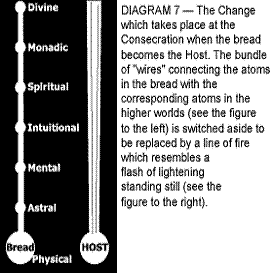
What happens at the moment of the Consecration of the Host is the instant deflection of this bundle of wires. (Diagram 7). It is switched aside with the speed of a lightning flash, and its place is taken by what looks like a line of fire—a single thread of communication, reaching up, without division or alteration, to the Lord Christ Himself, as the Teacher and Head of the Church, and through Him to a height beyond any power of clairvoyant vision which we at present have at our disposal—into that other divine Aspect of Himself which is Very God of Very God.
It may be contended that this is a miracle—an infringement of the laws of nature. There is no such thing as a miracle in that sense of the word; everything which happens in the world, however unusual or incredible, must occur and does occur under the eternal and immutable laws which God has imposed upon His creation. This is undoubtedly an achievement beyond our physical capacity; we know little as yet of those mighty laws, and much which is impossible to us is certainly well within the power of the mighty Intelligences in whose hands is the execution of this divine plan.
From what I have described, it will be seen that though the outer form of the bread and wine is unchanged after the Consecration, the manifestation of the divine life which underlies them is utterly different. It was divine life before, for all life is divine; but now it is a far fuller and closer epiphany of God, and that is why the Church has always so strongly insisted upon the Real Presence of Christ in the Sacrament, and has spoken of it as just as truly His Vehicle as though it were actually His living Flesh and Blood.
All through the ages it has been found necessary to combat man's materialism by strenuously insisting upon the reality of the change which takes place when ordinary, everyday food is made into holy food, bearing with it a special and mighty potency. The very fact that to physical eyes the bread and the wine are evidently just what they were before, makes it the more needful to emphasize that in another and higher sense they are quite different. The "accidents" being unchanged, it must be made clear to those who are blind to higher planes that the "substance" has been definitely altered.
If we may be forgiven a little excursion into etymology, we may note that the derivation of the technical words used in connection with this change is full of significance. "Accident," the name given to the physical bread and wine, and meaning philosophically "a property not essential to our conception of a substance," comes from the Latin ad, to, and cadere, to fall, and means therefore "falling into juxtaposition with". "Substance" comes from the Latin sub, under, and stans, standing; it is that which stands under or behind a physical object. Trans is the Latin for across, and we have seen how the "substance" of the bread and wine is swept across and replaced by another.
The "beads" are not really beads unless the counterparts are taken separately, but it is impossible in physical terms to describe them exactly as they are. To understand the true relation between the physical matter of the Host and its counterparts requires the sight of other and higher dimensions of space. So in a sense we are only describing a diagram when we say that the Angel of the Presence brushes aside a bundle of wires or lines running up from the wafer to the Deity, but there is no other way of making the process thinkable to those who cannot see in the inner worlds. If we try to analyse the thing we shall find it rather complicated, because every atom has always its connection with the Deity. Truly the divine life is everywhere, as I have already said, but through the act of consecration, a special manifestation of it flashes out in the matter of the Host, welling up from the very heart of the Christ, so that it becomes in that moment a veritable epiphany of Him. It is then that the Host glows with unearthly radiance, as befits the most precious gift of God to man.
It was this glow which first brought to my notice the possibility of studying clairvoyantly the hidden side of the eucharistic Service. It may perhaps help the reader to realize the actuality and the material nature of the phenomenon if I reproduce here an account (written soon afterwards) of the first occasion on which I had the opportunity of observing it.
"My attention was first called to this matter by watching the effect produced by the celebration of the Mass in a Roman Catholic church in a little village in Sicily. Those who know that most beautiful of islands will understand that one does not meet with the Roman Catholic Church there in its most intellectual form, and neither the Priest not the people could be described as especially highly developed; yet the quite ordinary celebration of the Mass was a magnificent display of the application of occult force.
"At the moment of consecration of the Host glowed with the most dazzling brightness; it became in fact a veritable sun to the eye of the clairvoyant, and as the Priest lifted it above the heads of the people I noticed that two distinct varieties of spiritual force poured forth from it, which might perhaps be taken as roughly corresponding to the light of the sun and the streamers of his corona. The first (let us call it Force A) rayed out impartially in all directions upon the people in the church; indeed, it penetrated the walls of the church as though they were not there, and influenced a considerable section of the surrounding country.
"This force was of the nature of a strong stimulus, and its action was strongest of all in the intuitional world, though it was also exceedingly powerful in the three higher divisions of the mental world. Its activity was marked in the first, second and third subdivision of the astral also, but this was a reflection of the mental, or perhaps an effect produced by sympathetic vibration. Its effect upon the people who came within the range of its influence was proportionate to their development. In a very few cases (where there was some slight intuitional development) it acted as a powerful stimulant to their intuitional bodies, doubling or trebling for a time the amount of activity in them and the radiance which they were capable of emitting. But forasmuch as in most people the intuitional matter was as yet almost entirely dormant, its chief effect was produced upon the causal bodies of the inhabitants.
"Most of them, again, were awake and partially responsive only as far as the matter of the third subdivision of the mental world is concerned, and therefore they missed much of the advantage that they might have gained if the higher parts of their causal bodies had been in full activity. But at any rate every ego within reach, without exception, received a distinct impetus and a distinct benefit from that act of consecration, little though he knew or recked of what was being done.
"The astral vibrations also, though much fainter, produced a far-reaching effect, for at least the astral bodies of the Sicilians are usually thoroughly well-developed, so that it is not difficult to stir their emotions. Many people far away from the church, walking along the village street or pursuing their various avocations upon the lonely hillsides, felt for a moment a thrill of affection or devotion, as this great wave of spiritual peace and strength passed over the countryside, though assuredly they never thought of connecting it with the Mass which was being celebrated in their little cathedral.
"It at once become evident that we are here in the presence of a grand and far-reaching scheme. Clearly one of the great objects, perhaps the principal object, of the daily celebration of the Mass, is that every one within reach of it shall receive at least once a day one of these electric shocks which are so well calculated to promote any growth of which he is capable. Such an outpouring of force brings to each person whatever he has made himself capable of receiving; but even the quiet undeveloped and ignorant cannot but be somewhat the better for the passing touch of a noble emotion, while for the few more advanced it means a spiritual uplifting the value of which it would be difficult to exaggerate.
"I said that there was a second effect, which I compared to the streamers of the sun's corona. Suppose we call it Force B. The light which I have just described (Force A) poured forth impartially upon all, the just and the unjust, the believers and the scoffers. But this second force was called into activity only in response to a strong feeling of devotion of the part of an individual. At the elevation of the Host all members of the congregation duly prostrated themselves—some apparently as a mere matter of habit, but some also with a strong upwelling of deep devotional feeling
"The effect as seen by clairvoyant sight was most striking and profoundly impressive, for to each of these latter there darted from the uplifted Host a ray of fire, which set the higher part of the astral body of the recipient glowing with the most intense ecstasy. Through the astral body, by reason of its close relation with it, the intuitional vehicle was also strongly affected, and although in none of these peasants could it be said to be in any way awakened, its growth within its shell was unquestionably distinctly stimulated, and its capability of instinctively influencing the astral was enhanced. The awakened intuition can consciously mould and direct the astral; but in even the most undeveloped intuitional vehicle there is a great storehouse of force, and this shines out upon and through the astral body, even though it be [done] unconsciously and automatically.
"I was naturally intensely interested in this phenomenon, and I made a point of attending various functions at different churches in order to learn whether what I had seen on this occasion was invariable or, if it varied, when and under what conditions. I found that at every Celebration the same results were produced, and the two forces which I have tried to describe were always in evidence—the first, apparently without any appreciable variation, but the display of the second depending upon the number of really devotional people who formed part of the congregation." [3]
The Bread then has become most truly a vehicle of the Christ, and in a very special way an outpost of His consciousness, and it is because of this that we see this marvellous sunlike radiance streaming from it. But these two forces here described are quite distinct from that which is to be distributed by the Angels (which we will call Force C), though they all flow from the same source. These forces or emanations differ somewhat as do those from radium, for the glow is a vibration like light or heat, pouring out in all directions all the time, and apparently inexhaustible; while Force C is limited in amount, and can be divided as it were into blocks and apportioned precisely as though it were a material substance, though its nature seems to be more analogous to that of an electric charge.
Force itself is always invisible, in the higher worlds as in this; it can be seen only by its effect in some kind of matter. The clouds and streams of crimson and blue out of which the Angel builds his edifice are not themselves the love and devotion of the people, but the effect of that love and devotion upon various types of matter, etheric, astral and mental. In the same way when we speak of seeing Force C radiating from the Host, it must be understood that what we see is its most wonderful and beautiful manifestation in finer forms of matter—a stream of liquefied light, of living gold dust, or perhaps better still of star-dust, the flashing fire-mist of cosmic space. No earthy analogy is really appropriate; but we may perhaps think of the force as a charge of electricity—an amount stored up, to be released only by touching it, the required touch being the action of the Directing Angel. The other radiation (Force A and Force B) is continuous, and does not require the intervention of the Angel but it can be to a certain extent concentrated and directed by the will of the Priest.
It is by the power of the Angel of the Presence that the inner change takes place in connection with the elements, when the full force from above is outpoured. The Angel of the Presence differs from all those previously mentioned in that he is not a member of the glorious kingdom of the Angels, but is actually a thought-form of the Christ, wearing His likeness. We have, I suppose, an analogy for this at an almost infinitely lower level in the fact that, as I have before explained, an affectionate thought of a man in the heaven-world attracts the attention of the ego of his friend, who at once responds by pouring himself down into the thought-form and manifesting through it, although the friend in his physical consciousness knows nothing about it. Perhaps that may help us to understand how the same power, raised to the nth degree, makes it possible for the Christ to send His thought simultaneously to a thousand Altars, opening through each the marvellous channel of His strength and His love, and yet at the same time to carry on as freely as ever the exalted work in which He is always engaged.
It is not even only His power, immeasurable as that must be to us; it is the force of the Second Aspect of the Deity Himself, of whom the World-Teacher is a chosen channel, an especial epiphany, in some marvellous way that to us must remain a mystery. but of the fact that this most wonderful and beautiful manifestation does take place at every celebration of the Holy Eucharist there is no doubt whatever, for it has repeatedly been observed by many competent witnesses. We need not wonder that those among churchmen who are at all sensitive to this holy influence should speak of it as "a means of grace," and find it the most powerful stimulus to their spiritual life.
When the Angel of the Presence flashes out, he attracts large hosts who do not belong to the working but to the contemplative and guardian types of Angels. They come hovering around to bathe in the light radiating from the Host. These Angels are at the same level in the angelic kingdom as are human beings in the human kingdom who attend a Service purely for the purpose of adoring devotion, and without any particular idea of doing anything themselves, or even understanding that there is a way in which they can do anything. These Angels, however, do draw down and generate a good deal of force by their devotion. That is their line, and so they are always attracted when the light shines out from the Host.
Much incense should be used at the time of the elevation, because the Angels send up their thoughts in and with the incense. When the Host is reserved there are always Angels hovering around it, not only because they enjoy the radiance which surrounds it, but also because they regard it as a great privilege to guard it, and to be there in attendance. Wherever the Host is, be sure that there are always Angels present.
When the Angel of the Presence deflects the bundle of "wires" connected with the Host, what takes its place looks like a flash of lightning standing still. This line of fire not only flows down to the Host, but also into the consecrated Altar-stone in which are set the seven jewels which we shall describe in Chapter VII. When this takes place the jewels glow like seven points of fire. The celebrant himself is of course on one of the Rays with which these stones are connected, and the influence flows into him most readily through the jewel connected with his Ray. This raises him to his highest possibility, and then through him the force invoked at the Consecrations plays upon the congregation. Thus there is an interchange of force between the Host, the jewels set in the Altar-stone the candlesticks, the Ray-centres on the walls of the church, the Priest who stands in front of the Altar, and the Angel of the Presence. (Diagram 8.)
As soon as the Host and Chalice are consecrated, and so long as they are upon the Altar, a vivid interplay of forces takes place between them and the minute consecrated jewels embedded in the Altar-stone, the tabernacle (or Altar) cross, the six shields of the candlesticks, and the six Ray-crosses placed in the body of the church. The Altar-jewels act somewhat as a prism might, separating the force radiating from the sacred elements into its component parts, one shaft of force darting towards each Ray-cross and towards each candlestick from the corresponding jewel in the Altar-stone. The Ray-crosses and candlesticks are likewise joined by a similar though feebler line of radiation. Each consecrated object in turn radiates force generally over the people, so that the whole interior of the church seems filled with an interweaving maze of lines of many-coloured fire. It is of interest to note that the Altar-jewels and Ray-crosses are so arranged in the church that, generally speaking, the positive or masculine Rays are represented on the south or Epistle side and the negative or feminine Rays on the north or Gospel side. More specifically it should be remembered that the 4th and 5th Rays are predominantly masculine, the 3rd and 6thRays predominantly feminine, the2nd Ray dual but about equally balanced, the 1st Ray dual but with the masculine intensified, and the 7th Ray dual but with the feminine intensified.
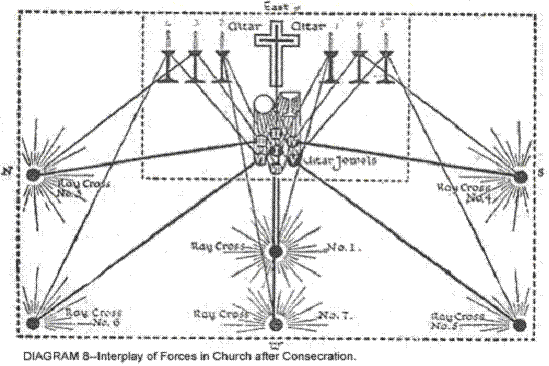
As soon as the Host and Chalice are consecrated, and so long as they are upon the Altar, a vivid interplay of forces takes place between them and the minute consecrated jewels embedded in the Altar-stone, the tabernacle (or Altar) cross, the six shields of the candlesticks, and the six Ray-crosses placed in the body of the church. The Altar-jewels act somewhat as a prism might, separating the force radiating from the sacred elements into its component parts, one shaft of force darting towards each Ray-cross and towards each candlestick from the corresponding jewel in the Altar-stone. The Ray-crosses and candlesticks are likewise joined by a similar though feebler line of radiation. Each consecrated object in turn radiates force generally over the people, so that the whole interior of the church seems filled with an interweaving maze of lines of many-coloured fire. It is of interest to note that the Altar-jewels and Ray-crosses are so arranged in the church that, generally speaking, the positive or masculine Rays are represented on the south or Epistle side and the negative or feminine Rays on the north or Gospel side. More specifically it should be remembered that the 4th and 5th Rays are predominantly masculine, the 3rd and 6thRays predominantly feminine, the2nd Ray dual but about equally balanced, the 1st Ray dual but with the masculine intensified, and the 7th Ray dual but with the feminine intensified.
When in addition to this the Bishop's crosier is near the Altar there is introduced a highly complicated interplay of the lines of light which it is scarcely possible to describe. In the crosier the seven jewels flame out like stars, and between them and all the other jewels strands of living flame are ceaselessly darting. In physical mechanics, every time a force is transferred something is lost by friction. The contrary takes place during the consecration, for all the instruments of this wonderful Sacrament are already magnetized with a living force, and the more interplay there is the stronger the force becomes.
Having knelt in adoration before this wondrous manifestation of the Presence of the Christ, the Priest raises the Host reverently above his head, that all the people may see; and it is at that moment of the elevation that the secondary rays of fire stream out in response to special feelings of devotion, as I saw them in that church in Sicily. The elevation of the Host in sight of the people has been the custom of the Church from the earliest days, though it was not always done immediately after the consecration. Indeed, its introduction at this point dates only from the twelfth century, but it is clearly both appropriate and beneficial here, so none need hesitate to adopt it because of its comparative modernity. We must beware of the tacit denial of the living influence of the Christ in His Church which is involved in the theory that all improvements introduced since the date of the Ascension are without His approval. Assuredly many mistakes have been made by portions of His Church, and He has not interfered to correct them; but we need not therefore doubt that He has at various times inspired His officers to make changes which practical experience had shown to be of value, and this may well be a case in point.
The cross which the celebrant makes over the elements with the word "receive" not only breaks the link with the people, but also with the nature-force from the Altar-stone, and therefore cuts off the source of supply which has held up the spinning rod which we have compared with the stick of an umbrella; that, therefore, now disappears. At the word "purify" any trace of anything not quite noble in what has been poured into the elements as the offering from the people is cleaned out. The cross at the word "hallow" makes the bread and wine glow very distinctly.
During the prayer commencing "Wherefore, O Holy Father Almighty," the celebrant extends his hands towards the oblations. This has the effect of extending the glow around them—made by the last cross at the word "hallow" to include his own hands and so, through this connection, more of this glowing light flows into the bread and wine, which vivifies the physical atoms, so that the life, which is always welling up form within them increases in quantity and brightness and makes all the sprillÊ glow; and at the same time it begins to flow along the lines which, when in ages hence the atoms are fully evolved, will then be taken by the new-grown sprillÊ. A further effect is the brightening of the colours of the rosy cross which is seen when one looks down into the heart of the atom. The sign of power and the word "bless" intensify this effect and really build in a sketch, made in lines of light, of the as yet undeveloped sprillÊ. The whole atom is now a thing of light—living and brilliant. The next cross and the word "approve" have the same effect on the astral atoms, and the succeeding crosses do the same thing all the way up to the buddhic level. We now have the accidents on all these planes made really pure and fitting vessels for His Presence. Then comes the consecration, when the "bundle of wires"—the life behind the form, which supports it and to which its very existence is due, The life which wells up through the centre of the atom—is in a moment swept aside and something infinitely grander flashes down into its place. (The bubbles in koilon, however, of which the atom is built, do not appear to change in any way; at any rate their appearance remains the same; it is the force which builds them into atoms which is affected.) the form of the physical bread is still the same because the shape and arrangement of the physical atoms are still the same, although the life which now throbs through them is utterly different and invests them with a glory of radiant light. The same thing happens with the astral, mental and buddhic atoms.
There is a certain sort of grouping of atoms which on the astral level represents the presence of bread on the physical plane; though it does not look like bread up there, it yet has its own distinctive appearance. When the Host is consecrated, this distinctive appearance is entirely blotted out by the thousand times more brilliant Life which comes into this astral manifestation of bread.
The consecrated Host appears to ordinary clairvoyant vision a glowing mass of dazzling white light honeycombed with lines of darker gold—a beautiful gleaming maize-colour. The arrangement of these lines of golden light appears somewhat like a section of honeycomb. If one tries to see an individual cell, the richer colour seems rapidly to fade into what is to all intents and purposes white, but really is, I think, a sort of sublimated primrose, such as we observed in the Collect for Peace. Each cell looks not unlike a set jewel held up to the light, which in the centre is of a luminous brightness, but as the eye approaches quite near to the edge, shades off into topaz; but the whole effect is one of amazing brilliance.
The white or sublimated primrose force is, I think, the force A, referred to by our Presiding Bishop; and the golden network of light would then be the force B. The force A makes a wonderful sphere of white light around the wafer which has a slight bluish tinge just at the edges.
The golden force B (which, I think, comes from the glowing maize-coloured lines in the Host) is indeed a mighty power which beams out with what one would imagine from its appearance to be a shattering, crashing energy. It bursts from the Host like sheet after sheet of living flame, with all the strength of a colossal charge of electricity. What I take to be the force C looks almost a palpable thing. Its appearance is such as to suggest that one could take it in one's hand, and that it would feel like frost when rubbed between the fingers—crisp and yet so infinitely delicate, each particle being composed of the finest filigree or lace-work, which would be crushed at the slightest touch. Each tiny filigree ornament on each particle refracts the light, and so the whole produces the most delicately fairy-like effect. It too is golden in colour with a silver sheen over all, so that it resembles a rare shot silk with gold and silver inwoven, such as it made in the sunny East. Its golden particles flash a kind of white-diamond fire, as they roll over one another; it looks like a stream of rich-coloured Indian corn poured out in the sunlight.
After a second genuflection and a pause of a few moments the Priest proceeds to the consecration of the Chalice.
|
ROMAN |
LIBERAL |
|
In like manner after he had
supped, taking also this excel- lent chalice into his holy and venerable
hands: also giving thanks to thee, he
|
In
like manner, after He had supped, taking also this noble chalice into His
holy and venerable hands, again giving thanks to Thee, He
|
By the sign of the holy cross he presses his second tube through into the higher world as he did the first, just a moment before the actual Consecration, and again at the Word of Power the transubstantiation takes place, and the bundle of lines representing the inner realities of wine and water are swept aside and replaced by the living fire which is the life of the Christ. But this time the fire is not the blinding white and gold which makes the Host shine forth as a sun, but a glowing sword of intense crimson in colour like the fingers of a hand
Before a burning taper as Tennyson puts it. The processes of genuflection and elevation are repeated, and this second form of the divine force is shed upon the congregation. It is complementary to the other, but it seems to descend somewhat nearer to us; the Wine has a very powerful influence upon the higher astral levels, and the Water sends out even etheric vibrations. The force of the Host may be described as essentially monadic, and acts most powerfully upon whatever within us represents the direct action of the Monad—the strength, the accuracy and the rhythm belonging to the Epistle side of the Altar; the force of the Chalice is more that of the ego, and seems to express rather the fiery devotion, the adaptability and the ceremonial method of the Gospel side. Both are necessary, and when they radiate out together there is no good that is not stimulated by their vibrations, no evil that may not be assuaged.
So much for their effect; but in addition to that we shall do well to remember that all through the Holy Eucharist there runs a double symbolism—that of the Holy Trinity as well as of the descent of the Christ into matter. (Diagram 9.) The Host typifies God the Father, and also stands for the Deity whole and indivisible; the Wine stands for God the Son, whose life is poured down into the chalice of material form, and the Water represents God the Holy Ghost—the Spirit who brooded over the face of the waters and yet is at the same time Himself symbolized by water.
When we apply the same imagery to the manifestation of the Deity in man, the Host signifies the Monad, the totality, the unseen cause of all, while the paten means the Triple Atma or Spirit through which that Monad acts on matter; the Wine indicates the individuality, poured into the chalice of the causal body, and the Water represents the personality which is so intimately commingled with it. That is why at an earlier stage, when we are typifying a condition in which the Monad is merely hovering over the lower manifestation, the paten is hidden under the corporal or under a veil clasped to the breast of the subdeacon; when it is brought forth and the Host is laid upon it, we symbolize the time when a junction is effected.
From the point of view of the decent into matter the Host stands for the Eternal Unity—the Christ within the bosom of the Father; while the Wine and the Water represent the dual manifestation of the Christ in matter—positive and negative, or male and female.
The chalice is for ever hallowed by a similar happening to its contents. This consecration seems similar to that of the bread, except that the sword of light which descends into the wine is a burning red as though it were fresh from the forge. The element itself receives the same warm living tone, a hue tender and soft, yet also very strong—material—meet for the robe of a soldier king. There are two shades of it; as with the Host, the darker colour marks the lines of cleavage, but here, in these lines, there is another colour also, a slight touch of a beautiful blue, which, like a fair tunic, is just seen at the opening of the cloak of royal scarlet in which the Master comes.
At the first Eucharist, the Christ having uttered the words: "This is my Body," as He raised the cup and held it a moment before drinking, added: "As oft as ye shall do these things, ye shall do them in remembrance of me." His mention of men performing this act is naturally a thought of the future, but on the timeless plane on which His mighty Consciousness lives, everything now and always exists in its completeness and fullness of perfection, so that this mention of the future is far more than a mere reference. It is actually a touch with the now existent order of things, which will one day be worked out down here in terms of time and space. Similarly we touch the past, for the words about doing "these things" in memory of Christ links us with that time when He did them Himself, and every other time throughout the centuries when He has done it through His clergy. But far more than this, it establishes a relation between ourselves and the great fact of His coming down into matter, by which He created, still continues to create, and always will continue to re-create, all things. Thus we have a bond with the cosmic act when He, "abiding unchangeable within Himself did nevertheless in the mystery of His boundless love and His eternal Sacrifice breathe forth His own divine life into His universe, and thus did offer Himself as the Lamb slain from the foundation, of the world dying is very truth that we might live." Grand though the connection with the past, present and future of the Church is, grander still is this relation with the eternal operation of creation, which is the archetype behind countless processes of nature and of the human heart, and is therefore found reflected in our actions, our allegories and works of art, in our whole lives and the entire method of manifestation. Thus in saying this little sentence we are making concrete the glorious act we have just consummated, and are bringing down on to the physical level a symbol of cosmic action.
Much exception has been taken by the ignorant to the statement always made by the Church that the celebration of the Eucharist is a daily repetition of the sacrifice of the Christ. But when we understand that, from the inner point of view, that sacrifice of the Christ means the descent into matter of the outpouring of the Second Aspect of the Deity, we see that the symbolism is an accurate one, since the outflow of force evoked by the Consecration has a special and intimate connection with that department of nature which is the expression of that divine Aspect. The Christ quite truly incarnates again, and so continues His Sacrifice, every time the Holy Eucharist is celebrated; for He does verily put down something of Himself into that Bread and that Wine, which are then assimilated by us, and become part of our flesh and blood.
The Priest who comprehends this will not fail to assign to that Service its due position, and will take care to surround its culminating point with whatever in the way of ritual and music will add to its effect and prepare the people to take part in it more receptively. Realizing also of how tremendous a mystery he is here the custodian, he will approach its celebration with the utmost reverence and awe. for though his attitude towards it makes no difference to the central fact and to its effects, there is no doubt that his deep devotion, his comprehension and co-operation can bring down an additional influence which will be of the greatest help to his congregation and his parish. A priest who has the advantage of being also a student of the physics of the inner life has a magnificent opportunity of widespread usefulness.
Such an one has also the further advantage of understanding something of the nature of the stupendous force with which he is dealing; and he will thereby be enabled to avoid many of the mistakes into which those who are unlearned in these matters so readily fall. Many and various are the types of force which God pours out upon His world, and each has its own appropriate occasion and channel, for which He has fitted and intended it. It is unwise for men to cavil at the restrictions which He has seen fit to impose, and to ignore eternal laws of nature in order to suit their own temporary convenience.
For example, the marvellous efflux of the Holy Eucharist is arranged to synchronize with and take advantage of a certain set of conditions in the daily relation of the earth to the sun. There is an outflow and a backflow of magnetic energy between sun and earth—a magnetic tide, as it were; and the hours of noon and midnight mark the change from one to the other at any given point of the earth's surface, so that the currents flowing in the morning are different from those of the afternoon. Therefore the Holy Eucharist should never be celebrated (or at any rate the Service should never be begun) after the hour of noon. Since noon is the turning point of the tide, the flow for a short time before that, and the ebb for a short time after, are not very strong; so that if the Consecration takes place, set us say, before 12-30 p.m., the counter-current would not be severe enough to make the desired results unattainable.
But it should be distinctly understood that neither the angelic hosts nor their Lord and Master will violate the laws of nature to suit the whims of the indolent; and the Priests who provide evening Communions for fashionable congregations are possibly giving them a pleasant devotional Service, but are not celebrating the glorious ceremony of Christ's Holy Eucharist. When once the force is stored up in the consecrated Host, it may be used as well between noon and midnight as in the morning, so that the reserved Host may, in cases of necessity, be administered at any time. A very wonderful result is obtained from it at the Service called Benediction of the Blessed Sacrament, to which we shall refer in another chapter.
Another of the conditions under which we receive this mighty gift of grace is that it is arranged to flow through the masculine organism. In these days when it is the fashion to ignore or decry all distinctions of nature, and to claim that everybody can do everything equally well, women-folk sometimes clamour for priestly position, asking why they should not hold such an office and exercise its powers just as will as men. The ordinary clerical answer is in the old words: "We have no such custom, neither the Churches of God," fortified perhaps by the reminder that the Christ is said to have chosen His twelve apostles and His seventy preachers exclusively from among men. That is an argument of some force; but the student can add to it a further consideration—that this particular type of magic is not adapted to work through the feminine organism. There are other types of energy which are so arranged, but they are of quite different character, and are little known to our present civilization—much, I fancy, to its loss. The cult of our Blessed Lady in the Roman Church is an unconscious effort to fill a gap which many people instinctively recognize.
The hymns which follow are used in this connection only in the Liberal Catholic Liturgy.
|
|
Thee we adore, O hidden Splendour, Thee, Who in Thy Sacrament dost deign to be; We worship Thee beneath this earthly veil, And here Thy Presence we devoutly hail. |
|
|
O come, all ye faithful, joyful and triumphant, O come ye, O come ye to Bethlehem . Come and behold Him, Monarch of the Angels; O come, let us adore Him; O come, let us adore Him; O come, let us adore Him; Christ the Lord. |
After the consecration we kneel for a few moments in silent adoration, and then the melody of the ancient hymn steals on our ears, and very softly we all sing that wonderfully appropriate verse. Again there is a slight pause, and then all rise and join with heart and voice in the glorious song Adeste fideles, written originally indeed for the birth of Jesus at Bethlehem, yet surely a most fitting welcome for the new birth of the Christ upon His Altar in this more modern House of Bread.
The splendour of the scene to clairvoyant vision during the singing of these hymns is beyond all description, for the Angels join in them with a truly celestial fervour, and the outburst of their love and devotion not only fills the vast thought-edifice with living fire, but enormously enriches and adorns it. It is this time that the recessed openings which we have called doors are made, so that the basilica now stands complete (Frontispiece). The tube which the celebrant made has expanded into a huge funnel, still clearly marked in the midst of all this sea of light. Still the Host, the Chalice and the Angel are the centre of all, and from them radiate the fiery streams which are enlightening and vivifying the surrounding world. Forces A and B are in full operation all this time; Force C is steadily accumulating, filling the thought-edifice, and undergoing some sort of transmutation or materialization at the hands of the Angel of the Presence.
The Roman Missal does not use hymns of adoration immediately after the Consecration, but inserts instead the Agnus Dei, a little later in the Service, which is unfortunately by no means so effective. Such lively music has been set to those words by many composers that we are a little apt to overlook their actual meaning. Only the deadening effect of long custom has reconciled us to the irreverent inappropriateness of St. John the Baptist's zoological apostrophe, and the idea that He bears the sin of the world is as theologically misleading as are the connotations of the request to have mercy upon us.
It may well be that those who sing these words think little of their signification, and that the people listening to them are merely filled with a vague sense of devotion; but the practical effect is that the devotion is often sadly tinged with slavish fear, and that in many a great cathedral the Angels have to go to work and comb out the grey from the blue in the heavy clouds which float slowly over the heads of the congregation before they can use the material in the service of the King of Love. Often and often have I seen a kind of rubbish-heap, a huge mass of waste substance—a thick unpleasant mist of grey astral slime—thrown out from a church by the Angels before they can do their work in connection with the Holy Eucharist. Our wording, on the contrary, suggests only joyousness and praise and love so, as far as our people follow the ritual, and sing with feeling and understanding, they provide excellent material for the angelic workers.
The Church of England user the Gloria in Excelsis as her thanksgiving and hymn of adoration; it would be difficult to conceive anything finer, if it did not contain the very phrase about the Lamb of God which I have stigmatized as in my opinion undesirable. Another objection to the insertion of the Gloria in Excelsis here is that it has to be omitted from its traditional place in the earlier part of the Service, where its presence is so necessary to the erection of a stately and effective sacramental edifice.
Even at a Low Celebration it is desirable that the first and last verses of the Adeste should be recited, for if that is not done the Angel is obliged to draw upon his stock of force for this part of the work, and consequently that much less is left for the object of the whole ceremony. The edifice constructed at a Low Celebration is naturally very much smaller than that built by the great musical Service with a large congregation; but if the celebrant really understands the full detail of his work, puts his whole heart into it and co-operates intelligently with the Angels in charge, that comparatively small form may be a glowing jewel, a veritable Cappella Palatina like that at Palermo, and neighbourhood like a fountain of fire.
|
ROMAN |
LIBERAL |
|
Wherefore, O Lord, we thy servants, as also thy holy peo- ple, calling to mind the blessed passion of the same Christ, thy Son, our Lord, and also his rising up from hell, and his glorious ascension into heaven, do offer unto thy most excel- lent majesty of thine own gifts
bestowed upon us, a clean
victim, a holy
spotless
bread of life everlasting, and
the chalice
vation. Vouchsafe to look upon them with a countenance merciful and kind, and to receive them, as thou wast pleased to receive the gifts of thy just servant Able, and the sacrifice, of our father Abraham, and that which Melchisedech thy high-priest offered up to thee, a holy sacri- fice and spotless victim. We most humbly beseech thee, almighty God, to com- mand that these things be borne by the hands of thy holy angel to thine altar on high, in the sight of thy divine majesty. |
Wherefore, O Lord and heavenly Father, we thy hum- ble servants, [bearing in mind the ineffable sacrifice of Thy Son, the mystery of his wond- rous incarnation, His mighty re- surrection, and His triumphant ascension, do here make before Thy Divine majesty the me- morial which our Lord hath willed us to make and we] do offer unto Thee this, the most precious gift which Thou hast
bestowed upon us: [this pure
Host, this holy
glorious
Bread of life everlasting, and
the
tion. This do we present before Thee] in token of our love and of the perfect devotion and sacrifice of our minds and hearts to Thee; and we pray that Thou wouldst command Thy holy Angel to bear our oblation to Thine Altar on high, there to be offered by Him who, as the eternal High Priest, for ever offers Himself as the eternal Sacrifice.
|
(The portions within brackets are omitted in the shortened form of the Service, and the five crosses are made where they should be according to the meaning of the action—at the words love, devotion, sacrifice, minds, hearts.)
The Bread and the Wine, now veritably vehicles of the Christ, have become to us the greatest Jewels upon earth, the most wondrous gifts of God. Therefore at once we lay them at His feet, in token and as an expression of our love, devotion and sacrifice. This is far more than a mere symbol. It will be remembered that at an earlier stage we offered ourselves, our souls and bodies to be used absolutely and completely in His service. Then afterwards the Priest broke the link and swept out from the oblation every tinge of the lower and the earthly, that it might be made a meet channel for that most august power.
Now that power has filled it, and nothing but the very highest can enter into its shrine. And so once more we make our humble offering of all that we have and are, all our gratitude for this His most marvellous gift of Himself, all the strength, the love, the devotion that that gift has evoked in us, all that we felt and expressed at the elevation and while singing the hymns—all these we try to pour through the channel that His loving kindness has opened for us, while the holy Angel who is in very truth a part of Him is still present with us. And just as that Angel so acts upon and transmutes the down-pouring of Divinity that it becomes assimilable by mortal men, so does he act upon and transmute our responsive upward stream of love, all feeble though it be, until it becomes not altogether unworthy to be offered before the Majesty on high.
So, as the Priest makes the five signs of power, he thinks of the fivefold man, imaged in Hermetic mysteries by the five-pointed star. The five principles or parts are (a) spirit, (b) intuition, (c) intelligence—the three aspects of the true inner man (often called the soul or the ego), typified here as love, devotion and sacrifice—(d) the lower mind, and (e) the emotions. (Diagrams 11 and 12.) All these, and all the force flowing from them under the incalculable stimulus of the Holy Eucharist, he offers utterly and unreservedly to our Blessed Lord, through the direct and especial channel now open to him, asking that the Angel of the Presence may bear this our humble oblation to the eternal Alter on high.
This Angel is an extension of the consciousness of the Christ Himself, and as our Lord who extended that ray draws it back into Himself, it bears with it the impress which we, through the sacred elements, have stamped upon it. Thus the force which we ourselves down here have generated is actually utilized in higher worlds, and we have the unspeakable privilege of contributing, in however small degree, to that great reservoir of spiritual force from which Christ's Priests draw their power when they administer the holy Sacraments. So when the Angel disappears with his glorious smile at the moment when he is mentioned in the prayer, this is what he bears back with him as our tribute of love. His presence was necessary for the act of consecration and for the transmutation of the forces, but now he is to return, bearing his sheaves with him.
It is of course true that all force in the world is divine force, and so, as is said in a well-known hymn:
We give Thee but Thine own
Whate'er the gift may be.
But it is God's Will, His system for our progress, to give each of us a certain limited amount of this force, and see how we use it. As in the parable of the talents, some make good use of it, some squander it, some bury it in the ground and ignore it altogether. So, though it be by God's power alone that we are able to do anything, it is also true that when we pour ourselves out in uttermost devotion we are expending for good a certain amount of energy which, if we were more foolish or more ignorant, we might have employed less wisely. We are doing that which God intended us to do—using the power which He has given us in harmony with the evolution which is His plan.
Remember, too, that other law of higher life which I have previously mentioned. For every uprush of love or devotion there comes a bounteous response from on high; and because the forces are living, the effect is far greater than the cause. And all this also is added to our contribution to the reservoir. We may say with utmost reverence that God calculates upon the aid of His creatures—that it is part of His scheme that as soon as they become sufficiently intelligent to understand that scheme they should hasten eagerly to range themselves under His banner as workers.
Let us briefly recapitulate. First, the Priest blew a kind of gigantic bubble at the Asperges; then the Angel of the Eucharist, taking our devotion and affection, began inside that to build the great eucharistic edifice. Inside that edifice by the second censing the Priest made a kind of casket round the elements, cutting them off from the rest of the church, just as he had temporarily cut off the church from the world outside. Within that innermost casket the Priest began his tube; inside that tube again the change took place at the Consecration, so that the divine influence could flow down.
The Christ Himself pours out the power; in order that He may do that easily and with the least exertion, leaving the greatest possible amount of force to be used for its real purpose, the Angel of the Presence by the actual transubstantiation makes the line of fire along which He can pour it. The Priest, however, by pushing up his tube and so preparing a channel, has made it possible for the Angel to do that. There are many electrical experiments which must be performed in a vacuum; and in that case it is of course necessary to make the vacuum first. So in this case the tube must be made before that especial line of communication can be inserted in it. But the Priest could not make that tube unless he had first made a properly isolated casket from which to push upwards, and so he has performed the isolation of the elements. The people have assisted the Priest, and have supplied the material for the edifice through which the force is distributed when it has been poured down. Thus we see that all have taken their due part in the somewhat complicated process which produces so magnificent a result.
|
ROMAN |
LIBERAL |
|
That so many of us as at this altar shall partake of and re-
ceive the most holy
and
filled with every heavenly bless- sing and grace. Through the same Christ our Lord. Amen.
|
And [as He hath ordained that the heavenly Sacrifice shall be mirrored here on earth through the ministry of mortal men, to the end that Thy holy people may be knit more closely into fellowship with Thee.] We do pray for Thy servant who ministers at this Altar, that, meetly celebrating the myster-
ies of the most holy
and blessing. |
In the shortened form of the Service the words within brackets are omitted. Now that the Angel of the Presence, having done his work, has withdrawn, a certain rearrangement becomes necessary. Up to the point of his retirement, there were three direct links with the Christ in full operation—the Angel, the Host and the Chalice, if for the moment we understand the last term to mean not the cup itself, but the intensely charged Wine and Water which it contains. These three channels have each its special function, bearing to one another the same sort of relation that we find in all threefold manifestations, from the Three Persons of the Ever-Blessed Trinity down to the three essential qualities of matter. All three in this case are filled with the life of our Lord, and are indeed extensions of His consciousness, though each represents what we from our lower point of view should call a different part of that consciousness. So when one of these disappears, it must either be replaced by some other, or the representation must be left imperfect.
The Priest at his ordination was specially linked with his Master the Christ, and because of that intimate connection it is possible for him to take the place of the Angel of the Presence—not indeed for the act of consecration, but for the work at a lower level which still remains to be done. He is about to pour out the divine force upon the people, but he cannot do that until he has himself become a part of the channel; and so "to the end that Thy holy people may be knit more closely into fellow ship with Thee," he prays that he may so celebrate the mysteries as to be filled with the mighty power and blessing of the Lord. And as he says these words he makes the sign of power over the Host, over the Chalice, and over himself, so that the threefold representation may be restored.
|
ROMAN |
LIBERAL |
|
Be mindful, O Lord, of thy servants, men and women, N. and N., who are gone before us with the sign of faith, and sleep the sleep of peace. To these, O Lord, and to all that rest in Christ, we beseech thee, grant a place of refreshment, light and peace. Through the same Christ our Lord, Amen. To us sinners, also, thy servants, who hope in the mul- titude of thy mercies, vouchsafe to grant some part and fellow- ship with thy holy apostles and martyrs; with John, Stephen, Matthias, Barnabas, Ignatius, Alexander, Marcellinus, Peter, Felicitas, Perpetua, Agatha, Lucy, Agnes, Cecily, Anastasia, and with all thy saints; into their company, we pray thee, admit us, not out of considera- tion for merits of ours, but of thine own free pardon. Through Christ our Lord. Through whom, O Lord, thou
dost create,
en, and
ever-bountiful gifts and give them to us. |
The corresponding prayer precedes the Consecration. Like wise we pray Thee to sanctify thy people here present with these Thy heavenly gifts, and through these mysteries do
thou
and
their hearts and in their lives they may show forth Thy praise and glorify Thy holy Name. |
The Priest now sends out the divine life over the congregation, thinking as he makes the three crosses of the threefold nature of the force with which he is flooding them, and willing earnestly that it may have practical effect both on their hearts and on their lives
|
ROMAN |
LIBERAL |
|
By
and in
the Father
unity of the Holy
honour and glory. For ever and ever. Amen. |
All these things do we ask, O Father, in the Name and through the mediation of Thy most blessed Son, for we ac- knowledge and confess with our
hearts and lips that
were all things made, yea, all things both in heaven and earth;
Life do all things exist, and
in Him as the transcendent Glory all things live and move and have their being: To whom with Thee, O mighty
and glory, throughout the ages of ages. R. Amen. |
In gratitude for this wondrous outpouring they at once join him in a magnificent ascription of praise and worship to the second Person of the most Holy trinity, acknowledging that but for the influence which He sends out into the world there could be no life therein. And in thus rendering thanks they receive, as ever, far more than they give, for as the Priest makes the three crosses with the Host over the chalice, he wills strongly that the holy influence from the monadic level should descend into the ego in its threefold manifestation of spirit, intuition and intelligence; and then, as he makes the two crosses between the Chalice and his own breast he draws that influence into his own mental and astral bodies, that through him it may radiate fully upon his people.
The symbology here is precise and beautiful, and it is remarkable that it should have been preserved so exactly through the centuries in which it would seem that its meaning was almost entirely lost. All through the earlier stages of evolution the Monad hovers over its lower manifestations, brooding over them, acting upon them, but never touching them; so the Priest holds the Host above the Chalice, yet never touches the one with the other until the appointed time has come.
As the Priest concludes the prayer, he makes what is called the Minor Elevation, raising the Host in his right hand above the Chalice in his left, thus not only typifying the hovering of the Monad, but also showing the line down which the force is flowing. It is now the custom for the Priest to hold the sacred elements before his breast, but in earlier days he probably raised them high enough for the people to see. It is at this point that in many Liturgies occur the words Sancta Sanctis—"holy things to the holy."
In trying to follow the symbolism, we must always bear in mind that Christianity is a cult of the Second Aspect of the Logos—one of the religions which emphasize the Second Person of the blessed Trinity; and thus we find ourselves especially worshipping the Word, and setting forth the Wisdom even before the Strength and the Beauty. There must be wisdom to conceive, strength to execute, and beauty to adorn. The Vaishnavite tendency in the Hindu religion, and the remarkable cult of Mithra, which so nearly superseded Christianity in the Roman world, are other examples of the same type. The Saivite aspect of Hinduism emphasizes the First Person, as do Muhammadanism and Judaism, so far as the latter has shaken itself free from the blood thirsty elemental-worship of its beginnings. All the feminine cults—the worship of Isis, Astarte, Vesta, Venus, Pallas Athene—essentially emphasize the third Person, whom now we call God the Holy Spirit.
Note The hymns after the Consecration generate a blazing mass of colours, some of the finest of which collect around the celebrant and can be seen as through an amber-coloured crystal, for a golden cocoon-like shape surrounds him and the purified colours from the people enter into this and gleam out through it. This aspiration and thanksgiving are poured through the elements into the Angel of the Presence at the five crosses in the prayer following the Adeste Fideles, for we now re-form the link between ourselves and the elements. When the Angel goes, this glittering cocoon seems to disappear also. And the same moment, the two lines of light connecting him with each of the elements vanish, thereby depriving us of the trinity made by the Host, the Wine and himself. Now that the main part of the work is done, the Priest is able to take the place of the Angel, and so complete the triangular arrangement. This he immediately does by the next three crosses over the wafer, the chalice and himself. The Host glows gold, representing the First Person; the cup flames out with the crimson of the Holy Ghost, and the celebrant, who takes the place of the extensions of Christ's Consciousness which has just departed, shines with the light sapphire color of the Christ.
This which glows in the Priest is the part of the Christ's own consciousness which was put into him (or rather vivified within him) when the direct personal link with the Christ was given to him at his ordination. This makes a wonderful sight—the red and gold on the Altar, each with a line of that colour connected to the blue in the celebrant, who is surrounded with the golden buddhic power and with many other colours which stream out all around him. It may be thought that from the ceremonial point of view—for the sake of perfectly correct form—the celebrant should represent the Arm of the Logos stretched out in activity in matter—the Third Person—while the Host and the Chalice should represent the Father and the Son. But as this is a religion of the Second Person, this arrangement is not followed, and the Christ is represented by His Priest.
The three crosses which follow, when the people are hallowed, quickened and blessed, are an extension of this connection with the officiant to include the congregation. They follow the same order as the previous set of three, so that it is the Holy Ghost, the Life-Giver, who "quickens" the congregation. In this act of extending the triple influence at the Altar to include all present, their various chakras are affected in the following order; by the first cross, at the word "hallow"—the Brahmarandhra or Sahasrara and the pituitary body; by the second cross, at the word "quicken"—all the lower centres; including the solar plexus, the spleen, and the centre at the base of the spine; by the third cross, at the word "bless"—the heart and throat. At the same time the three lights at the "point of entry" are made to shine out, but in the order of white, red and blue, instead of the more usual white, blue and red.
At the next three crosses, when we "acknowledge and confess . . . that by Him . . .with Him . . . and in Him" "were all things made," the three lights at each man's point of entry again glow out, but this time in their customary order of white, blue and crimson, corresponding with the power of the Father, Son and Spirit. This part of the ceremony establishes the full and complete unity in Christ of the celebrant, the elements and the congregation because we are here uniting and offering ourselves from the very core of our beings. We begin with dedicating the Atma, then the Buddhi, and then the Manas; and at the next two crosses, we continue down to the mental and astral bodies.
|
ROMAN |
LIBERAL |
|
Let us pray. Taught by the precepts of salvation and fol- lowing the divine command- ment, we make bold to say: Our Father, who are in heaven, hallowed by thy name; thy kingdom come; thy will be done on earth as it is in heaven. Give us this day our daily bread; and forgive us our tres- passes, as we forgive them that trespass against us. And lead us not into temptation. R. But deliver us from evil.
|
Let us pray. Instructed by the words of sacred Scripture, and the following the tradition of holy Church from of old, we now say: Our Father, who are in heaven, hallowed by Thy Name; Thy kingdom come; Thy will be done on earth as it is in heaven. Give us this day our daily bread; and forgive us our tres- passes, as we forgive them that trespass against us. And lead us not into temptation, but deliver us from evil. For Thine is the kingdom, the power and the glory, for ever and ever. Amen. |
In the Roman ritual the Lord's Prayer or Paternoster follows in this place. It appears in every known Liturgy, so we have inserted it here, as many of the faithful cling to it for the sake of sentimental associations. I rarely use it myself, for it has no part in the magic of the ceremony, and I must in honesty remain silent during the repetition of several of its clauses. If I am to ask God to give us this day our daily bread, I must perforce seek for some symbolical interpretation of the phrase, for I know that God does not give daily bread to any man unless he earns it, or is able to pay for it, or receives it as a gift from some other man. It is not true in these days, if it ever was, that ravens will bring food to a man who sits down in the desert and waits for it. If it be a request for spiritual food it would surely be better to say so; and even in that sense the prayer is unnecessary, for God is always offering to every man all that he is capable of receiving, and if he fails to take advantage of it he has only himself to blame.
To the petition "forgive us our trespasses" there is the same objection as to the expressions in the older confessions—the suggestion that God would hold a grudge against the man if the application were not made. The wording implies lack of faith—an altogether wrong conception of God. Still worse is the next clause "lead us not into temptation," for that is an actual insult to the heavenly Father. No good deity has ever led men into temptation. St. James remarks with refreshing common sense; "Let no man say when he is tempted, I am tempted of God; for God cannot be tempted with evil, neither tempteth He any man. But every man is tempted when he is drawn away of his own lust and enticed." This is exactly what scientific research into higher worlds also teaches us.
The Petition "deliver us from evil" may no doubt be taken in various senses, but again it has a faithless flavour. No evil can come to us unless we have deserved it, and as that happens under God's law it may be said to be in accordance with His will; but our duty is clearly to meet it bravely and truly, so that out of that long-past wrong which was the cause of it we may make a present good for ourselves by developing courage, cheerfulness and resourcefulness. One interpretation of these words which would enable one to use them is to take them as an apostrophy to the God within us to guide us through stress of evil; but even so one feels that it might be more clearly expressed.
For the clauses of the prayer which introduce and follow those to which I have referred I have the greatest admiration; if the whole middle of it were cut out we could all conscientiously repeat it.
Many who cannot approve its sentiments feel bound to recite in because our Lord Himself is supposed to be its author. He may or may not have prescribed it for His disciples, but it is at least certain that He did not compose it, for every clause of it was used in Jewish synagogues and Bablyonian temples centuries before His birth at Bethlehem. The Rev. John Gregorie quotes the following form of it, put together from the Jewish Euchologues. [4]
Our Father which are in heaven, be gracious to us; O Lord our God, hallowed be thy name, and let the remembrance of thee be glorified in heaven above, and upon earth here below. Let thy kingdom reign over us now and for ever. The holy men of old, said remit and forgive unto all men whatsoever they have done against me. And lead us not into temptation, but deliver us from the evil thing. For thine is the kingdom, and thou shalt reign in glory for ever and for evermore.
There is no question as to the antiquity of the prayer. Basnage, in his Histoire des Juifs, tells us that some of its clauses occur in the Kadosh, one of the oldest prayers preserved by the Jews, so old that it was traditionally recited in the Chaldean language, coming down from the return from the captivity. So we need not feel bound to use it on account of its authorship.
Thus it affects me; but there are many to whom it is dear from long association and for sentimental reasons; and for their sakes I append here a most beautiful interpretation of it given by my dear and learned friend, Mr. Jinarajadasa:
"What better mode of bringing His mighty mystic action here and now within our hearts, than the words He once gave men in Palestine? You repeat them so often; repeat them again, but do it now in a new way. You have said them, and say them every day: 'Our Father, which art in Heaven, hallowed be Thy name.' Yes, but He is our Brother too, and His heaven is not far away; His life is flashing through us every day, and His Name is hallowed, for it is He who stands rejoicing with the great life of God, though there is also the evil, the grief of all men, in His consciousness.
"'Thy kingdom come,' we say. Not a far-off kingdom, but this Kingdom which He is planning to bring to all men, a part of the great divine Plan that He shall establish on earth for all men, for the first time in the history of humanity, truly the Kingdom of Righteousness on earth. When we say this, let us think of this Kingdom He is going to bring to all men, and long to help in its achievement.
"'Thy will be done on earth as it is in Heaven.' Who can understand these words so well as we? For in that invisible world of His consciousness, in that mysterious heaven-world that is here and not far away, He is flashing His inspiration; there no misery is, nor tribulation, but one insistent joy, and He is there, flashing that joy on all His beloved children.
"And that joy it is that He desires to give to all men on earth. Always is God's will there, in the heaven-world; but it is so rarely that conditions may be so arranged that something of heaven may be known by men here on earth. He has gathered His children of the Star for that, and we prepare ourselves for that service by doing His will here.
"Give us this day our daily bread. What is that daily bread which all men require? Not earthly sustenance, but that bread of Love which will make our hearts new each morning, and wake them to a new spring of life each day. For so hard are the conditions of life for all of us, that Love it is that we require to make our load easier. That Love is everywhere, but we cannot see it. Let then our prayer mean to us; 'Teach us to see this love, this daily bread everywhere.' For it is there for us, if only we will stretch out our hands to receive. Hard though life may be to us all, yet to His children of the Star every occasion in life can become an opportunity to love.
"'And forgive us our trespasses as we forgive them that trespass against us.' So difficult that, to forgive the trespass of the other, to understand why he trespassed, to sympathize and to forgive. That requires almost divine understanding, and yet there is our Brother, the Great Brother, by our side, to teach us. And so, if we will be taught by Him, He will teach us. He is teaching us. He has come into our lives and told us of Devotion, Steadfastness and Gentleness; If we will only live for these great ideals, He will help us; and then we shall find He does forgive us our trespasses, and that the burden of our trespass goes, and much as we have to pay the debt to nature, the guilt has gone. For the Great Teacher will make our guilt His guilt, and He will unweave all the wrong and make it as though it never has been.
"'And lead us not into temptation.' Temptations are on all sides to transgress the law of love, but He is with us to show us how to overcome them; we must never doubt that. As we work for Him and in His Name, His strength is our strength.
"'But deliver us from evil.' It is love that delivers us from all evil, and His wealth of love is ours to transmute all evil power into good.
"'For Thine is the kingdom, the power, and the glory.' Yea, truly, since we seek most the great Kingdom of Love; it is His Kingdom we seek, and more and more it is ours as more and more we love. Our power to love is made to grow by Him as God's Mediator; our glory is His glory too, since we are His, and He is God's.
"These are the ways of finding Him. We need but to understand and say His prayer, to will that His Kingdom shall be established on earth, and determine and be steadfast for its establishment, and we shall find He knows our hearts and abides there." 1
The Message of the Future, by C. Jinarajadasa, M.A. (Cantab.), p.84.
I have received yet another interpretation of the Lord's Prayer from a very learned and most kindly critic—an interpretation so ingenious and at the same time so well-supported that I feel sure it will both please and interest my readers. It is as follows:
"The objections you make to the Paternoster are—from your point of view and your interpretation of the text—very real and important. But your conception of the prayer is that the individual postulant independently approaches Deity with a personal request, and uses historic and ancient words in the meaning which they would bear if he had himself spontaneously worded them. So that, for instance, 'Lead us not into temptation' must mean, in effect: 'I suspect the All-Holy of designs to lure me, by means of a bait, into doing what I know to be wrong; but I will try, by truckling to Him, to wheedle Him into foregoing this design.' The petitioner is (1) thinking only of himself; (2) has no inkling that the word περασμοσ means any kind of trial—not necessarily a moral temptation, and that the evil, τον πονηρον is very probably the devil (that is, a general term for anything that in any way harms mankind) and in any case is probably not abstract moral evil, sin, but 'the evil man' or 'whatsoever works ill' of any kind. It is evident that such a prayer is selfish, unheroic, faithless, involving a crude and coarse conception of God. Taking your ground, I am entirely with you; but I do not in this matter take your ground.
"Notice that in the account given in the sixth chapter of Matthew several sayings on prayer, some addressed to disciples in the plural, some to the individual, have been brought together; but the prologue to the Lord's Prayer begins at the seventh verse, and after that all the verbs are in the second person plural. Notice also in the eighth verse that individual needs are not accounted fit matter for prayer—as if God did not know what we really need! In the prayer itself every petition is in the plural; the disciples are supposed to be praying collectively—each for all and all for each.
"Three spiritual prayers begin—purely spiritual—which involve spiritual aspiration and effort. They are that the loftiest possible conception of God may be entertained, that His kingdom may be established, that His will may be done. It is obvious that these prayers imply self-consecration, giving in prayer, not getting, and continual evolution in holiness.
"Next come three prayers covering the circumstances and needs of men: (1) for the supply of man's physical needs; (2) for mutual kindliness and forbearance, emphasized by a reminder that we all need forbearance and charity from the Supernal; (3) for relief from every kind of trial, and for deliverance, physical, mental and moral (that is, spiritual)>
"Here then is a prayer which is to be offered collectively (even when the petitioner is alone); it expresses aspirations that cannot be achieved except collectively, and yet calls on the best effort of each worshipper. And in the three specifically human petitions it links men up so closely that they cannot pray sincerely without vowing, and acting on their vows. 'Give me my daily bread' may be selfish. 'Give us our daily bread,' whatever breadth or narrowness you assign to the symbolic 'bread,' must be unselfish. It means, for each petitioner: 'I sincerely desire that all may have their needs supplied': and consequently it means: 'I shall supply other men's needs so far as my means may reach.'
"'Lead me not into trial or temptation' is—not indeed a base prayer; 'Lead us not into trial or temptation' is a noble prayer. It is full of kindly concern for all human beings especially such as we can associate with and influence, and it certainly entails a vow that we (including I) will not try any fellow-man exorbitantly, even in seeking our just dues, and cannot be capable of luring them into base conduct. So also 'Forgive, for even we forgive each other' (or, in the variant, 'as we forgive each other') is a vow as well as a prayer. All these petitions express a sense of imperfection (with a longing for advance towards perfection), a sense of membership in each other, and a common will to shield, aid and forbear with one another, and the acknowledgment that this is the will of God.
"When we regard the actual words of the Paternoster and the words that introduce it, we see that its intention is the very reverse of what you impute to it. It is a lesson in kindliness and fellowship, sanctified by the thought of God. It expresses our responsibility for the physical and superphysical needs of our fellows. It expresses a religious horror of oppressing or misleading our brothers and sisters, and a religious duty to protect them from every evil, from indigence to vileness or blasphemy, from which we ask God to protect us, the actual petitioners. No doubt in actual history it has prompted many a Christian to share his crust or his fortune, to abstain from harsh insistence on his rights or from seduction of others, and to feel the inspiration of belonging to a holy family.
"When we appreciate its plurality, the ye of the introduction and the we of the prayer, it ceases to be a puling cry intended to appease an angry Deity, and becomes a hallowing of love and fellowship, an offering rather than a claim.
"Lest there should be any ambiguity remaining, I append a rough sketch of what, in sum, I mean: Jesus found personal prayer to God an institution. He discerned in it much formalism, much vanity, much selfishness, much futility. His plan was always not to destroy but to fulfil (to complete, to perfect) all institutions of religion which were not wholly bad. Therefore He first taught His disciples not to insult God by asking selfishly, but to leave the Universal Father to attend to His children's real wants. It is not necessary to inform God; if it were possible to wrap His will, it would be disastrous.
"Then He taught them to be brotherly and sisterly, in the sense that they really had one Divine Father; and to carry this brotherliness into their prayers by addressing that Father, and praying always as a family. In that way the Paternoster was a purification of prayer—the very antithesis of what an individualist interpretation makes of it. Instead of degrading both God and man (as the individualist interpretation implies) it was a grand enlargement both of intellectual scope and of faith in man, and also enshrined a nobler conception of God. 'I' and 'me' and 'my' are banished. 'We' and 'us' and 'our' take their place."
|
LIBERAL |
|
|
Deliver us, O Lord, we be- seech thee, from all evils, past, present and to come; and by the pleading of the blessed and glorious Mary, ever a virgin and mother of God, and of thy holy apostles Peter and Paul, and of Andrew, and of all the
saints,
in our times, that through the help of thy bountiful mercy we may always be free from sin and safe from all trouble.
|
Here do we give unto thee, O Lord, most high praise and hearty thanks for the wonderful grace and virtue declared in holy Mary, the ever-virgin Mother, and in all Thy glorious saints from the beginning of the world, who have been the choice vessels of Thy grace and a shining light unto many genera-
tions. And we
them in worship before Thy great white throne, whence flow all love and light and blessing through all the worlds which Thou hast made. |
The shorter form is simply:
We praise and thank Thee, holy Lord, for the glory of
Thy saints, and we
join
with them in worship before thy great white throne, whence flow all love and
light and blessing through all the worlds which thou hast made.
Here again the symbology is prominent, for as the Priest says these words he withdraws the paten from its seclusion and makes the sign of the cross over himself with it. Just as the Host signifies the Monad, so does the paten typify the vehicle of the Monad—that Triple Spirit through which alone the Monad influences us or can in any way become known to us at our present stage of evolution. Now that Triple Spirit rests in what, because of it, we call the spiritual world (or sometimes the atmic or nirvanic plane), and it is at that level that the consciousness of all Adepts and great Saints functions. It is at that level only that we can perfectly join with them, and so the Priest makes the sign of that junction with the paten, and them proceeds to slide it under the Host, to show that the Monad is assuming its vehicle, in order that it may influence the ego.
Yet the elements are not merely symbols; they are also magical implements, by means of which what is symbolized is actually done, as far as it can be done. If members of the congregation were sufficiently advanced in spiritual growth, there would be a these words a perfect blending of consciousness between them and the great Saints of old; and though that cannot be as yet, we assuredly do reach up as far as we can towards those Holy Ones, and come into contact with their thought and feeling at such level as we have attained. The perfect unity of the spiritual world is not for us while still we walk below; but the wondrously close union of the intuitional world is to some extent open to us.
Many of us have no conscious development at that level, and so we cannot as yet have the calm certainty of knowledge; but before that is gained, there is a long gestation period—a time of unconscious growth comparable to that of a chicken within the egg; and that has already begun for many earnest and devoted people. They may not yet be able to see, but at any rate they can feel something of what is taking place, and they may well be conscious of great upliftment and perhaps sometimes of a rush of emotion at some of the critical points of the Service.
The church is filled with the most powerful vibrations, and they must inevitably stimulate the higher thought and the higher feeling of all who are present, whether they are conscious of the effect or not. The Service is arranged to help all, and each man gains from it what at his stage of advancement he is able to gain. Something comes to every one, but most of all to the man who understands what is being done, and knows how to make himself receptive.
The Roman prayer at this point mentions several Saints, and asks for their intercession; we make special reference only to Our Lady. This is not the place to explain the wondrous wealth of meaning which for us lies behind that title; it will be found in a later volume on the Christian Festivals.
|
ROMAN |
LIBERAL |
|
Through the same Jesus Christ, thy Son, our Lord. Who liveth and reigneth with thee in the unity of the Holy Ghost; For ever and ever. R.
Amen. The
Lord be
R. And with thy spirit. May this mingling and hal- lowing of the body and blood of our Lord Jesus Christ avail us that receive it unto life ever- lasting. Amen.
|
O Son of God, who showest Thyself this day upon a thou- sand Altars and yet art one and indivisible. in token of Thy great Sacrifice we break this Thy body, praying that by the action, ordained from of old,
Thy
Thy
dost give us in this holy Sacra- ment, may be spread abroad upon thy flock; and as Thou, O Lord Christ, wast made known to Thy disciples in the breaking of bread, so may Thy many children know themselves to be one in Thee, even as Thou art one with the Father. R. Amen. |
I have already written of the "Presence upon a thousand Altars" which the Priest is here showing forth in symbolism. In token of the great Sacrifice the descent of (the Second Aspect of the Logos into matter( he breaks the Host into two parts, typifying that primordial division of the One into Two, the Unmanifested and the Manifested, which later leads us to Spirit and Matter, positive and negative, male and female, and is the beginning of all the pairs of opposites which we find down here. Then, because the right hand always signifies the higher and the left hand the lower, he breaks a tiny piece from the left half to recall the continuation of the process, the further division of that lower manifestation into the many, and with that fragment he magnetizes the Chalice as he prays that strength and peace and blessing may be spread abroad upon the world.
Hitherto the ceremony has been directed towards the gathering and storage of the force; and its effect upon those who are present; now with these words begins the great outpouring upon the neighbourhood which is one of the principal objects of the Eucharist. It commences now, but it continues all through the Salutation of Peace and the Communion—practically through the rest of the Service. We must not confuse this with the radiations of Forces A and B, which have been going on all the time; this is a distinct flood of the third force which we have called C, pouring out at high pressure through the doors of the eucharistic edifice, and being directed and specialized by the minor Angels to whom that task has been assigned.
It must be understood that the whole scheme of the magic which is arranged for the Christian Church is intended to be available and effective even though none of the people concerned, neither the Priests nor the congregation, know anything about it. The student learns intentionally and comprehendingly to use the higher forces, but the scheme of the Church is especially planned to give something of the benefit of these forces to those who are ignorant of them. Therefore exists the special reservoir; therefore it is decreed that his daily ceremonies, and that influence shall be poured out upon the entire parish, even though there may be but few in it who are sufficiently responsive to obtain any great benefit.
The power which radiates from the reserved Host was better realized in the Middle Ages, for in all the older villages in England we find the cottages clustering round the church, and it was considered the proper thing to go into the church each morning and pray for a time, even apart from attendance at any Service. The older religions, though flowing from the same divine source, have not the same plan of a special reservoir and of distribution of spiritual force by means of a public Service. that is the special new idea which the World-Teacher, if we may in all reverence venture to say so, invented for this religion, and the Christian Church is the first in which it has been tried exactly in that form.
The older religions have practically no public Services; they are almost entirely individual. Each man comes to the temple when he likes, makes his own little offering and says his own little prayers. The images which the missionary ignorantly calls idols are highly charged with magnetism, and each man as he puts himself into touch with them receives an outpouring of that magnetism. It also is to some extent permanently radiating out upon the district surrounding it. The new invention of our Lord for Christianity was the daily ceremony at which a special and tremendously intensified wave of force would be called down by the new daily act of magic and so, besides the gently though persistent radiation, there should be at least once a day a much stronger stimulus. I know, of course, that the Eucharist was not always celebrated daily, but I hold that our Lord inspired His Church to move in that direction when the proper time came.
Men have asked whether it would not indicate a higher stage of development to be able to do without these "means of grace," and whether they cannot by private meditation obtain the same benefit that the Priest gains in the Eucharist. It is unquestionably a higher stage when a person can, through his own higher principles, realize himself as a part of the Lord and in direct touch with Him, and that is what students are gradually learning to do. The "means of grace" are provided principally for those who cannot do this, and are effective for them; there is no reason why we (who know a little more) should not take advantage of them also, so long as we feel them to be of any value to us; but when really highly developed we can, no doubt, do without them. At the same time, in the intermediate stages while we are yet learning, if we attend these means there is no doubt that we gain very much more from them than the people who do not understand them.
The Priest is not seeking primarily to gain any benefit for himself when he celebrates the Holy Eucharist, but is making himself a vehicle for enormous spiritual benefit to his fellow-men. the power from the reserved Host is entirely different from anything which can be gained in private meditation. We cannot compare two things which are radically different. The pouring forth from the Host tunes up and strengthens the various vehicles of those who come under its influence. Meditation is a kind of spiritual and mental athletics to develop the powers of the higher vehicles. The ordinary man is raised and helped by the influence of the Service; the student is gradually training himself in quite another way to be able to help others. The Priest is doing his appointed work as a channel which brings down the forces to these lower planes; the student is aiming at presently qualifying himself for the universal priesthood of the servants of God upon higher planes—the priesthood of the Order of Melchizedek.
When, in the prayer which we are considering, the Priest makes the three signs of power, he symbolizes the threefold constitution of the ego—the spirit, intuition and intelligence which in it represent the Three Aspects of the Divine; for God made man in His own image. Then he drops the fragment of the Host into the Chalice, signifying thereby the descent of the ray of the Monad into the ego. Before, the Monad has brooded over the lower forms from above, but without contact; now a ray is actually dropped, and Wisdom, Strength and Beauty are manifested one stage lower down. Yet as he drops it he prays that men may realize their unity with God and with one another; for though so far as physical appearance goes—the Host is broken, in spiritual reality it is still one, for the part can never be separated from that to which it belongs, and we are all one in Him, even as He is one with the Father. And though a ray as been dropped into the ego, far more remains behind—the stupendous divine reality which as yet we cannot know.
The student should take heed that in his enjoyment of all this beautiful sequence of symbolism, he never forgets that it is not mere symbology, but is intended all the while to act definitely upon the higher vehicles of those who are present, according to the stage of their development. Its power in this way to reproduce that which it typifies is most remarkable, and so far as we know it is limited only by the capacity of the recipient to be influenced.
Note
The Christ-Principle is the celebrant, who is now acting as the representative or head or a perfectly united congregation, reaches up at the commemoration of the Saints—to that great Brotherhood, and touches Its collective consciousness, as he makes the sign of the cross over himself with the paten, the symbol of that Atmic life. A Priest who is himself an Initiate of that Brotherhood, can touch its consciousness at lower levels also; and in doing this he sends up a great geyser of light through his brahmarandhra chakra. Even an uninitiated celebrant has this centre at the top of the head working well at this point, and sends up a line of light through it.
With the next three crosses made with the particle of the Host over the chalice, the beautiful Force C commences its outpouring. It runs down like yellow sand under a tropic sunset—like new and shining gold-dust.
When the fragment of the Wafer is dropped into the Wine, symbolizing the descent of the Monad into the ego, a beautiful red spreads out and enfolds the people. This colour may perhaps be caused by the fact that when the Monad touches the ego, it is naturally through that part of him which comes furthest into matter—the third aspect of him which corresponds to the third Person whose outpouring is as a crimson flame. It is also doubtless partially due to the unifying influence of the Love of the Christ, to whom at this moment we are praying that we may be united with him, even as he is united with the Father.
|
ROMAN |
LIBERAL |
|
Lamb of God, who takest away the sins of the world, have mercy on us. Lamb of God, who takest away the sins of the world, have mercy on us. Lamb of God, who takest away the sins of the world, have mercy on us. O Lord Jesus Christ, who didst say unto thine apostles, I leave you peace, my peace I give unto you; look not upon my sins but upon the faith of thy church; and vouchsafe to grant her peace and union ac- cording to thy will: who livest and reignest God for ever and ever. Amen. |
Omitted from the liberal Catholic Liturgy. O Lord Jesus Christ, who didst say to Thine apostles: "Peace I leave with you, My peace I give unto you,:" regard not our weakness, but the faith of Thy Church, and grant her that peace and unity which are agreeable to Thy holy will and commandment. R. Amen. |
|
LIBERAL |
|
|
V. Peace by with you. R. And with thy spirit. |
P. The Peace of the Lord be always with you C. And with thy spirit. |
This form of the Minor Benediction is slightly different from the other nine found in the Service of the Eucharist. Instead of holding out his hands towards the whole congregation and using the usual formula, the celebrant turns to the cleric highest in rank who is present in the channel and gives him what was, according to ancient tradition, called the Kiss of Peace. We call it now the Salutation of Peace, for the lips are no longer used, but the celebrant touches his neighbour lightly on both shoulders simultaneously as though embracing him, and says to him: "The peace of the Lord be always with you." The cleric who receives this greeting extends his own arms as he kneels and touches the elbows of the celebrant, also symbolizing an embrace, and replies with the usual words: "And with thy spirit." Immediately he rises to his feet and passes on the greeting to the cleric next in rank, using the same words and gestures, and in this way the greeting is handed on until all those in the chancel have received it and responded to it.
. In older times it was the custom that the youngest of the acolytes, who was the last to receive the greeting, descended the chancel steps and passed it on to some member of the congregation in the front seats, who in his turn sent it along the row; it was then transmitted to the next row, and so on until every person in the whole congregation had been definitely individually linked in this way in an unbroken chain with the celebrant.
Modern conditions do not now permit the full detail of this touching old ceremony; our hurried European life leaves little time for such individual attention; so when the greeting has passed round among the officials of the church, sometimes the celebrant himself, sometimes the youngest acolyte who has just received it, comes down to the chancel gates and standing in the entrance gives the greeting to the whole congregation en masse, and the laity reply together; "And with thy spirit." Clearly in this there is a double signification: first, to make the strong individual magnetic link of actual touch with every person present; and secondly, to express strongly and clearly the idea that all are absolutely at peace with one another and in perfect harmony and love before they engage in the wondrous and beautiful act of Communion.
This ceremony is also of great importance to those who are for some reason unable to communicate; for from the closeness of the connection which is thus made with the Priest they are able to partake spiritually of his communion. In the shorter form of the Service the physical touch is omitted, and the Priest is enjoined to make his link by a strong effort of the will, as in the other Minor Benedictions. On our modern plan this of course makes no difference to the members of the congregation, who do not receive the physical touch in any case.
|
LIBERAL |
|
|
O Lord Jesus Christ, Son of the living God, who according to the will of thy Father didst by thy death, through the co- operation of the Holy Ghost, give life to the world, deliver me by this thy most holy body and blood from all my trans- gressions and from every evil; and make me always cleave to thy commandments, and never suffer me to be separated from thee: who livest and reignest with the same God and Father world without end. Amen. Let not the receiving of thy body, O Lord Jesus Christ, which I, though unworthy, pre- sume to take, turn against me unto judgment and damnation; but through thy loving-kindness may it avail me for a safeguard and healing remedy for my soul and body who with God the Father, in the unity of the Holy Ghost, livest and reignest God for ever and ever. Amen. |
O Thou who in this adorable Sacrament hast left us a living memorial and pledge of Thy marvellous love for mankind, and dost therein graciously draw us into wondrous and mystic communion with Thee, grant us so to receive the sacred mys- teries of Thy Body and Blood that our souls may be lifted into the immensity of Thy love and that, being filled with a high endeavour, we may ever be mindful of Thine indwelling Pre- sence and breathe forth the fragrance of a holy life. R. Amen.
|
The people being thus drawn closely together the celebrant utters on their behalf a peculiarly beautiful prayer that their reception of this holy Sacrament may have upon them to the full the effect which our Lord intends it to have—that they may realize His love and His perpetual presence, and may thereby be encouraged to live a holy life of noble work in His service for their fellow-men.
The celebrant then immediately proceeds to his own Communion; and we must remember that this is not merely an action personal to himself, but a necessary part of the whole ceremony. It is through him that the final and most physical side of the outpouring takes place. He partakes of both the Bread and the Wine, since as he is the important factor in the distribution of the force, he must be able to transmute it. When he partakes of both he can more easily perform the transmutation, because as the Bread and Wine enter his body they become part of him, and therefore all of his forces are at the disposition on the physical plane of the power which flows through him.
If he did not take the chalice, he would be but a partial channel, and the forces would not flow so easily. The Sacred Elements become one with him, permeate him, making it possible for force to be brought down through him in a different way, and to a greater degree. The Host is intended to bring the mighty power of the Life of the Christ down to the lower mental level; the Wine is truly the vehicle for its astral manifestation, and the water for the etheric. But when the Host alone is received, the power filters down from it to the lower levels, and is just as strong, though perhaps not quite so easily assimilable. If the Priest did not himself partake, the force would lose its outer ring or circle of influence on the physical level of things, for the celebrant is the pivotal centre of the distribution.
He next administers the most holy Sacrament to those among the clergy and the choir who wish to receive it, and then, blessing the whole congregation with one of the smaller Hosts, he calls up those who desire to partake of the Communion.
|
LIBERAL |
|
|
I will take the bread of heaven and will call upon the name of the Lord. Lord, I am not worthy that thou should enter under my roof; say but the word, and my soul shall be healed. May the body of our Lord Jesus Christ keep my soul unto life everlasting. Amen. What return shall I make to the Lord for all he has given to me? I will take the chalice of salvation and call upon the name of the Lord. Praising, I will call upon the Lord, and shall be saved from my enemies. May the blood of our Lord Jesus Christ keep my soul unto life everlasting. Amen. After giving communion to the people: Grant, O Lord, that what we have taken with our mouth, we may receive with a clean mind, and that from a temporal gift it may become for us an everlast- ing remedy. |
The Body of our Lord Jesus Christ keep me unto life eternal. The Blood of our Lord Jesus Christ keep me unto life eternal.
of the Body of the Lord, draw nigh and receive this most holy Sacrament.
|
For the communicant this is the culmination of the Service. He draws into himself that line of divine and living Fire which comes unbroken directly from the Christ Himself—and that in the double sense; from the Christ, the World-Teacher, who is the Man, but also through Him from the Logos, the Second Person of the Most Holy Trinity, of whom He is in sacred mystery so real an epiphany. For Christ is verily God and Man, and has indeed two Natures—not in the sense generally supposed, but in this far higher and truer meaning.
The tremendous waves of force which the communicant has thus drawn into the closest possible association with himself cannot but seriously influence his higher bodies. For the time these waves raise his vibrations into harmony with themselves, producing in him, if he is at all sensitive, a feeling of intense exaltation. This, however, is a considerable strain upon his various vehicles, which naturally tend gradually to fall back again to their normal rates.
For a long time the indescribably vivid higher influence struggles against this tendency to slow down, but the dead weight of the comparatively enormous mass of the man's own ordinary undulations acts as a drag upon even its incredible energy, and gradually brings it and themselves down to the common level. But undoubtedly every such experience draws the man just an infinitesimal fraction higher than he was before and so leaves a permanent result behind it. He has been for a few moments or even for a few hours, in direct contact with forces of a world far higher than any that he can otherwise touch.
Not only is the communicant stimulated and strengthened in every way by coming into so close a relation with this splendid manifestation of the divine power, but he himself becomes for the time a subsidiary centre of that power, and radiates it in turn upon those around him in the same readily assimilable and material form as does the Priest. Thus for the time he assumes the very function of the Priest, and becomes a radiant sun among his brethren, exemplifying thus the doctrine of the priesthood of the laity. In this way he greatly helps the other members of the congregation, and any neighbours and friends among whom he happens to move during the next few hours.
Some of the lesser Angels hover for a while about those who have partaken of the communion, since there is around them such a tremendous manifestation of a higher power on this lower plane that the Angels do not willingly relinquish the pleasure and advantage of bathing in its influence while there is anything of it left. The reason is that they cannot reach the level of that force under normal conditions, so it is to them an intense delight and a great opportunity when it thus comes down to the physical plane, and radiates from a human body.
To understand clearly all its different modes of action, we must bear in mind that the force manifested at the Eucharist comes down from the Deity Himself, and as it descends through the various grades of matter it radiates out on all the levels as it reaches them, and not only on the lowest. So while the physical radiation is acting upon the dense and etheric physical matter the astral radiation is affecting the astral bodies of the congregation and also of the astral visitors; and at the same time the mental radiation is influencing the mental bodies of the congregation, of the dead and of those Angels who do not manifest below the mental plane. If a man is at all developed on the intuitional level, he will receive a still greater stimulation from the force—a stimulation altogether out of proportion to anything known in lower realms of thought and experience. In that higher world the result shows itself as an increased glow in the light which ever surrounds those who are conscious there.
What of it all a man is able to assimilate depends upon two factors: the stage of his advancement in evolution, and the attitude in which he approaches the Sacrament. When a vehicle is as yet practically dormant, even this wondrous eucharistic force can operate upon it only as heat works upon the germ within the egg, by bringing it nearer to conscious life. That much at least is being done at all levels for every one who is present during the Service. But some development of astral and mental consciousness there must be in all who attend, and wherever it exists it is stimulated. No doubt some receive only a tiny fraction of what they might obtain; but the more a man opens his heart and soul to the influence, the nearer he can come to the feeling of unity, the more will he gain from presence at the ceremony, or from the reception of the sacred Bread.
All this marvellous aid to spiritual growth, all this unequalled opportunity of doing good to our fellow-men, is offered to us daily by our holy Mother the Church. Verily those of her members who neglect to take frequent advantage of it are not only ungrateful but foolish. It is not indeed "necessary to salvation," as some have rashly said, but it unquestionably offers men very powerful assistance in quickening their evolution.
Our Church follows the Roman plan of administering the Sacrament in one kind only, and of placing the consecrated wafer by preference directly in the mouth of the communicant rather than in his hands. In some ancient Churches, and sometimes now in the Church of England, the custom has obtained, of placing the right hand, palm upwards, upon the left, receiving the Host in that open palm, and then reverently consuming it. I see no objection to this method, except that it involves an additional and unnecessary touching of the holy symbol.
The laity do not lose anything essential by not partaking of the Chalice as well as of the Host, though I personally should be very willing to give both to them if anyway of doing so could be devised which is at once reverent, safe and sanitary. The Anglican scheme that all shall drink from the same cup is to me repulsive, and is certainly hygienically unsafe, even though the lip of the cup be wiped immediately after each mouth touches it. Besides, that very act of wiping is itself hardly reverent.
The suggestion that each person should bring a cup of his own is open to the objection that it is the Priest's duty to carry out the ablutions with the utmost care, and he could not possibly delegate that task to laymen. Even if the church supplied a multitude of little cups and collected them, the ablutions would present a serious difficulty, and would occupy so much time as to make the plan practically unworkable. Besides, to pour the consecrated wine into hundreds of tiny cuplets would involve a risk of profanation by spilling which no Priest would care to face.
In the Mysteries of ancient Egypt a sacrament was administered in which each communicant brought a tiny earthenware cup of no value, in which the officiating priest placed a spoonful of the sacred fluid. As soon as this was swallowed the cup was deposited by an acolyte in a great golden bowl, the contents of which were afterward carefully emptied into the Nile by the Chief Priest. Thus the same cup was never used twice; but as this method required that each communicant should come up separately to the celebrant, it was obviously suited for small numbers only. Besides, it has always been the custom of the Christian Church that the Sacred Elements should touch only linen and gold.
The plan of intinction has been tried—the dipping of each Host in the Chalice just before administering it; but in that there is terrible danger of irreverence, as the moistened Host becomes limp and unmanageable. The Eastern Church obviates that difficulty by giving to each member a spoonful from the Chalice, and dropping into each spoonful a minute fragment of the Host; but as the same spoon goes into all mouths, this is even worse than drinking from the one cup. Absorption through a reed has been tried, but is open to similar objection; for there must either be one reed or many, and we are again faced with the question of the ablutions. Assuredly much time is saved, and reverence, safety and hygiene are secured, by administration in one kind only; let us see what, if any, are the drawbacks to this plan.
It will be remembered that the celebrant dropped a fragment of the Host into the Chalice, thereby mystically linking the two elements. And the communion of the Priest (who in turn has been most closely linked with his people) has brought down both sets of radiations to the same definitely physical level, so that unquestionably he who receives the consecrated Host receives the power of both the elements. If he partook of the Chalice as well, it would be a supplementary application to him of the secondary form of the force, at a somewhat lower level, and in a more immediately assimilable form, but he would not actually receive anything new.
If the celebrant had not partaken of the Chalice, the stream of force would not have fully permeated the Physical plane, and so would have been only partially available; but since that has been duly achieved, the reception of the Host alone does all that can be done for the communicant. The latter must not therefore imagine that the Priest's communion takes the place of his own; truly he obtains great benefit from merely assisting at the action of the celebrant; but in order that he may profit to the fullest extent, in order that he may draw the life of the Christ into himself and radiate it on others, he must himself eat of that sacred Bread. But he would receive that divine grace no more fully if he drank of the cup as well. Yet for literal compliance with the recorded words of the Christ one would fain do it if it could be done; though of course those to whom that command was addressed were apostles, to whom also were spoken those other words: "Whose sins ye remit, they are remitted"—which were certainly not of general application!
A custom upon which many ecclesiastical authorities strongly insist is that of fasting communion. Those of our members who prefer to adopt it are perfectly at liberty to do so; but we do not prescribe it, as after exhaustive investigation we have been unable to find that the presence of food in the stomach makes the slightest difference in the action or intensity of the force.
|
ROMAN |
LIBERAL |
|
The following is said during the ablutions: May thy body, O Lord, which I have received, and thy blood which I have drunk, cleave to my bowels; and grant, that no stain of sin may remain in me, whom thy pure and holy sacraments have refreshed: who livest and reignest, world with- out end. Amen. |
The following is said after the ablutions: Under the veil of earthly things now have we communion with our Lord Jesus Christ; soon with open face shall we behold Him, and, rejoicing in His glory, be made like unto Him. Then shall His true dis- ciples be brought by Him with exceeding joy before the pre- sence of His Father's glory. |
Here the statement is made that we are now in the fullest sense in direct touch with the Lord Christ Himself. we express our hope and our belief that by following this, the line of development directed by the Church, we may soon draw nearer still; as is written in the Scripture, we shall be like Him, for we shall see Him as He is, and when we wake up in His likeness, we shall we satisfied with it. then a hint is given of a yet further advancement beyond even that, when through Him we shall be brought face to face with the glory of the Father.
|
ROMAN |
LIBERAL |
|
The Communio varies. That which follows is of Trinity Sunday. We bless the God of heaven, and we will praise him before all living; because he hath shown his mercy to us.
|
Amen. Blessing, and glory, and wisdom, and thanksgiving, and honour, and power, and might, be unto our God for ever and ever. Amen. P. The Lord be with you. C. And with thy spirit. |
The whole congregation now joins in a splendid outburst of thanksgiving, the force generated by which is poured outwards and upwards by the Angels. Then the Priest pronounces again the Minor Benediction, endeavouring once more to share with his people the new and higher conditions which have now been set up. The idea is also present that those who have actually taken the sacred Body and Blood should through this Minor Benediction share yet again the blessing which they have received with those who for some reason have not taken it, though present at the sacrifice. And yet, again, beyond that is the idea of sharing with outsiders not present in church at all, and the thought (expressed also in the next prayer) of the necessity of employing in definite practice the strength which has been received.
|
LIBERAL |
|
|
The Postcommunio varies That which follows is of Trinity Sunday. Grant, we beseech thee, O Lord, that, filled with so great gifts, we may both receive graces for our salvation and may never cease from thy praise. Through or Lord.
|
We who have been refreshed with Thy heavenly gifts, do pray Thee, O Lord, that Thy grace may be so grafted inward- ly in our hearts, that it may continually be made manifest in our lives. Through Christ our Lord. R. Amen. |
We have here an interesting little prayer that the wondrous stimulus which we have received may not evaporate in mere feeling, but may so continue to do its work within us as to affect the whole of our future lives. And this is no mere empty form of words, for (as I have already said) if the fullest advantage has been taken of the outpouring of spiritual force a permanent balance to the good is unquestionably left, even after the overflowing tide of temporary enthusiasm has ebbed back to the prosaic level of ordinary life. Indeed, for the Christian who regularly and frequently enters thus into high communion with his Lord, ordinary life soon ceases to be prosaic, for it is lived under the continuous radiance of the light that never was on sea or land, the effect of one great outburst of sunlight persisting until it is renewed by the next.
This prayer fills a part analogous to the action of "locking" a talisman after it had been magnetized, in order that the force which has been stored in that talisman may not be prodigally and uselessly dissipated, but may radiate in a steady flow, so that it may continue to do its appointed work for many years.
|
ROMAN |
LIBERAL |
|
V. The Lord be with you R. And with thy spirit. Then either: V. Ite, messa est.
Or
V. Benedicamus Domino. R. Deo gratias May my worship and bounden duty be pleasing unto thee, O holy Trinity: and grant that the sacrifice which I have offered all unworthy in the sight of thy majesty may be received by thee and win forgiveness from thy mercy for me and for all those for whom I have offered it up. Though Christ our Lord. Amen |
P. the Lord be with you. C. And with thy spirit. P. Ite, missa est. C. Deo gratias.
|
The last instance of the Minor Benediction immediately precedes the mystic words: Ite, missa est, by which the end of the magical part of the ceremony is announced. There have been various theories as to the exact meaning of this, all based upon the idea that the words are addressed to the people. The explanation usually accepted is that missa is a late Latin form of missio, originally signifying merely dismissal. In the primitive Church the catechumens were sent away with these words before the Canon, and so it is thought that a custom arose of repeating them again for the faithful at the end of the whole Service: "Go, it is the dismissal."
In reality the phrase is addressed, not to the congregation, but to the great host of Angel messengers who have gathered round to take their part in this most wonderful of acts. It is, as it were, their word of dismissal, their formal release from the service to which they have been devoting themselves. It is the signal for a splendid exodus of majestic rainbow-coloured forms, each charged with his proportion of the divine outpouring, and hastening to fulfil the mission entrusted to him. Since there seems so much doubt about its translation, it is perhaps as well to leave it in the picturesque uncertainty of the original Latin.
The people respond with all heartiness: "Thanks be to God," thus again finally expressing their gratitude to the holy angels who have given us such wondrous help, as well as to Him who sent them. We may somewhat fancifully interpret the phrase, along with the Minor Benediction immediately preceding it, as having a sort of meaning for the congregation as well; it is as though the celebrant said to them: "Go now; but as you are about to leave, draw yet again as close as you can to receive the final outpouring of God's blessing."
Now that it has done its beneficent work, the Directing Angel sweeps together the material of the mighty edifice which he has been using as his instrument, so that all the love and devotion which have gone to the building of it are shed abroad upon the world, along with the benediction with which the celebrant immediately thereafter concludes the Service. He turns to the people and says:
|
ROMAN |
LIBERAL |
|
May God almighty bless you.
The Priest turns towards the People. Father, Son
R. Amen.
|
The peace of God, which passeth all understanding, keep
your hearts and minds in the knowledge and love of God, and of His Son,
Christ our Lord; and the blessing of God Almighty, the Father,
R. Amen. |
This beautiful blessing is taken from the Communion Service of the Church of England. It was borrowed by the compilers of that Prayer Book from the Churching Office of the Roman Ritual and enlarged by a quotation from the Epistle to the Philipians. It was certainly a happy inspiration, for it has proved an appropriate and effective ending to many Services. It has a strong keynote of peace and sympathy, and it spreads its influence over the people on waves of lovely delicate rose-coloured and green, When given by a bishop, it has additional beauties; but it is always one of the impressive and dramatic points of any Service in which it is used.
It is essentially a blessing of the second Ray, and so a most appropriate conclusion to a ceremony which has definitely the character of that Ray; and it makes the Service end, as it began, with the Name of the ever-blessed Trinity. In Roman and Anglican Services, as soon as this is done the Directing Angel, with a graceful gesture of farewell, disappears from the scene of his labours. We have, however, found it useful in our Service to add to it a further blessing of different character, belonging to the first Ray—the Ray of Power; so the angel waits yet a few moments longer to give this special blessing in the Name of the spiritual King.
|
|
LIBERAL |
|
|
May the Holy Ones, whose pupils you aspire to become, show you the Light you seek, give you the strong aid of their compassion and Their wisdom. There is a peace that passeth understanding; it abides in the hearts of those who live in the Eternal; there is a power that maketh all things new; it lives and moves in those who know the Self as One. May that peace brood over you, that power uplift you, till you stand where the One Initiator is invoked, till you see His Star shine forth. R. Amen. |
This is not used, so far as we are aware, in any other Liturgy, but its effect is wonderfully invigorating. The Holy Ones are of course the Great White Brotherhood, the communion of the Saints. All of us who are striving to press forward along the upward path to perfection desire to put ourselves under their tutelage; and so the Priest sends forth a fervent aspiration that we may be able to learn from Them the Diving Wisdom which we need. The One Initiator is a title given to the Head of that great Hierarchy, the chief representative of that first Ray upon earth. The silver Star is His sign, and its shining forth is a token of His approval of a candidate for one of the Initiations which lead from degree to degree in that great Lodge, from step to step on that upward path.
This is then a prayer that all present may attain the sublime heights to which they aspire, and that on the way to such attainment the divine peace and strength may support them. The flood which it pours over the congregation is of many colours, among which an electric blue is perhaps predominant, but all are strongly suffused with a glorious golden light, and dazzling silvery rays dart constantly through its stream. When it is spoken, clairvoyants have sometimes caught the gleam of the Star upon the forehead of the Angel as he stands above the head of the celebrant.
Here our Service ends with a recessional hymn, but the Roman Mass adds the Last Gospel. This is not found in any of the earlier Liturgies, but was inserted in its present place by Pope Pius V in 1570. Before that time it was sometimes said as a private devotion by Priests after Mass, and the Sarum Missal prescribes it to be recited during the procession back to the sacristy. Even now a Bishop says it privately while returning to his throne after the conclusion of the Service.
|
ROMAN |
|
|
In the beginning was the Word, and the Word was with God, and the Word was God. The same was in the beginning with God. All things were made by him: and without him was made nothing that was made. In him was life, and the life was the light of men: and the light shineth in the darkness, and the darkness did not comprehend it. There was a man sent from God, whose name was John. This man came for a witness, to bear witness of the light, that all men might believe through him. He was not the light, but was to bear witness of the light. That was the true light which enlighteneth every man that cometh into this world. He was in the world, and the world was made by him, and the world knew him not. But as many as received him, to them he gave power to be made the sons of God, to them that believe in his name; who are born, not of blood, nor of the will of the flesh, nor of the will of man, but of God. Here all kneel. And the Word was made flesh, and dwelt among us (and we saw his glory, the glory as of the only-begotten of the Father), full of grace and truth. R. Thanks be to God. |
|
This is clearly not a necessary part of the Service, but perhaps we may account for it somewhat in this fashion. Once more by means of the Minor Benediction the Priest makes his final link with his people before he reads the last Gospel—a lection which comes not inopportunely to remind them of the source of all this beauty and this glory. It is as though he said to them: "Now that you have God's blessing, yet once more share it to the full and let us preserve it, never forgetting that we owe it all to the mighty Logos whose glory we have now beheld, the Light and Life of men. Many there are who know not God, and in their ignorance are therefore ungrateful; but you have now experienced His sweetness and His love; see to it that you never forget it."
Note
The beautiful words referring to Initiation which commence "Under the veil of earthly things," wake the people on to the physical plane again, and they begin to feel their way back to collective action; but now, with the wonderful stimulus of the Host acting from within them, their aspirations, rise coloured, as all this last part of the Service seems to be, with gold and rose. These are the colours which, when fully waked and roused to a final effort of praise, the congregation send streaming up and out through the openings of the edifice at the Communio. This is a very wonderful uprush because of the power of the Host working in the congregation, and the response to it is proportionally fine. The celebrant immediately spreads out this down-pouring by the Minor Benediction, which glows most gloriously, and this time with gold rather than primrose.
Every one's connections with his higher self are not fully opened, and at the Post Communio this condition is strengthened, for a curious sort of white substance seems to come down into the communicating channels, so as to hold them open. This ensures that the power of the Host within the man will have a clear path down which it can act, through each person who has partaken of it, as a powerful radiating centre on to the world in general. But though this substance keeps the channel between the lower and higher parts of the person open, it also has a second function of preventing too sudden an outrush of power in a way that might prove less effective than its conserved and gradual distribution. This is what is meant when this part of the Service is compared to the locking of a talisman.
A great flood of power rushes down into all present; this is specially the case with the celebrant, who therefore immediately shares it with the congregation in the following Dominus Vobiscum.
289 With the words Deo Gratias, a great wave of thankfulness goes up to the Angels, who, as a parting gift, send back a fine stream in response. This is caught by the celebrant and poured out during the final benediction, along with the power and material of which the whole eucharistic edifice was constructed, which, as it is broken up, dissolves into great streams of rushing force and a mighty shower of countless myriads of tiny snowflakes—not white only, but of every imaginable bright colour, which fall as gently as confetti, spreading benediction wherever they go.