I QUOTE from the
preface to this section of our Liturgy:
“Holy Orders is the Sacrament by which, in their various
degrees, ministers of the Church receive power and authority to perform their
sacred duties. Our Lord works through human agency, and to the end that those
who are chosen for this sacred ministry as Bishops, Priests, or deacons shall
become readier channels for His grace, He has ordained that they shall be
linked closely with Him by this holy rite, and shall thereby be empowered to
administer His Sacraments and act as almoners of His blessing. but it is most
important that the people should remember that they receive all Sacraments from
the hand of Christ Himself, and that the Priest is but an instrument in that
hand.”
Among students of Church history widely divergent views
are held about the origin of Holy Orders. The Roman Church has always
maintained that the three Orders (Bishop, Priest and deacon) were instituted by
Christ Himself, and that the first Bishops were consecrated by the apostles.
Presbyterians and others, not themselves possessing the apostolic succession,
contend that in the earliest times Bishops and presbyters were synonymous
terms. They advance the idea that if a church was founded under Jewish influence
its officers were called elders, but if Gentile influence predominated, the
name of Bishop was used. Some of them attached great importance to the tactual
succession, but consider that it is conveyed through the unbroken line of
presbyters from Christ's day to this, and that there is consequently no need of
the intervention of the Bishop. Bishop Lightfoot wrote a painstaking and
scholarly essay on the question, taking the view that the priesthood and the diaconate
were probably first instituted, and that the episcopate was added very soon
afterwards, as the needs of the growing Church required it. When St. Ignatius
wrote in the year A.D. 107 the three orders of Bishops, Priests and deacons
were already considered necessary to the very name of a Church.
A document called the Didache, or Teaching of the
Twelve Apostles, to which reference is made in the writings of some of the
Fathers, was rediscovered in 1883 by Bryennios, the Greek Orthodox metropolitan
of Nicomedia. In this treatise there are some obscure passages bearing on this
subject, which suggest that the earliest Orders were apostles, prophets and
teachers, who were appointed charismatically or by direct inspiration, but that
in addition to this there was a local and administrative ministry. The date and
origin of the Didache, however, are unknown, though it must have been a
very early production, and some writers are therefore not disposed to attach
much weight to it. Bishop Gore, for example, speaks of it as emanating from a
semi-Christian community, and Dr. Swete says that at best it illustrates the
practice of some remote Church, and its trustworthiness as a historical
monument has been called in question.
It appears to be true that in the earliest days of the
Church there existed bodies of believers (indeed, one such is mentioned in the
Acts of the Apostles) who were unacquainted with sacramental rites, though some
fragments of the preaching of the Christ had penetrated to them. It is quite
possible that the Didache may represent the belief of such a body. The
Rev. A. E. J. Rawlinson, in his essay in the will known book Foundations,
graphically describes the position of the argument as one of stalemate. The
historical evidence available is insufficient to prove any of the theories. On
p. 384 he says: “All are more or less legitimate interpretations of the
evidence; none is certainly demonstrable.” That fairly sums up the result of
the large amount of minute and careful study which has been devoted to the
question. Those who wish to read for themselves an impartial statement by
scholars whose learning gives weight to their opinions may be referred to Essays
on the Early History of the Church and the Ministry, edited by Dr. Swete. I
select the following remarks from those of the editor, when epitomizing in his
preface the conclusions at which the essayists arrive: “Primitive Christianity
recognized . . . no assured gifts of grace outside the Catholic community. In
the earlier stage the Bishop is a presbyter distinguished from other presbyters
by his power of ordination. The theory of a charismatic ministry based upon the
Didache is found to have no support from St. Paul's Epistles. It was the
Gnostic peril of the second century which gave prominence to the principle of
apostolic succession. When Gnosticism laid claim to a secret tradition derived
from the apostles, the Catholic Church replied by pointing to churches whose
Bishops could show an unbroken succession from apostolic founders. There is no
ground for thinking that prophets were ever admitted to the presbyterate
without ordination.” Another book on the subject is The Government of the
Church in the first Century, by the Rev. William Moran; and a clear, terse
statement of the Roman doctrine will be found in the article on Holy Orders in The
Catholic EncyclopÊdia, from which I extract the following paragraph:
“The New Testament does not clearly show the distinction
between presbyters and Bishops, and we must examine its evidence in the light
of later times. Towards the end of the second century there is a universal and
unquestioned tradition that Bishops and their superior authority date from
Apostolic times. Towards the end of the second century there is a universal and
unquestioned tradition that Bishops and their superior authority date from
Apostolic times. It throws much light on the New-Testament evidence, and we
find that what appears distinctly at the time of Ignatius can be traced through
the pastoral epistles of St. Paul, to the very beginning of the history of the Mother
Church at Jerusalem, where St. James, the brother of the Lord, appears to
occupy the position of Bishop. Timothy and Titus possess full episcopal
authority, and were ever thus recognized in tradition. No doubt there is much obscurity
in the New Testament, but this is accounted for by many reasons. The monuments
of tradition never give us the life of the Church in all its fullness, and we
cannot expect this fullness, with regard to the internal organization of the
Church existing in Apostolic times, from the cursory references in the
occasional writings of the New Testament. The position of Bishops would necessarily
be much less prominent than in later times. The supreme authority of the
Apostles, the great number of charismatically gifted persons, the fact that
various Churches were ruled by Apostolic delegates who exercised episcopal
authority under Apostolic direction, would prevent that special prominence. The
union between Bishops and presbyters was close, and the names remained
interchangeable long after the distinction between presbyters and Bishops was
commonly recognized, e.g., in Iren., Adv. hÊres, IV, xxvi, 2.
Hence it would seem that already, in the New Testament, we find, obscurely no
doubt, the same ministry which appears so distinctly afterwards,”
Clairvoyant investigation into those early periods
absolutely confirms the contention of the Roman Church.1 In the
minds of those who have learnt how to look back into the indelible records of
the past there can be no doubt whatever that the Christ definitely intended and
founded 2 the three Orders of His Church; so for them this historical
discussion is not of primary interest. They know that there has been no break
in the apostolic succession, but they also know that the Gnostics were right in
claiming the existence of a secret tradition—that the Christ, not only after
His resurrection but even after His ascension, taught His apostles many things
concerning the kingdom of heaven, and that of these “many things” some at least
were by His order kept secret among the members of the Essene community to
which He had belonged. The further explanation of all this, however, belongs
rather to our later volume on Christian doctrine.
There are two groups of Orders in the Christian Church as
it stands to-day—the minor and the major; and there is a preliminary stage
leading up to each group. The minor Orders are four, and the ancient names may
be translated as doorkeeper, reader, exorcist and acolyte. The preliminary step
leading up to the first of these is the cleric.
The major Orders of the Church are three—deacon, Priest
and Bishop. The step leading from the minor group to the major is that of the
subdeacon. Let us tabulate them that we may have them clearly in mind.
Minor Orders
|
Major Orders
|
|
Preliminary step: Cleric
|
Preliminary step: Subdeacon
|
|
1. Doorkeeper
|
1. Deacon
|
|
2. Reader
|
2. Priest
|
|
3. Exorcist
|
3. Bishop
|
|
4. Acolyte
|
|
These three last-mentioned are the only Orders universally
recognized in the Church—the only Orders in the true and higher sense that they
put the recipient in relation with the Christ as His representative, and confer
definite powers. Minor Orders have their uses, but they do not do that, nor are
they part of Christ's original institution, as are the major Orders.
There are many ways in which laymen can help in the
Service of the Church, and it is a natural and beautiful idea that those who
devote themselves to such work, as regularly and constantly as their worldly
occupations will allow, should receive the Church's especial blessing on their
labours. It was in this manner that minor Orders originally arose. They were
not then intended as stages of progress, nor was it expected that any one man
should pass through all of them; but each man was blessed for the work that he
undertook to do. The doorkeeper had his little blessing, the lay-reader had
his. Those who were found to be men of great faith and strong will, and so
capable of curing cases of obsession, received a benediction which was aimed at
strengthening them still further for that work; while those who showed especial
devotion, purity and holiness of life were chosen and blessed for the actual service
of the Altar.
So these four Orders came into existence, and it was only
at a considerably later date that they were arranged in their present order,
and regarded as necessary or at any rate desirable preliminaries to the greater
Orders. Though the Roman Church places them thus consecutively, her Services
for these minor Orders take no note of the fact, and are evidently relics of
the time when each stood alone. In the Liberal Catholic Church, we have thought
it well to emphasize their sequence, and to make clear the precise effect which
each is intended to produce. The charges put in the mouth of the Bishop in our
Liturgy explain this so well that it will be enough for our present purpose to
reproduce them almost without comment.
The Orders of Cleric
The cleric dedicates himself to the divine service, and is
willing to make some sacrifice for it; go give up a good deal of his spare
time, for example, to helping in religious work, or to put aside worldly
ambition in order to devote himself to the needs of the sanctuary. In older
days he cut off his hair as a token of this readiness to sacrifice, for at that
time long and scented hair was considered a great glory. The real reason for
the tonsure, which however was never mentioned and probably not even widely
known, was to leave uncovered the force-centre at the top of the head (the
gateway to which we referred when considering the Sacrament of Baptism) so that
there might be not even the slightest hindrance in the way of the psychic force
which in their meditations the candidates were intended to try to arouse.
In the charge which he gives to the clerics the Bishop
outlines for them the whole course which lies before those who wish to take
minor Orders, laying stress upon the control and care of the physical body
which marks this first step on the upward path. He speaks as follows:
Those who in ancient days desired to dedicate their
lives to the service of Christ's holy church were admitted, as a preliminary
step, to this Order of Cleric. Being set apart from the life of the world, they
were admonished to put away worldly distractions and secular desire, the
abandonment of which, as typified by outer adornment of the person, was
indicated by the shaving of hair from the head and the relinquishment of
secular garb.
You, who now come before us, are likewise minded to
dedicate yourselves to the service of Christ, and desire to enter this ancient
Order that you may receive help and instruction in preparing yourselves for the
life of service. In these later days it is no longer necessary to be tonsured
or to wear a special dress outside of the Church; but none the less is it true
that he who wishes faithfully to serve the Christ must set himself apart from
the world, in that considerations of Christ's work must take pre-eminence over
the fulfilment of merely personal desires.
In this grade of cleric you set before yourselves a great
and glorious ideal—to become fellow-workers with God, to co-operate in His Plan
for the perfecting of His creation. For this you must both learn self-control
and acquire additional powers. Instead of allowing your body to direct and
enslave you, you should endeavour to live for the soul. Wherefore as a first
step you must learn in this grade of cleric to control, and rightly to express
yourselves through, the physical body, as in the next stage, that of
doorkeeper, it will be your duty to control and rightly to develop, the emotions,
that whatever power in them lies may be used for the service of God. In the
grade of reader you are taught to take in hand the powers of the mind and
devote those also to God's service. Having thus diligently laboured at the training
of the body, the emotions and the mind, you enter upon a higher phase of your
work, and in the Order of Exorcist you develop more definitely the power of the
will, that you may conquer evil in yourselves and such evil suggestions as may
be imposed upon you from outside; also you will now the better be able to help
others to cast out evil from their natures. Above the grade of exorcist lies
that of acolyte, wherein your task is to quicken the intuition and to open
yourselves to all manner of spiritual influence.
Beyond these grades, which among us are intended for
the many, there lies for the few a higher, though straiter service in which the
man is to set himself wholly apart for the service of the Christ, and, having
passed the probationary grade of subdeacon, enters upon the greater Orders of
deacon and Priest. but even should you elect not to enter upon this higher
path, yet happy indeed will you be, for even in the minor Orders you will have
unfolded many powers within yourselves, and with those powers rightly developed
and trained will be able to offer acceptable service to Him in whose service
there is perfect freedom.
In this Order of Cleric, then, you must learn
self-control with regard to the body. It must be trained to habits of accuracy
and neatness; it must be kept in perfect health, and cleanliness, and you must
see that it devotes its energies to God's service, not in disorderliness and
selfishness, but in harmony and rhythm. In your gesture, in your manner and
your speech, strive to show forth the ideal of beauty, never forgetting that
our physical bodies are the temple of the Holy Ghost. Moreover, as you learn to
respect your own body, so must you scrupulously respect the bodies of others,
picturing them ever as the temple of the eternal Beauty.
The charge being ended, the candidates kneel before the
Bishop, who rises and says:
O Lord Christ, who art ever ready to receive and to
strengthen the earnest aspirations of Thy children, look down in Thy love upon
these Thy servants who desire to become worthy to serve Thee as clerics in Thy
holy Church. Sanctify them, O Lord, with Thy heavenly grace, that growing
continually in virtue they can rightly practice the duties of their office and
so be found acceptable in Thy sight, O Thou great King of Love, to whom be
glory for ever and ever. R. Amen
The ordinands kneel before the Bishop in succession. He
places his right hand on the head of each, as he says:
In the Name of Christ our Lord, I admit thee to the
Order of Cleric.
The Bishop places a surplice on each of the ordinands,
saying to him:
I clothe thee with the vesture of holiness, and do
admonish thee diligently to develop the powers that are in thee, that thy
service may be of good effect.
Having ordained the several candidates, he blesses the new
clerics in the following words:
The blessing of God Almighty, the Father, the Son, and
the Holy Ghost come down upon you, that you may rightly fulfil that which
to-day you have undertaken. R. Amen
The Order of Doorkeeper
The special object set before the doorkeeper for
attainment is a general purification and control of the emotional side of his
nature. The bishop's charge to him is as follows:
It was the duty of the doorkeeper in olden times to ring
the church bells, to open the church at the appointed times to the faithful but
to keep it even closed to unbelievers, to open the book for the preacher and to
guard with diligence the church furniture, lest any should be lost. In our time
these functions no longer appertain to the Order of Doorkeeper, but rather do
we treat them as symbolical and invest them with a moral significance. It will
thus be your duty as doorkeepers to keep the keys of your heart, to open the
heart at all times for the expression of that which is noble and good, but
sternly to keep it closed against evil and unworthy suggestions. As it is your
duty to keep your own heart, so should you also seek to predispose the hearts
of others to things which are beautiful, and seek in persuasive language to set
forth to them the attractiveness of noble ideals. Thus may you, in these days,
discharge the duties of service which marked the work of our earlier brethren.
In this degree you learn control of the emotions and
passions, as before you learned to master the crude instincts of the physical
body. There are those who have thought of emotions as necessarily evil, and
have taught others to uproot it from the nature. Not for you is it to think
thus. God had given us the power to feel emotion, and it, too, is a power which
can become mighty in His service. At whatever stage a man's emotions may be,
they represent the working of the divine power within him, and should not be
suppressed, but raised and consecrated to the service of God. If through
carelessness or selfishness the emotions have been allowed to become
self-centered, it is our duty not to kill them out, but to purify and raise
them; to substitute for devotion to our own pleasure devotion to God and
humanity; to put aside, as far as may be, affection for self for the affection
that gives, caring nothing for any return; not to ask love, but to give love.
Hence it is your task as doorkeepers to train your emotions, laying them as a
gift on Christ's holy Altar, that they too may be used in His service.
The Bishop then formally admits them to the Order, and
hands each in turn a key and a bell. Each ordinand locks and unlocks the door
of the church and rings the bell thrice. The Bishop says to him:
Like as he who bears the key throws open the church for
the use of all mankind, so shalt thou throw open the doors of thy heart for the
service of thy brethren. And as he who rings the bell summons men to divine
worship, so by the force of good example shalt thou also summon men to the
service of God.
The Order Of Reader
As in the last stage the candidate is intended to learn to
control his emotional nature, so in this stage it is his business to learn to
wield the forces of the mind, and the power which the Bishop pours into him is
specially directed to strengthen him for that purpose. So the charge runs:
We learn from ancient tradition that it belonged to the
reader in olden times to read for him who was about to preach, to intone the
lessons, to bless bread and all first-fruits. The passage of time has stripped
the office of reader of these duties and its functions, but it is still of the
essence of his office that he dedicate the gift of his mind to the glory of
God. You have learned in the preceding Orders that you should control the
physical body and train the emotions for service; and you will have seen from
experience that in so far as your affection has been bestowed upon others you
have greatly helped to develop affection in them. It is now your duty at once
to train your own mind and to influence for good the minds of others. As you
have had to conquer and control wrong tendencies of emotion, so now is it also
necessary to discipline your thought; for just as you know that the physical
body is not yourself, nor your emotions, however glorious and beautiful they
may be, so also the mind is not you. Your thought is a power, splendid and
great, given to you for the service of God; it also has to be your servant and
not your master. It needs careful training. and that training is the especial
purpose of this step you are about to take. You will find yourself prone to
wandering thought; this you must conquer. You must develop within yourself the
power of concentration, that you may study effectively and communicate the
results of that study to others.
As you had to learn to purify emotion, so also must
your mind be pure. As you learned to perceive the necessity for physical
cleanliness, or to throw off with repugnance the lower emotions, so also must
you thrust away unworthy thought, remembering that all thought is unworthy that
is impure, selfish, mean or base; such, for example, as would seek for flaws
instead of gems in thinking of the character or work of another. All such
thought is impure beside the white light of the thought of the Christ, Who is
our pattern and perfect ensample. Wherefore as a reader it is your duty to
train and develop the powers of your mind, to study and fit yourself that you
may help to train and develop the minds of others.
The prayer and the form of admission are as before, and
the Bishop hands a book to each ordinand, saying:
Study diligently the Sacred Science, that thou mayest
the better be able to devote thy mind and all its powers to the service of God.
The Order Of Exorcist
The ordination of the cleric is intended to act
principally on the etheric body, that of the doorkeeper on the astral, and that
of the reader or lector on the mental. Continuing the sequence, the ordination
of the exorcist is aimed at the causal body, and is intended to develop the
will and to give the soul fuller control of the lower vehicle. The Bishop's
exhortation is as follows:
It was the duty of the exorcist in the ancient Church
to cast out devils, to warn the people that non-communicants should make room
for those who were going to communion, and to pour out the water needed in
divine service. The book of exorcism was handed to him with the words: “Take
and commit this to memory, and receive the power to lay hands on demoniacs,
whether they be baptized or catechumens.” The candidate was admonished that as
he cast out devils from the bodies of others he should rid his own mind and
body of all uncleanness and wickedness, lest he be overcome by those whom he
drove out of others by his ministry. For then only would he be able safely to
exercise mastery over the demons in others, when he should first have overcome
their manifold wickedness within himself.
Such exorcism as is now performed in the Church is
undertaken only by those who have been ordained Priest, and even for them a
special authorization is usually required; also with the passage of time the
other duties attaching to the office of exorcist have fallen into abeyance. Moreover,
our conception of these matters is different in some respects from that
entertained in former times. Men of old thought of temptation as being due to
the attacts of demons from without. But in truth this not generally so. There
lies behind each one of us a past which, since we are growing in grace, must
have been less desirable than the present. There are habits, very instinct,
built into the bodies, which rise against us when we try to live the higher
life. This which we try to conquer is not a devil of great power attaching us
from outside, not is it even inherent wickedness in ourselves. It is the
consequence and relic of earlier action permitted in days of ignorance. In the
grade of exorcist it is your duty by strenuous effort to develop the power of
will, and by it exercise to cast out from yourselves the evil spirit of
separateness and selfishness. Having learned to control your own evil habits,
you will have greater power to help others to cast out the evil from
themselves, not only by example but by precept, and even by direct action on
our part. In olden times it was often true and still in rare cases remains
true, that, through weakness or by persistence in evil, men allow their bodies
to become obsessed or partially controlled by evil spirits. To some, especial
power and authority is given to hold unclean spirits in check and to cast out
this evil influence from the bodies of others. There are some, too, who possess
the gift of healing, and are able by the virtue flowing from then to alleviate
suffering and sooth afflictions of the body; this gift may likewise be
strengthened in the Order of Exorcist; indeed, in ancient times the exorcist
was regarded as a healer in the Church.
Wherefore, dearly beloved sons, strive diligently in
this new office to which you are called to exercise mastery over yourselves,
that you may the more effectively help others to gain a similar mastery over
their weakness.
The symbols handed by the Bishop to the ordinand are in
this case a sword and a book, and as he given them he says:
Take this sword for a symbol of the will, and this book
for a symbol of knowledge, whereby thou shalt be strong in the warfare of the
spirit.
The Order Of Acolyte
This is assuredly the most important of the four minor
Orders, not only because it qualifies its recipient for direct service at the
Altar, but because its special outpouring of force is intended to develop and
stimulate within him the power of the higher intuition. The charge is this:
It was the duty of the acolyte in olden times to carry
the candlestick, to light the tapers and lamps of the church, and to present
wine and water for the eucharistic offering. These duties are no longer confined
to the acolyte, but are usually discharged by lay boys or men; therefore, as in
the case of the previous Orders, we treat the duties as symbolical and invest
them with a moral significance. Where the acolyte served before the Altar of
the church you now serve before the altar of the human heart, on which each man
must truly offer himself as a sacrifice to God. You will have noticed that in
the former degrees the training consisted partly in the cultivation of your own
powers, but also in learning to exercise those powers for the helping of
others. Assuredly this training through which you have passed were vain did it
not lead you for Christ's sake to consecrate your powers to wider interests of
humanity. Remember the words of the Christ, how He said: “Whosoever will be
chief among you let him be your servant: even as the Son of Man came not to be
ministered unto but to minister.” Wherefore as you are about to offer yourself
to Him to be enrolled in the fellowship of those who seek to be in very truth
spiritual servers of the world, do you endeavour in singleness of heart to
perform the office you now undertake. For then only will you meetly present
wine and water to be used at the sacrifice of God, when by the continual
practice of unselfishness you shall have offered yourself as an acceptable
sacrifice to God.
In the ancient symbolism of this Order the candidate,
in addition to receiving a cruet as the visible token of this sacrifice, is
also given a candlestick with a candle, and told that he is bound to light the
lights of the church in the Name of the Lord. That lighting of lights may be
your duty in the literal sense, and it should bear ever with you the spiritual
light of Christ's holy Presence, and strive to enkindle that sense of His Presence
within the hearts of your brethren, who form the great catholic Church of
humanity. In many forms of religious faith light has been taken as a symbol of
Deity—the Light which lighteth every man that cometh into the world. That Light
is universal, but it also dwells in the heart of man. It is our duty to see
that Light in every one, however dimly it may burn, however veiled and darkened
it may appear to our ordinary perception. And having learned thus to recognize
the Light both in ourselves and in others, we may help them to cause that
radiance of their inner Divinity to shine forth in its pristine glory and
splendour, till the Light within becomes one with the universal Light without.
To this end, indeed, are we constantly admonished in the words of the Christian
Scriptures: “Let your light so shine before men that they may see your good
works and glorify your Father who is in heaven.” “They that be wise shall shine
as the brightness of the firmament, but they that turn many to righteousness as
the stars for ever and ever.” Or as the Apostle Paul Speaks: “In the midst of
'a crooked and perverse generation' among whom shine ye as stars in the world.”
Or again: “Let then your loins be girded about and lamps burning in your hands,
that ye may be children of light.” “For ye were sometimes darkness, but now are
ye light in the Lord. Walk as children of light.”
This degree of acolyte is intended to help you to
quicken your spiritual faculties, and especially the intuition through which
the light of the divine love and wisdom may lighten your understanding. As you
fulfil worthily your ministry by helping others, so shall you be helped by
those Great Ones, whose ears are never deaf, whose hearts are never closed
against the world They love.
At the end of his charge the Bishop presents to each
ordinand two objects; first, a candlestick with a lighted candle in it, with
the words: “As thou dost bear this visible light, so shalt thou ever shed
around thee the brightness of the divine Light”; and secondly, a cruet, saying:
See to it that thou dost pour out thy life in union with the great Sacrifice by
which the world is maintained.”
It will be seen that with us the minor Orders represent a
series of definite opportunities for spiritual progress. A common custom in
later centuries has been to confer them all on the same day; but one can see
that they might effectively be separated by periods of some months, during
which the candidate might make a determined effort towards the unfoldment of
the characteristics required by each stage, and might be assisted therein by
selected meditations, by special advice, or by a course of classes or lectures.
The admission into one of these Orders cannot of course confer the qualities
assigned to it; but the Bishop, as he lays his hand on the head of the ordinand,
pours into him a current of force calculated to stimulate their growth, and to
provide a reservoir of energy upon which the recipient can draw for that
purpose.
As stated in our Liturgy, lay boys or men are now
frequently permitted to serve at the Altar, and a little Service for the admission
of a layman to that office is provided in our prayer-book; but when at all
possible it is eminently desirable that those who do so should take these minor
Orders, that they may be to some extent set apart for the holy work which they
are privileged to do. It is obvious, however, that no one should be recommended
for such Orders unless he is known to be of good character and really devoted
to the work of the Church.
It is appropriate that those who have taken one or other
of these steps should, while taking part in the Services of the Church, wear
some small badge or token of their Order—say, a key for the door-keeper, a book
for the lector, a sword for the exorcist, a sun with rays for the acolyte. Such
badges might either be embroidered on silk and attached to the surplice or
cotta, or made of metal and suspended by a chain or ribbon.
We come now to the consideration of the greater Orders of
the Church—those which definitely confer power. Putting aside the subdiaconate,
which is purely preparatory and confers no power, these major Orders are
three—Bishop, Priest and deacon. The deacon is practically a kind of apprentice
or assistant Priest. He has not yet the power to consecrate the Sacrament, to
bless the people or to forgive their sins; he may baptize children, but, as I
have already explained, even a layman is permitted to do that in case of
emergency. After a year in the diaconate he is eligible for ordination as a
Priest, and it is this second ordination which confers upon him the fuller
power to draw forth the force from the reservoir to which I have already
referred. To him is then given the power to consecrate the Host and also
various other objects, to bless the people in the Name of the Christ, and to
pronounce the forgiveness of their sins. In addition to all these powers, the
Bishop has that of ordaining other Priests, and so carrying on the apostolic
succession. He alone has the right to administer the rite of Confirmation and
to consecrate a church, that is to say, to set it apart for the service of God.
These three are the only Orders which mean definite grades, separated from one
another by ordinations which confer different powers. You may hear many titles
applied to Christian clergy, such as those of Archbishop, archdeacon, dean,
canon, prebendary, rector or vicar, but these are only the titles of offices,
and involve differences of duty, but not of grade in the sense of spiritual
power.
The clergy exist for the benefit of the world; they are
intended to act as channels for the distribution of God's grace. Priests and
Bishops have sometimes forgotten that primary fact, and have yielded to the
temptation to seek power for themselves and for the branch of the Church to
which they belong. Their duty is to explain the truth as they see it and to
offer guidance and advice where it is needed; never under any circumstances
have they the right to attempt to dominate the minds of others, or force them
into any course of action. Any branch of the Church which entangles itself in
politics thereby betrays its spiritual heritage and departs from the path which
our Lord has marked out for it; and in so doing it lays itself open to the just
condemnation of honest and right-thinking men.
I fear there is little doubt that the great Roman Church
has laid herself open to this charge in the past, and is even now open to it in
various parts of the world. The condition existing in the Middle Ages is well
expressed in a recent book of considerable influence. “The Roman pontiff,
clinging to political claims, unable to conceive the Church's function as
essentially spiritual, became merely one in a crowd of jostling monarchs. The
Church became one of the great powers of Europe, and fell into grave danger of
ceasing to be the channel of the power of God. The energies and genius of
faithful churchmen were required in the service of upholding her political
interests, bargaining and plotting with the mob of diplomats, winning worldly
allies, brow-beating weak foes and fawning upon strong ones. The Church began
to look as if she were existing for her own sake, and for her own sake not as
the Bride of Christ, but as a political and financial corporation whose hand
was at one time or another against every nation, and every nation's hand
against her.”
Most sincerely do I hope, most firmly do I trust, that our
Liberal Catholic Church, which begins its career under such benign auspices,
may never thus be false to Christ our Lord and Master; for His kingdom is not
of this world; His throne is the heart of man.
The grace of God is the life of God, and it is poured
incessantly upon the world in many ways and at many levels. It is one of the
purposes of every religion to provide its people with channels for this
outpouring, and to prepare them to take full advantage of it. It is obviously
the will of God that as His people climb higher and higher up the ladder of evolution,
and so learn to see Him more clearly and to comprehend His plan better, they
should have the opportunity and the privilege of co-operating in this mighty
and wonderful scheme of His. To understand how they can do this we need a
little knowledge of what may be called the physics of the higher worlds—the
laws under which these mighty forces act, and the way in which advantage can be
taken of them.
On every plane of His solar system God pours forth His
light, His power, His life; and naturally it is on the higher planes that this
outpouring of divine strength can be given most fully. The descent from each plane
to that next below it means an almost paralysing imitation—a limitation
entirely incomprehensible except to those who have experienced the higher
possibilities of human consciousness. Thus the divine life flows forth with
incomparably greater fullness at the mental level than at the astral; and yet
even its glory in the mental world is ineffably transcended by that at the
intuitional level. Normally each of these wondrous waves of influence spreads
about its appropriate plane (horizontally, as it were), but it does not pass
into the obscuration of a world lower than that for which it was originally
intended.
Yet there are conditions under which the grace and
strength peculiar to a higher plane may in a measure be brought down to a lower
level, and may be spread abroad there with wonderful effect. Repeated
experiment and long-continued patient investigation show us that this happens
only when a special channel is for the moment opened; and that work must be
done from below and by the effect of man. When a man's thought or feeling is
selfish, the energy which it produces moves in a closed curve, and thus
inevitably returns and expends itself upon its own level; but when the thought
or feeling is absolutely unselfish, its energy rushes forth in an open curve,
and thus does not return in the ordinary sense, but pierces through into
the plane above, because only in that higher condition, with its additional
dimension, can it find room for its expansion.
But in thus breaking though, such a thought or feeling may
be said to hold open a door of size equivalent to its own diameter, and thus
furnishes the requisite channel through which the divine force appropriate to
the higher plane can pour itself into the lower with marvellous results, not
only for the thinker but for others. An infinite flood of the higher type of
force is always ready and waiting to pour through when the channel is offered,
just as the water in a cistern may be said to be waiting to pour through the
first pipe that may be opened. The result of such a descent of the divine life
is not only a great strengthening and uplifting of the maker of the channel,
but also the radiation all about his of a most powerful and beneficial
influence. This effect has often been described as an answer to prayer, and has
been attributed by the ignorant to what they call a special interposition of
providence, instead of to the unerring action of the great and immutable divine
law.
It will be readily understood that the great Saints and
Angels have a power of devotion far above our own, and that their efforts can
reach higher levels than we can at present hope to attain. There have been
Saints in all religions, and for millenniums these great ones have been
flooding the world with spiritual power of the most exalted type, so that what
may be called a great reservoir of such force has been formed, which is under
certain conditions available for the helping and uplifting of humanity. Many
holy men and women, especially those of the contemplative orders, devote
themselves all unconsciously to this work; and even we, in our humbler way, may
share that glorious privilege.
Tiny though our efforts may be as compared with the
splendid outpouring of force of the Saint or Angel, we also can add our little
drops to the great store in that reservoir, and we can do it by the unselfish
love or devotion of which I have just written. Not only does such a thought or
feeling hold open the door of heaven, as I have described, but the grandest and
noblest part of its force ascends to the very throne of God Himself, and the
magnificent response of benediction which instantly pours forth from Him falls
into that reservoir for the helping of mankind. So that it is within the power
of every one of us, even the weakest and the poorest, to help the world in this
most beautiful manner. It is this adding to the reservoir of spiritual force
which is the truth that lies behind the curious idea of works of
supererogation.
The arrangement made by the Christ with regard to His new
religion was that of a kind of special compartment of that reservoir should be
reserved for its use, and that a set of officials should be empowered by the
use of certain special ceremonies, certain words and sign of power, to draw
upon it for the spiritual benefit of their people.
The scheme adopted for passing on the power is what is
called ordination, and thus we see at once the real meaning of the doctrine of
the apostolic succession, about which there has been so much of argument. To
this I shall return later.
The economy and efficiency of the whole plane of the
Christ depend upon the fact that much greater powers can easily be arranged for
a small body of men, who are spiritually prepared to receive them, then could
possibly be universally distributed without a waste of energy which could not
be contemplated for a moment. In the Hindu religion, for example, every man is
a priest for his own household, and therefore we have to deal with millions of
such priests of all possible varieties of temperament, and not in any way
specially prepared. In Christianity the scheme of the ordination of the Priests
gives a greater power to a limited number, who have by that very ordination
been specially set apart for the work.
Carrying the same principle a little further, still higher
powers are given to a still smaller number—the Bishops. They are made channels
for the force which confers ordination, and for the much smaller manifestation
of the same force which accompanies the rite of Confirmation. The hidden side
of these ceremonies is always of great interest to the student of the realities
of life. There are many cases now, unfortunately, where all these things are
mere matters of form, and though that does not prevent their result, it does
minimize it; but where the old forms are used as they were meant to be used,
the unseen effect is out of all proportion to anything that is visible in the
physical world.
It is by this Sacrament of Holy Orders that a man is
endowed with power to draw for certain definite purposes upon the reservoir of
which I have written. The three stages of deacon, Priest and Bishop represent
three degrees of this power, and at the same time three degrees of connection
with the Lord. Each ordination confers its own special powers, and as the
ordinand rises from one rank in the Church to the other he draws nearer and
nearer to his great Master the Christ. He comes more and more closely into
touch, and he controls more and more of the mighty reservoir. In that reservoir
itself there are different levels and different degrees of power. The working
of the whole scheme can be to some extent indicated or symbolized by a diagram,
and we shall presently try to help our comprehension of it by that means; but
naturally anything in the nature of a mechanical drawing can only very faintly
adumbrate what is really taking place. For all these forces are living and
divine; and though there is a mechanical side to their working, there is always
also another which can never be portrayed by drawings or by words.
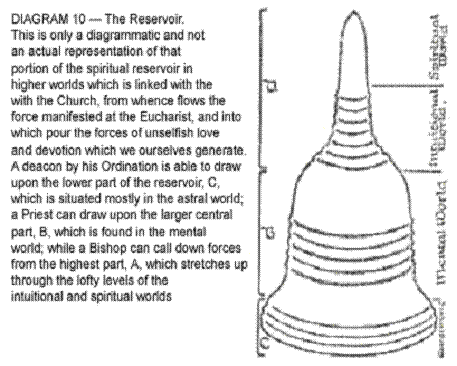
This reserved portion of the reservoir is not easy to
describe. It extends through several planes or states of matter, and if we try
to represent it by a form confined to our three dimensions, the nearest we can
come to an expression of it is a vast bell-shaped object not unlike a Buddhist
dagoba. (Diagram 10.) It is divided into three parts, which we have labeled A,
B and C. The ordination of a deacon puts him in touch with the rim of the bell,
marked C, and enables him to draw strength from it—strength, primarily, for his
own progress and for his preparation for the reception of that which is to
come; yet he may also to some extent pass it on to others by an effort of his
will, and so he can help people both astrally and mentally.
But it is at the next stage, that of the priesthood, that
the real power begins. The Priest draws from the part marked B, the main body
of the form; by his ordination the ego (or soul) has been more definitely
awakened, and thus he can act directly upon other souls at the level of the
causal body. It is this relation which gives him the power to straighten out
the distortion caused by deviation from the path of right, and so it is said
that he can remit sin. In him also is vested the power to bless, and to offer
the sacrifice of the Holy Eucharist. The strength which the Priest brings down
is not for himself, but for the flock which is committed to his care.
The spire of the dagoba, the handle of the bell-form
(marked A ) reaches up into the intuitional and spiritual planes; and it is
upon this that the episcopate can draw. The Bishop is intended to be a
veritable manifestation of the Christ principle, capable of radiating that upon
all with whom he comes into contact. The power for good which lies within his
reach is not easily to be exaggerated.
so there are two aspects of ordination—the gift of the
Holy Ghost, which provides the key to the reservoir, and the personal link of
the Christ Himself with His minister. The former of these is the official
connection which enable a Priest, for example, to consecrate the Host and to
dispense absolution and blessing. This is the irreducible minimum of power,
which is equally possessed by all properly ordained Priests, and is quite
independent of their acquirements in other directions—their spiritual or
devotional development, for example, or their comprehension of the mechanism of
the Sacraments which they administer—just as a man may be a rapid and accurate
telegraphist, even though he does no know what electricity is, and though his
moral character is not above reproach.
Many people think this strange, because they have not
grasped the nature of the Priest's relation to the Sacrament. If the Host were
a talisman into which he had to put his personal magnetism, obviously the
nature of that magnetism would be all-important. There is, however, here no
question of magnetization, but of the due performance of a certain ceremony, in
which the character of the performer has nothing to do with the matter. If the
faithful had to institute an exhaustive enquiry into the private character of a
Priest before they could feel certain of the validity of the Sacraments
received from his hands, an element of intolerable uncertainty would be
introduced, which would practically render inutile this wondrously-conceived
device of the Christ for the the helping of His people. He has not planned His
gracious gift so ineptly as that. To compare great things to small, to attend a
celebration of the Holy Eucharist is like going to a bank to draw out a sum of
money in gold; the tellers' hands may be clean or dirty, and assuredly
cleanliness is preferable to dirt; but we obtain the gold all the same in
either case. It is obviously better from all points of view that the Priest
should be a man of noble character and deep devotion, and should thoroughly understand,
so far as mortal man may, the stupendous mystery which he administers; but
whether all this be so or not, the key which unlocks a certain door has been
placed in his hands, and it is the opening of the door which chiefly concerns
us.
I cannot do better than repeat here some part of what I
wrote in The Hidden Side of Things on this subject, when I first investigated
it:
“First, only those Priests who have been lawfully
ordained, and have the apostolic succession, can produce this effect at all.
Other men, not being part of this definite organization, cannot perform this
feat, no matter how devoted or good or saintly they may be. Secondly, neither
the character of the Priest, nor his knowledge or ignorance as to what he is
really doing, affects the result in any way whatever.
“If one thinks of it, neither of these statements ought to
seem to us in any way astonishing, since it is obviously a question of being
able to perform a certain action, and only those who have passed through a
certain ceremony have received the gift of the ability to perform it. Just in
the same way, in order to be able to speak to a certain set of people one must
know their language, and a man who does not know that language cannot
communicate with them, no matter how good and earnest and devoted he may be.
Also his ability to communicate with them is not affected by his private
character, but only by the one fact that he has, or has not, the power to speak
to them which is conferred by knowledge of their language. I do not for a
moment say that these other considerations are without their due effect; I
shall come to that later, but what I do say is that no one can draw upon this
particular reservoir unless he has received the power to do so which comes from
a due appointment given according to the direction left by the Christ.
“I think that we can see a very good reason why precisely
this arrangement has been made. Some plan was needed which should put a
splendid outpouring of force within the reach of every one simultaneously in thousands
of churches all over the world. Perhaps it might be possible for a man of most
exceptional power and holiness to call down through the strength of his
devotion an amount of higher force commensurate with that obtained through the
rites which I have described. But men of such exceptional power are always
excessively rare, and it could never at any time in the world's history have
been possible to find enough of them simultaneously to fill even one thousandth
part of the places where they are needed. But here is a plan whose arrangement
is to a certain extent mechanical; it is ordained that a certain act when duly
performed shall be the recognized method of bringing down the force; and this
can be done with comparatively little training by anyone upon whom the power is
conferred. A strong man is needed to pump up water, but any child can turn on a
tap. It needs a strong man to make a door and to hang it in its place, but when
it is once on its hinges any child can open it.
“Being myself a Priest ordained in the Church of England,
and knowing how keen are the disputes as to whether that Church really has the
apostolic succession or not, I was naturally interested in discovering whether
its Priests possessed this power. I was much pleased to find that they did; but
I also soon found by examination that ministers of what are commonly called dissenting
sects did not possess this power, no matter how good and earnest they might be.
Their goodness and earnestness produced plenty of other effects which I shall
presently describe, but their effects did not draw upon the particular
reservoir to which I have referred.
“I was especially interested in the case of one such
minister whom I knew personally to be a good and devout man, and also a
well-read student of the inner things. Here was a man who knew much more about
the real meaning of the act of consecration than nine hundred and ninety-nine
out of a thousand of the Priests who constantly perform it; and yet I am bound
to admit that his best effort did not produce this particular effect, while the
others as unquestionably did. (Once more, of course, he produced other things
which they did not—of which more anon.) If we think of it, we must see that it
could not have been otherwise. suppose, for example, that a certain sum of
money is left by a rich Freemason for distribution among his poorer brethren,
the law would never sanction the division of that money among any others than
the Freemasons for whom it was intended; and the fact that other poor people
outside the Masonic body might be more devout or more deserving would not weigh
with it in the slightest degree.
“Another point which interested me greatly was the
endeavour to discover to what extent, of at all, the intention of the Priest
affected the result produced. In the Roman Church I found many Priests who went
through the ceremony somewhat mechanically, and as a matter of daily duty,
without any decided thought on the subject; but whether from ingrained
reverence or from long habit they always seemed to recover themselves just
before the moment of consecration and to perform that act with a definite intention.
“I turned then to what is called the Low Church divisions
of the Anglican community to see what would happen with them because I knew
that many of them would reject altogether the name of Priest, and though they
might follow the rubric in performing the act of consecration, their intention
in doing it would be exactly the same as that of ministers of various
denominations outside the Chruch. Yet I found that the Low Churchman could and
did produce the effect, and that the others outside did not. Hence I infer that
the “intention” which is always said to be required must be no more than the
intention to do whatever the Church means, without reference to the private opinion
of the particular Priest as to what that meaning is. Indeed, there was once a
Bishop so blatant in his ignorance as explicitly to state to his unfortunate
candidates for ordination that he did not ordain them as sacrificing Priests,
but only as gospel ministers. Yet even in a case so extreme as this, his
ill-directed will was unable to render nugatory what his Church intended him to
do. Verily it is true that all Sacraments are received from the hands of Christ
Himself, no matter how weak and ignorant may be the instruments through whom
they come. I have no doubt that many people will think that all this ought to
be quite differently arranged, but I can only report faithfully what my investigations
have shown me to be the fact.
“I must not for a moment be understood as saying that the
devotion and earnestness, the knowledge and the good character of the officiant
make no difference. They make a great difference; but they do not affect the
power to draw from that particular reservoir. When the Priest is earnest and
devoted, his whole feeling radiates out upon his people and calls forth similar
feelings in such of them as are capable of expressing them. Also his devotion
calls down its inevitable response, and the down-pouring of force thus evoked
benefits his congregation as well as himself; so that a Priest who throws his
heart and soul into the work which he does may be said to bring a double blessing
upon his people, though the second class of influence can scarcely be
considered as being of the same order of magnitude as the first. This second
outpouring, which is drawing down by devotion itself, is of course to be found
just as often outside the Church as within in it.
The additional power of helpfulness which the Priest may
develop depends largely upon his cultivation of the second gift which he
receives at ordination—the personal link established between himself and his
Lord and Master. This also was explained by the Christ to His apostles; He
tells them that He has prayed to his Father that they may be one with Him in
the same way that He is one with His Father. People think of such sayings quite
vaguely, and do not realize that they refer to definite scientific facts. Again
He says with absolute clearness: “Lo, I am with you always, even unto the end
of the age.”
If we examine the inner side of the ceremony of
ordination, we shall see that there is a special sense in which this promise is
kept. It is not merely that there is the Christ principle in the Priest, as
there is in every man; so great is the wonderful love, and condescension of the
great World-Teacher that by the act of ordination He draws His Priest into a
close personal union with Him, creating a definite link through which the
divine force can flow, making them channels for Him in imitation, at an almost
infinitely lower level, of the mysterious and wonderful way in which He is a
channel for the Second Aspect, the Second Person of the Ever-blessed Trinity.
Of course there are many Priests who are entirely unconscious of this; unfortunately
there are also many who so live as to make but little use of the splendid
possibility which this channel opens for them. Nevertheless this statement is
entirely true; and therefore to describe Him as still present with His Church,
is still definitely guiding those who lay themselves open to His influence, is
no mere figure of speech, but the expression of a sublime reality.
A diagram cannot express this great spiritual truth, but
it may help us to understand a little of the method of its working. Anything
which does that has its value, because the fact becomes more real to us when we
are thus enabled to see a little more of it. Those who have not yet opened
within themselves the power of clairvoyant sight cannot actually see
these processes taking place, as some of us can; but they can form their own
opinion as to the reasonableness of what is reported by those of us who do see,
and they can also obtain a good deal of corroborative evidence on various
points—sometimes from their own feelings, sometimes from those of others. For
those who know me I offer my assurance that all which is here recorded is the
result of oft-repeated observation and experiment, so that I have no doubt of
its accuracy as far as it goes.
I have remarked in an earlier chapter that God made man in
His own image, and that consequently the soul in man shows a threefold
manifestation corresponding at his level to the threefold manifestation of the
Deity; and also that in this case the lower is not a mere reflection or symbol
of the higher, but actually in some way an expression of it.
The true man, the Monad (marked 1 in Diagram 11), is a
spark of the divine life existing on a plane to which, because of that, we give
the name of monadic. That plane is at present beyond the reach of our
clairvoyant investigation, and the highest which any of us actually know of man
from direct observation is the manifestation of that Monad as the Triple Spirit
a stage lower. Each of the three aspects or division of this spirit has its own
qualities and characteristics. The first stays at ist own level, while the
second descends (or more correctly, moves outwards) to the intuitional plane;
the third moves down (or out) through two stages, and shows itself in the
higher part of the mental world as intelligence. It is these three
manifestations (numbered 2, 5 and 7 in the diagram) taken together which
constitute the soul or ego in man; it inhabits the causal body, and in that
body is often called the augoeides. It passes from life to life unchanged, except
for such development as may accrue to it from the good deeds of each
incarnation. Behind the principles marked 5 and 7 (the intuition and the
intelligence) there remain three others, in us still latent and undeveloped,
which are marked 3, 4 and 6 (fig. 1, Diagram 11). It must of course be understood
that 2, 5 and 7, though not actually latent like the others, are very far as
yet from the full development which they will attain in the perfected spirit.
(Fig. 10, Diagram 11.)
Christ
our Lord is Perfect Man, as we are told in the Anthanasian Creed. In Him also
therefore these principles exist in exactly the same order, but in His case all
are fully developed and mystically one with the Second Person of the
Ever-blessed Trinity. The second of the gifts conferred by ordination is the
linking of certain of these principles in the ordinand with the corresponding
principles of his Lord and Master, so that a definite channel is made down
which spiritual strength and wisdom will flow, up to the fullest limit of the
ordinand's receptivity.
This opening of a channel is so great a departure form
ordinary life that it can be done only by stages, and the first step towards it
is practically a psychic surgical operation. This is performed in the ordination
to the diaconate, while the subdiaconate (Fig. 2, Diagram 11) is a time of
preparation intended to bring the patient into a condition favourable to the
success of the operation. The giving of the Holy Ghost described above, which
confers priestly power, is full, definite, final for each of its stages, and
the same in all cases; but this operation of linking the man to the Christ,
while it can never fail, may yet succeed more fully in one case than in another,
because of the subject's greater or less advancement along the path of
evolution, which governs the degree of his sensitiveness to the divine
influence. Also this sensitivity is cultivable; it can be very greatly increased
after ordination by earnest aspiration and devotion, and the determined effort
of the Priest to bring his human nature into harmony with the divine Nature—to
live the life of the Christ.
In the ordination of a deacon, (Fig. 3, Diagram 11) the
first drill is driven through the rock, and a definite link is made, the
intelligence (marked 7 in the diagram) being joined to the corresponding principle
in the Christ, so that the latter can influence the former, and stir it into
beneficent activity. It does not at all follow that it will so affect
it; that depends upon the deacon; but at least the way is laid open, the
communication is established, and it is for him to make of it what he can. It
is for him to acquire as much knowledge as he can of these inner things of the
soul, and to strive earnestly to develop both the higher and the lower mind
within himself, that in both he may reflect and express the thought of his
Lord. “Let the same mind be in you which is also in Christ Jesus.” He must
endeavour to adapt himself to his new condition, to take full advantage of the
opportunity which is offered to him. So will he be ready in due course to
receive the higher benediction of the priestly Order.
DIAGRAM 11—The Awakening of the Human Principles at
Ordination. In the diagram 1 represents the Monad; 2, 3 and 4 the Triple
Spirit manifested in the spiritual world; 5 and 6 the dual Intuitional nature
in the intuition world; 7 the Intelligence in the causal or soul body; 8, the
link between the individual and the personality; while 9 represents the mind in
the mental body.
Fig. 1. In an intelligent and cultured layman the
causal body is only partially awakened. There may also be slight awakening of
the Intuition, 5, and even of the Spirit, 2. The link, 8, between the
individuality and the personality is slight.
Fig. 2. At the ordination of the subdeaconate the
connection, 8, is widened to prepare it for the sudden expansion which takes
place at the next ordination.
Fig. 3 At the ordination to the deaconate the
connection is widened to become a channel, and the Intelligence, 7, is linked
with the corresponding principle of the Christ. Principle 5 may also in some
case be awakened and made to low slightly, thereby establishing a slight line
of connection between it and 7.
Fig. 4. At the first imposition of hands in the
ordination of the priesthood principle 2 and 5 are made to glow, a line
between 2 and 5 is established, while that already existing between 5 and 7 is
intensified. The glow is usually slight in 2 but more marked in 5. The channel
8 is widened.
Fig. 5. At the second imposition of hands principle
5 in the new Priest is linked with that of the Christ, while the link previously
made with 7 is strengthened. The oblique line between 2, 5 and 7 is intensified
and 7 is opened still more to permit the flow of more force coming from the
oblique line.
Fig. 6. The development of an ideal Priest is
possible to a man of great determination who for years works at strengthening
the connection between his own principles and those of the Christ. He can
intensify the link made with 6 and 7, and can arouse to vigorous action
principles 2 and 5, thereby making himself a channel of extraordinary power.
Fig. 7. At the consecration of a Bishop, when the
actual words of consecration are said, principles 4 and 5 are linked with the
Christ, and the links already made with 6 and 7 greatly increased
Fig. 8. When the head of the Bishop is anointed with
chrism, his principles 2 and 3 glow out most wonderfully. The three lines
connecting principles 4, 6 and 7 indicate that a Bishop can draw down into the
causal body, and thus ray forth in blessing, the threefold power of the Triple
Spirit.
Fig. 9. The development of an ideal Bishop is
possible to one who takes advantage of every opportunity. All of his principles
become responsive channels to the power and love of the Christ, and he becomes
a veritable sun of spiritual energy and blessing.
Fig. 10. The perfect man is not only linked up with
the Christ with his own Highest Self, the Monad, but becomes ever more and more
an epiphany of the Logos, the Deity, who brought forth the solar system. He
becomes the Master, for whom incarnation is no longer necessary.
The responsibility of the Priest is far greater, because
so much more power is in his hands. For him the connection is pushed a stage
higher, and the hitherto latent principle which we have numbered 6 is called
into activity, and linked with that of the Christ. (Fig. 5, Diagram 11.) This
also involves a widening of the tube from 7 which was previously opened, so
that it can transmit a far greater volume of power. Furthermore, another type
of connection comes into play, which is to the former as Marconi's discovery is
to the ordinary form of telegraphy. To clairvoyant vision a clearly
distinguishable line of fire links principles 6 and 7 in a Priest to his
Master; but in addition to this, the spirit and intuition in him (marked 2 and
5 in Fig. 4, Diagram 11) are made to glow by sympathetic vibration in harmony
with the blinding light of the corresponding principles in his Lord.
This effect is usually but slight in the case of the
spirit, but is very marked in the intuition. Anyone in whom the faculty of
clairvoyance is developed will at once understand the difference between these
two methods of connection, but for a man who has not yet unfolded that inner
sense it is probably impossible to indicate it except by the clumsy symbolism
which I have just adopted. The result is that by this second aspect of
ordination the Priest is united with his Master, and becomes “His man,” in a
very real sense an outpost of His consciousness, a channel for His grace, an
almoner to distribute His force to the people—in English country speech, the
parson, which means of course nothing more than the person who
represents Christ in a certain parish.
If we remember the derivation of the word person from the
Latin per (through) and sona (a sound), and further bear in mind
that persona was used to designate the mask which a Roman actor wore,
through which came the sound of his voice, we shall begin to realize what the
old word parson was intended to convey. Obviously it is the parson's part to
vivify this sacred inner connection, and become more and more a personal
manifestation of his Lord. All the more sad is it to have to recognize that
thousands of Priests use only the mechanical link with the reservoir which
enables them to do their official duty, and remain ignorant of this direct
individual connection with the Christ whose ministers they are. Happily there
are also many Priests who, without knowing anything about the science of it
all, are nevertheless really beautiful and Christ-like in their lives, so that
His power flows through them mightily and sweetly for the healing of His
people.
The consecration of a Bishop represents the highest
possibility of attainment along this line of Holy Orders. In his case two more
very important links are added to those possessed by the Priest. In the first
place, the line of the intelligence, first opened at the diaconate, and pressed
a stage further up in the priesthood, is now immensely widened and pushed up to
the furthest limit at present within our reach, the third aspect of the Triple
Spirit, marked 4 in Diagram 11, Fig. 7.
Secondly, a direct connection is opened between the
intuition (which we have marked 5) and the corresponding principle in our dear
Lord. It is this function which gives the power to pass on the Orders,
and it means also the potentiality of awakening the Christ principle to the
second stage (3). In the Bishop, then, we find the direct connection operative
for 4, 5, 6 and 7, and a strong sympathetic glow in 2 and 3. We see at once how
closely affiliated is the Bishop to the Lord for whom he acts as legate, and
what a tremendous power for good is put into his hands.
We shall now examine and comment upon the Services for the
various stages of these major Orders.
The Subdiaconate
This is so essentially merely a preparation for what is to
follow it that it has many of the characteristics of the minor Orders, and
indeed it seems to have been counted among them until the middle of the Twelfth
century. The earliest historical mention of the order is in a letter from Pope
Cornelius to Fabius of Antioch in the year A.D. 255. St. Cyprian, writing in
the same century, also refers to it, as does the synod of Elvira in Spain fifty
years later. The Greek Church stills regards it as a minor Order, and the
Church of England ignores it altogether. There is no reference to it in the New
Testament, and it is not claimed that it was instituted by the Christ during
His earth-life, or even by His immediate apostles. From the inner point of view
it confers no power, but it does assist in preparing the way for what we have
called the surgical operation of the diaconate.
In the Service of the Roman Church for the admission to
this Order there is no imposition of hands, but there is in the Greek Service.
In this respect we have followed the example of the latter, for our ritual
directs the Bishop to lay his right hand upon the head of the ordinand, and
admit him solemnly in the Name of Christ our Lord, just as was done in the case
of the minor Orders. The Roman Church regards this Order as binding its
recipient to celibacy and to daily recitation of the divine Office. The general
purpose of the rite is clearly to enable the ego to express himself more freely
through the personality. I will proceed, as before, to quote the Bishop's
charge.
Dearly beloved sons, this Order of Subdeacon is a grade
of probation of the greater Orders of Deacon and Priest. It gives to those who
receive it greater strength and steadfastness of purpose, to the end that with
singleness of heart they may dedicate their lives to Christ in His holy Church.
So great, indeed, is the responsibility laid upon those who in these greater
Orders become Christ's representatives, that a season of trial in this
preparatory grade of the subdiaconate is oft-times appointed, wherein they who
aspire to so sublime an estate may test themselves if need be, more especially
if they be young in body or in experience of matters ecclesiastical, that they
enter not lightly or unadvisedly upon so solemn an undertaking.
You, well-beloved sons, having already offered
yourselves to the service of God and to help forward His kingdom upon earth,
are now moved in your hearts to devote yourselves still further to His service
and to that of your brethren. On this purpose we invoke the divine blessing;
and, with the help and ready concurrence of the faithful here assembled, shall
now proceed in the exercise of our office to bring you as a holy oblation into
the Presence of Christ, not doubting that at the latter end you, having the
witness of faithful service, will shine, pure and lustrous, as jewels in the
crown of our Master.
In the Roman rite there follows here a wearisome and
inappropriate litany, full of slavish appeals for mercy and deliverance. For
this we have substituted a metrical litany of the Holy Spirit, which may be
supposed to take, in this preparatory Service, the place occupied in the
greater ordinations by the Veni Creator. The importance of these
litanies, whether Roman or Liberal, centres in three petitions offered by the
Bishop, in the course of which he makes a special effort, by the use of the
sign of power, to purify the physical, astral and mental bodies of the candidates.
One cross is made for the physical body, two for the astral and three for the
mental. These three verses of the litany are sung by the Bishop alone; and for
the more effective achievement of his task he rises from his knees, assumes his
mitre and holds his crosier, so that, thus fully panoplied, he may be a more
perfect channel for the divine force. The verses are:
|
We beseech Thee, hear our
prayer:
Bless X
Thy servants, prostrate there;
Hold them in Thy loving care;
Hear us, Holy Trinity.
|
|
Hear Thy servants as they
pray,
Help Thy chosen ones to-day,
Bless X
and X hallow them for aye;
Hear us, Holy Trinity.
|
|
Pour Thy living kindness
great
On each chosen candidate,
Bless X
them, X hallow, X consecrate;
Hear us, Holy Trinity .
|
The closing verse of the litany is
then sung by all, and the Bishop resumes his charge as follows:
Dearly beloved sons, who are about to be admitted to
the Office of subdeacon, you should know what manner of ministry was in former
times committed unto your Order. It appertained to the subdeacon to provide
water for the service of the Altar, to minister to the deacon, to wash the
Altar cloths and corporals, to present to the deacon the chalice and paten to
be used at the sacrifice, to guard the church doors or the gates of the
sanctuary, and in later times to read the Epistles before the people.
Endeavour, then by fulfilling readily with neatness and diligence such of these
visible ministries as are still part of your office, to show true reverence for
the invisible things they may be said to typify. For the Altar of holy Church
is the throne of Christ Himself, and it is indeed fitting that they who
minister before it should walk circumspectly, and realize that upon them is
laid the high honour of its guardianship. Do you therefore take heed that you
be watchful sentinels of the heavenly warfare, so that, growing ever in virtue
you may shine, lustrous and chaste, in the company of the saints. Strive
earnestly to pattern yourselves after the ensample of our divine Master, that
you may meetly minister at the divine sacrifice, as well in the invisible
sanctuary of your hearts as in the visible sanctuary of holy Church.
From ancient times, also, it has been required of those
who enter this Order that they strive to acquire certain virtues of character,
such as are typified by the vestments delivered unto them. By the amice,
control of speech; by the maniple, the love of service or diligence in all good
works; by the tunicle, the spirit of joy and gladness, or freedom from care and
depression, that is to say, confidence in the Good Law, which may be interpreted
as a recognition of the Plan revealed by Almighty God for the perfecting of His
creation.
The Bishop then asks from the ordinands a solemn promise
that they will, as far as in them lies, order their lives in accordance with
the precepts which he has laid down; and upon their assent, he extends his
hands towards them and prays that their hearts and minds may be so opened to
receive that which he is about to give them that they may be steadfast in
Christ's service, and may so grow in knowledge that they may offer their lives
as a holy and continual sacrifice unto Him. Herewith he makes over them the
sign of the cross; and immediately thereafter each candidate kneels before him
and is formally admitted to the Order of Subdeacon, just as in the minor Orders.
The effect of the subdiaconate must be considered in
reference to what is to follow at the next step. At the ordination of a deacon
a serious operation is to be performed, and it is felt that this will be more
successful if a certain preparation has been undertaken. The Bishop attempts
gently to widen the connection. (Fig. 2, Diagram 11) between the soul and the
body, so that the former may be able more fully to work upon and through the
latter.
The Bishop then proceeds to give to each neophyte what may
not inappropriately be called the working tools of his degree, and to invest
him with its especial badges. First he hands him an empty chalice and paten,
admonishing him so to demean himself in his ministry as to be commendable in
the sight of God. Then in the Name of the Holy Trinity, and with the triple
sign of power he endures him with the amice, the maniple and the tunicle, in
each case again referring to the virtues which these vestments are respectively
supposed to signify. He then hands to each the book of Epistles, giving him
authority to read them in God's holy Church both for the living and the dead;
and he closes the ordination by a solemn blessing, giving especially to the end
that the neophytes may preserve with steadfastness and zeal in the life which
they have undertaken.
The degree of subdeacon can be conferred only during the
celebration of the Holy Eucharist, and immediately after the recitation of the
Collects; and after the ordination one of the newly-made subdeacons is
appointed to read the Epistle of the day.
The Diaconate
The ordination of deacons takes place after the Epistle,
and before the Gradual is sung. The Service begins with the presentation of the
candidates by a Priest, who brings them before the Bishop and says:
Right Reverend Father, our holy Mother the Church
catholic prays that you would ordain these subdeacons here present to the
charge of the diaconate.
The Bishop asks whether he knows them to be worthy of this
advancement, and he replies:
As far as human frailty allows me to judge, I do both
know and attest that they are worthy of the charge of this office.
The Bishop then addresses the congregation as follows:
Dearly beloved brethren, these subdeacons here before
you are presented for the Order of the Diaconate, to be irrevocably set apart
for the service of the Christ by the gift of God's most holy Spirit. Mindful of
the sacred trust reposed in us, we have sought to ensure that only such as may
be profitable to Christ's holy Church be thus presented; yet for further
precaution it is seemly that we should enquire if any know cause or just
impediment why these persons should not be admitted to the exercise of the
deacon's office. If, then, any of you know aught against them, in the Name of
God and for the benefit of His Church, let him boldly come forward and speak;
howbeit, let him be mindful of his own estate.
This last clause is intended to warn any possible objector
of the danger of libel, and the necessity of being sure of his ground before
venturing upon any adverse criticism. If no one speaks, the Bishop proceeds
with the following short exhortation:
Dearly beloved sons, who are now about to be raised to
the Order of Deacon, do you endeavour to receive it worthily, and blamelessly
to fulfil its duties when you have received it. It appertains to the deacon to
minister at the Altar, to read or intone the Gospel, to preach, and in the
absence of the Priest to baptize. Wherefore, dearly beloved sons, as now you
are charged to minister to the flock of Christ, be you raised above all
unworthy propensities which war against the soul; be seemly, courteous in
demeanour, and full of noble desires and of love for God and man, as befits the
ministers of Christ and stewards charged to dispense the mysteries of God. And
as you now have a share in offering and dispensing the Body and Blood of the
Lord, as Holy Writ has it: “Be ye clean, ye that bear the vessels of the Lord.”
Be it your care to set forth to others, by living deeds, the gospel your lips
will proclaim to them, that of you it may be said: “How beautiful upon the
mountains are the feet of him that bringeth good tidings, that publisheth
peace.”
He receives their promise that they will strive to use
worthily the power which he is about to entrust to them. and they then lie
prostrate before the Altar while the metrical litany is sung—not this time that
of the Holy Ghost, but a special appeal to the Lord Christ, recognizing His
Presence, announcing that the Bishop is about to use the power conferred upon
him by the same Lord at his consecration, and asking that his hands may be
strengthened for this great work.
The Bishop then recites a prayer in the course of which he
twice makes the sign of the cross over the ordinands. The first time he does
this with the intent of holding strongly the three vehicles which have been
cleansed in the litany, and working up through them to the link which connects
the personality with the soul—the link which the Indian philosophers call the antahkarana.
The object here, as in the subdiaconate, is to widen that connection, and so
give the soul more influence over his bodies.
If the Bishop has the good fortune to be clairvoyant, and
so can see the pituitary body, and watch the action of the force which he is
sending out, so much the better, for he can then direct it more scientifically.
Having thus opened more fully the way up to the causal body, he aims his second
cross at that body itself, with the object of carrying the same process a
little further, so that the candidate may be able to receive more of the power
of the Holy Ghost. Having thus prepared the way as far as may be, the traditional
call to God the Holy Ghost is sent out—-the Veni Creator; and
immediately thereafter the Bishop (wearing his mitre, and holding his crosier
in his left hand) lays his right hand on the head of the ordinand and says:
Receive the Holy Ghost for the office and work of a
deacon in the Church of God.
At these words comes the downrush of the power; yet that
term gives but an imperfect picture, for in reality that power flashes downward
and upward many times with inconceivable rapidity, just as lightning does. The
amount that a man can receive depends upon the preparation which he has made,
the extent to which he has opened himself to the divine influence. The crust is
now broken through, the link with his Lord and Master is made, as far as
principle 7 is concerned (Fig. 3, Diagram 11); the channel has been widened,
and it is for him to hold it in that improved condition by keeping the divine
grace constantly flowing through it for the helping of his fellow-men.
This idea is put prominently before the newly-ordained
deacon when the Bishop invests him with a white stole, saying:
Take thou the white stole for a symbol of thine office;
remembering that as for the service and love of man thou dost exercise the
power which now is in thee, so will it flow through thee in ever greater
fullness and glory.
As he says this, he makes the sign of the cross over the
heart of the deacon, so that an awakening or strengthening of the intuitional
principle (5) which may have taken place at the moment of ordination shall be
conserved and increased. The stole, which is always supposed to symbolize the
yoke of Christ, denotes the deacon's office only because of the sash-like way
in which he wears it over the left shoulder, and fastened under the right arm.
The Priest wears it over both shoulders, to show that he has fully assumed the
yoke and the responsibility, only a small part of which rests upon the deacon.
The Bishop then in the Name of the Holy Trinity, and with
the triple cross, invests each new deacon with a dalmatic, saying:
The Lord clothe thee with the vesture of gladness, and
ever encompass thee with the dalmatic of justice.
In the same holy Name, and with the same triple sign of
power, he gives him authority to read the Gospel in the Church of God, both for
the living and the dead. In each of these cases the threefold influence of
which the Bishop is so especially the custodian is energized, poured forth,
called strongly into manifestation, so that by playing upon the corresponding
principles in the ordinand it stirs them into sympathetic vibration, so that
they are, at any rate for the time, enormously more active and receptive than
ever before. It is for the deacon to see that this great temporary advance is
maintained and increased.
The service concludes with a beautiful prayer referring to
the close association with the angelic hosts which those enjoy whose happy work
it is to minister within the sanctuary.
O Christ, the Lord of Love, who, by the heavenly and
earthly service of Angels which Thou orderest, dost shed over all the elements
the efficacy of Thy will, pour out on thee Thy servants of the fullness of Thy X blessing, that in the fellowship of
these glorious Angels they may minister worthily at Thy holy Altars, and being
endowed with heavenly virtue and grace they may ever be watchful and zealous in
the service of Thy Church, thou Who reignest for ever and ever. R. Amen.
The final cross made during this prayer produces a general
intensification of all that has been done. Its especial purpose is to thicken
the walls of the much-expanded link between the soul and the personality, to
harden them and hold them more firmly in their new form. It is as though a sort
of frame-work were erected within, a lining to prevent the widened channel from
contracting. It will be readily understood that it is distinctly advantageous
to have a considerable interval between the ordination to the diaconate and
that to the priesthood, so that this link in its widened form may be
consolidated. The first opening of this channel, which we have likened to a
surgical operation, is so great a change, so radical a departure from all that
has gone before, that the man needs time to adjust himself to the new
conditions before any further strain is put upon him. Therefore the Church
prescribes that when possible the neophyte should remain for a year in deacon's
orders before being advanced to the priesthood.
It is again obvious how incalculable is the advantage
possessed by those among the clergy who know what they are doing in these
matters, and even still more by those who can see the effect of their
operations. the vast majority of Bishops are working blindly, yet no one need
doubt that their end is achieved; but unquestionably it would be far more fully
achieved if they had greater knowledge of the spiritual world, and of the
operation of its forces.
One of the newly-ordained deacons reads the Gospel, and
the Holy Eucharist is then continued as usual, except the special mention is
made in the prayer of consecration of those who in Christ's holy Name have just
been admitted to the Order of the Diaconate. Such a clause is inserted in all
the major ordinations, but not in the minors; indeed, these latter may be
conferred apart from the celebration of the Eucharist, though it must be before
the hour of noon.
The Priesthood
The ordination to the priesthood is solemnized after the
singing of the Gradual, and begins with the presentation of the candidates by a
Priest, just as in the previous Service. The Bishop then delivers the charge:
Dearly beloved brethren, as both the captain of a ship
and the passengers it carries have equal cause for security or for fear, it
behoves them whose interests are common to be of one mind. Nor has it without
purpose that the Fathers decreed that the people also should be consulted
touching the election of those who are to be employed in the service of the
Altar, for what is unknown of the many concerning the life and conversion of
those who are presented, may oft-times be known to a few, and all will
necessarily yield a more ready obedience, to one when ordained, to whose ordination
they have signified their assent.
If, then, anyone has aught to the prejudice of these
men, in the Name of God and for the benefit of His Church, let them boldly come
forward and speak; howbeit, let him be mindful of his own estate.
After a pause, the Bishop, addressing himself to the
ordinands, charges them as follows:
Dearly beloved sons, it is now our part solemnly and
for the last time, before the irrevocable act shall be accomplished, which shall
lay upon you the sweet but heavy burden of the priesthood, to charge you how
great is the dignity and responsibility of this office and how weighty are the
duties to be performed by those ordained thereto. It appertains to the Priest
to offer sacrifice, to bless, to preside, to loose and to bind, to anoint, to
preach and to baptize.
Wherefore, dearly beloved sons, whom the award of our
brethren has chosen that you may be consecrated to this office as our helpers,
after solemn premeditation only and with great awe is so sublime an office to
be approached, and great indeed must be the care with which we determine that
they who are chosen to represent our Blessed Lord and to preside in His Church
commend themselves by great wisdom, by worthiness of life and the persevering
practice of justice and truth. Do you, then, dearly beloved sons, keep these
things in remembrance and let the fruit thereof be seen in your walk and
conversation, in chaste and holy integrity of life, in continually abounding in
all manner of good works. Strive without ceasing to increase within yourselves
the perfection of heavenly love, that having your hearts filled with the love
of God and of man, you may be almoners of Christ's blessing and bearers of His
Love to the hearts of mankind. Forget never how great a privilege is yours to
bring the little ones to Him through the gateway of baptism and to lift the
heavy burden of the sorrow and sin of the world by the grace of absolution.
Consider attentively what you do, imitate those things which in the Church
of God it is your duty to handle and to transact. And forasmuch
as you will now be called upon to offer the Holy Sacrifice before the throne of
God, and to celebrate the sacred Mysteries of the Lord's love, be earnest in
ridding your members of all imperfections. Ye whose duty it is to offer unto
God the sweet incense of prayer and adoration, let your teaching be a spiritual
remedy unto God's people; let your words of blessing and consolation be their
help and strength; let the sweet savour of your life be a fragrance in the
Church of God.
Thus both by word and deed may you fashion the temple
of God, so that neither shall we appear blameworthy before the Lord, who in His
Name shall thus advance you, nor ye who shall thus be advanced; but rather may
we all find acceptance and abundant recompense for this day's act, which of His
infinite goodness and loving-kindness may He deign to grant.
The customary promise to strive to use the power worthily
is then asked and given, and the special ordination litany sung, as at the
previous Service, the candidates lying prostrate before the Altar. The prayer
which follows begins with the same words as that used for the diaconate, but
differs in its later petitions.
O Lord Christ, the Fountain of all goodness, Who by the
operation of the Holy Spirit hast appointed divers Orders in Thy Church, and
for its greater enrichment and perfecting dost pour down Thy gifts abundantly
upon men, do Thou pour forth Thy sanctifying grace upon these Thy servants, who
are about to be numbered among the Priests of Thy Church. May their hand be
strong to achieve, may wisdom guide and direct their life, may the beauty of
holiness sanctify them and shed a spiritual fragrance about their path, so that
in all their works begin, continued and ended in Thee, they may show forth the
abundance of Thy power and glorify Thy Holy Name, O Thou great King of Love, to
Whom be praise and adoration from men and from the Angel host. R. Amen.
Immediately after this prayer the Bishop amid perfect
silence lays both hands on the head of each ordinand. The same is done after
him successively by all the Priests present, each willing intensely to give all
that he can of help and consecration to the candidate. The Bishop uses his
power to pour into him the power of the Christ and to draw him into the closest
possible relation to Him. Referring back to Diagram 11, Fig. 4, the three
principles of spirit, intuition and intelligence (numbered 2, 5 and 7) in the
ordinand are made to glow with indescribable fervour. The oblique line
connecting them is opened up into activity, and greatly widened, so that not
only does the spirit become much more one with the Christ-spirit, but he is
also able to express himself far more fully than before through the intuition and
intelligence.
It does not at all follow that he will do so in
daily life; that depends upon the individual effort of the Priest; but the potentiality
is there, and he who knows of it may use it to great effect if he will. The
whole aura of the ordinand expands prodigiously with this direct influx of
power from the Christ; every atom within him is shaken as its various orders of
spirillÊ1 are aroused. The influx rushes into 2, 5 and 7 through the
corresponding principles of the Bishop himself, which is the reason why he lays
both hands upon the head of the candidate, instead of using only the right hand
to distribute what is drawn though the crosier in his left, as he does in the
case of the deacon, or at Confirmation.
When the neophyte's aura is thus dilated and extremely
sensitive, the Priests pour in their influence. They do not confer power as the
Bishop does, but each gives his quota of good; and adds whatever he has that is
of value, while the neophyte is in a condition to receive it. The Priests may
quite probably be on different Rays, and at any rate are sure to differ in
character, so each will have some quality to contribute. The bestowal of the
priesthood is above all things the granting of a wonderful, colossal opportunity,
and no effort is spared to help the recipient to take advantage of it.
The power of the Christ, the direct outflow from the
Second Person of the Holy Trinity, comes always in the silence, for it has not
yet descended sufficiently into materiality to manifest as sound; but the Holy
Ghost came as a rushing, mighty wind and showed Himself in tongues of fire,
conferring upon the apostles an unusual power of speech. So at the second
imposition of hands later the word of power is employed as in the other Orders;
but the tremendous gift of the first imposition descends in a silence that is
felt. It is this act which actually makes the man a Priest and endows him with
the power to celebrate the Holy Eucharist. The prayer which immediately follows
the ordination beautifully refers to this:
O Lord Christ, whose strength is in the silence, grant
that these Thy servants whom now Thou dost join unto Thyself in the holy bond
of the priesthood may hence forward minister faithfully of the priestly power
to those who ask in Thy Name. R. Amen.
Let us pray, dearest brethren, that Almighty God may
multiply the gifts of the Spirit in these His servants for the work of the
priesthood.
In the Liberal Catholic Church we sing the Veni Creator
here, and proceed at once to the second imposition of hands; but the Roman
Church has quite a different arrangement. In her ritual there comes at this
point an interesting prayer invoking upon the newly-made priests “the blessing
of the Holy Ghost and the power of priestly grace”—a prayer which was
originally intended to do the work now done by the second imposition—that is to
say, to push upward the channel made for the deacon, and enormously to widen
it. In the case of the deacon, principle 7 in our diagram was linked to the
corresponding principle in the Lord Christ; now the same connection is made for
principle 6 (Fig.5, Diagram 11), while that to 7 is greatly strengthened and increased.
The diagonal line which was called into existence at the first imposition
between 2, 5 and 7 is intensified; and 7 is opened out, so as to allow the
force from that oblique line to flow out better, as without that there would be
danger of a great congestion.
The single sign of the cross which accompanies the
utterance of the words above quoted seems to have been found insufficient to do
the work thoroughly, and so about the twelfth century the second imposition was
introduced, with its definite scriptural formula. Some Roman books, indeed
count this prayer for “the blessing of the Holy Ghost” (which is recited by the
Bishop with his hands extended over the new Priests) as a second imposition,
and call that which comes later in the Service the third.
After the recitation of that prayer in the roman rite the Sursum
Corda is sung, but instead of “therefore with angels and archangels” come
the words: “the source of hierarchical honours and the Dispenser of every
dignity.” The prayer or exordium runs on through a sort of historical
retrospect of examples of early priesthood, citing Moses, Eleazer and Ithamar.
After that the Roman Bishop rearranges the stoles of the new Priests, and vest
them with the folded chasuble. Then he recites a prayer which in the early
Pontificals is called the Consecration, or sometimes the Consummation (or
finishing touch) of the Priest. It invokes (with the sign of power) the grace
of God's blessing upon the neophytes, and plays a useful part in the ceremony,
as will be explained when we come to consider our own version of it, which we
place just after the second imposition.
After this prayer (still according to Roman ritual) comes
the Veni Creator, and while it is being sung the Bishop anoints and
binds the hands of his new Priests, and gives them authority to offer sacrifice
to God and to celebrate Mass both for the living and the dead.
Then the ordinary course of the Eucharist is resumed with
the Gospel, the Creed and the Offertory, the Priests reciting the words of the
Service along with the Bishop from “Receive, O holy Father.” It is only after
the communion has been received that the Bishop pronounces the words of
tremendous import: “Receive the Holy Ghost.”
I have thought it well to make this long digression to
explain the order adopted in the Roman ritual, in order that it may be clear
that in our own we omit none of its salient points, though we arrange them as
we find to be best from the consideration of the play of inner force. We will
now resume the comment upon our own Service, from which we turned aside at p.
381. Immediately after the exhortation there quoted to pray that God will
multiply the gifts of the Spirit, the people respond by singing the Veni Creator,
and at once the Bishop rises from his knees and, laying both hands on the head
of each new Priest in turn, says:
Receive the Holy Ghost for the office and work of a
Priest in the Church of God; whose sins thou dost
forgive, they are forgiven; and whose sins thou dost retain, they are retained.
We have already considered the effect produced by the
down-pouring which accompanies these momentous words, and have only to add that
the connection made with principle 6 enables the Priest to draw upon the great
central chamber of the reservoir, which we have marked as B (Diagram 10). It is
that connection which enables him effectually to give absolution and to bless
in the Name of the Holy Trinity. The Church of England uses a somewhat longer
form of ordination, for after the words “Church of God” she inserts, “now
committed unto thee by the imposition of our hands”; and at the end, after the
word “retained,” she adds “and be thou a faithful dispenser of the word of God
and of His holy Sacraments, in the Name of the Father, and of the Son, and of
the Holy Ghost. Amen.”
In this place follows our version of the prayer called
Consummation, to which I referred above. It runs thus:
O God, the source of all holiness, of whom are true
consecration and the fullness of spiritual benediction, we pray Thee, O Lord,
to X open to Thy heavenly
grace the hearts and minds of these Thy servants, who have been raised to the
priesthood, that through them Thy power may abundantly flow for the service of
Thy people. May they be earnest and zealous as fellow-workers in our Order, and
thus prove themselves worthy of the sacred charge committed unto them. And, as
by a spotless blessing they now shall change for the service of Thy people
bread and wine into the most holy Body and Blood of Thy Son, may they be ever
watchful that they keep the vessel of their ministry pure and undefiled. May
every kind of righteousness spring forth within them, and may their hearts be
so filled with compassion for the multitude, that they may forget themselves in
the love of others. Thus steadfast in that Thy most joyous service, may the
radiance of Thy love and Thy glory shine ever more brightly in their hearts,
till they rise unto mature spiritual manhood, unto the measure of the stature
of the fullness of Christ, when their lives shall be hid with Christ in God.
R. Amen.
The sign of power made at the word “open” is intended to
clear the way between the higher principles and the physical brain. The blessing
floods the etheric brain, and is meant to run up through the pituitary body,
which is the point of closest junction between the dense physical, the etheric
and the astral; but if the Bishop can at the same time pour the force into the
mental body of the Priest and work downwards, so much the better.
We come now to the vesting and anointing. The neophytes
are still wearing their stoles in diaconal fashion, so the Bishop rearranges
them as a Priest should have them, and then crosses them over the breast as
they are worn by the celebrant at the Holy Eucharist. The words with which he
accompanies this act refer not only to the symbolism of the stole, but also to
its actual use as a conductor of force:
Take thou this stole, for a symbol of the power of the
priestly office, and as a channel of the ever-flowing stream to Christ's love.
He next vests each new Priest with the chasuble, saying:
Take thou the priestly vestment, that in it thou mayest
offer with our Lord Christ the most holy sacrifice of His sacred Body and
Blood.
He then proceeds to the anointing of the hands of the new
Priests with the oil of the catechumens. The Priest lays his hands together,
palms upward, upon the gremial spread upon the Bishop's knees, and the latter,
taking some of the oil upon his right thumb, draws there with a line from the
right thumb of the Priest across the palms and up the first finger of the
Priest's left hand. Then he reverses the motion, starting down the Priest's
left thumb, across the palms and up the first finger of his right hand. He
makes a cross on each palm, and rubs the oil in all over with a circular
motion, After doing all this, he says:
Be pleased, O Lord, to consecrate and hallow these
hands by this anointing and our X
blessing; that whatsoever they X
bless may be blessed, and whatsoever they consecrate may be consecrated and
hallowed, in the Name of our Lord Christ. R. Amen.
The Bishop now closes the hands together, palm to palm,
and they are bound together with a strip of white linen. This is a quaint and
interesting symbolical ceremony, but it is also much more than that, for like
all rites it has its practical side. The oil of catechumens is constructive,
and is used in the building up of forms. The anointing with it is a setting
apart of the hands for saintly service, a moulding of them for the transmission
of that wondrous power. The hand of the Priest is a specialized instrument that
can transmit blessing. The anointing brings the opening forces to bear upon the
hands, and endues them with power whereby along the lines that are made in the
anointing the influence can pour out; it will be noticed that the two fingers
with which Bishop specially deals are precisely those that touch the Host.
It is not only that lines of force are set up in the aura;
it is still more a matter of higher working altogether. It is something like a
magnetization of steel: the anointing operates so that forces can pass through
the hand, and at the same time tempers the hands so that they can bear those
forces. It is not only a consecration, a setting-apart, but also a preparing of
the spiritual side of the Priest so that he can conduct the power; and there is
the idea associated with this of being able to transmit that power safely. It
is like conducting lightning, and without the anointing this might well be
dangerous. The power of the Host may work curious results in unworthy
surroundings; for example, there are stories of the touch of the Host burning a
vampire.
Of the two crosses which the Bishop makes while reciting
the words, the first is intended to arrange for the distribution of the force
which rushes down the diagonal line (2, 5, 7) in Diagram 11, Fig. 5, and the
second for the dispensing to that which flows from principle 6. As this
preparatory magnetism takes a little time to penetrate and permeate the hands,
the plan of tying them together for a while has a distinct practical utility.
The Bishop then holds out to the Priest a chalice containing wine and water,
with a paten and a wafer upon it, these being the practical working tools of
the degree in the Church which he has now attained. As the Priest's hands are
bound together, he cannot grasp the sacred vessels, but he receives then
between the tips of his fingers, taking care to touch both the chalice and the
paten. The Bishop says to him:
Take thou authority to offer sacrifice to God, and to
celebrate the Holy Eucharist both for the living and for the dead. In the Name
of the Lord. R. Amen.
The hands of the Priest are then unbound; they cleanse
them according to mediÊval custom with lemon and breadcrumbs, and the
Celebration proceeds with the reading of the Gospel. Just before the
Offertorium, the new Priests kneel for a moment before the Bishop and each
presents to him a lighted candle as a visible token of gratitude for the gift
received, and of the sacrifice of their lives for Christ's work. Thereafter the
new Priests recite with the Bishop the remainder of the Holy Eucharist word for
word, taking particular care to say simultaneously with him the Words of
Consecration with due intention to consecrate. A special clause referring to
the new Priests is inserted in the prayer of Consecration, and after the
ablutions they come forward and kneel once more before the Bishop. They take
what is called the oath of canonical obedience, pledging themselves to accept
the Bishop's ruling on all matters connected with the Services of the church,
and not to depart from the prescribed forms without his permission. He warns
them in the following words of the danger of removing any of the ancient
landmarks and of the necessity for caution and watchfulness in the celebration
of the sacraments.
Dearly beloved sons, as what you have to handle is not
without its mischances, I warn you that you do most diligently attend to the
course of the Holy Eucharist, and especially to that which regards the Consecration,
the breaking and communion of the Host. Be you also careful that in everything
which appertains to the administration of the Sacraments of Christ's holy
Church, you do adhere to the form set forth by lawful authority and presume not
to depart therefrom in any detail.
He then gives them a special blessing for the new work
which they have to do:
The blessing of God Almighty, the X Father, the X son, and the Holy X Ghost, come down upon you, that you may
be blessed in the priestly order, and in the offering of sacrifice to Almighty
God, to Whom belong honour and glory to the ages of ages. R. Amen.
He closes the ordination Service with a beautiful little
reminder of the only way in which they can both show gratitude to God for what
He has given them, and also continue steadily to draw ever nearer and nearer to
Him.
Dearly beloved sons, consider attentively the Order you
have taken and be ever mindful of the sacred trust reposed in you. Since it
hath pleased our Lord to call you closer to Himself, forget not the service of
your brethren, which is the golden pathway to his most glorious Presence.
Freely ye have received, freely give.
The Holy Eucharist is then continued to its close as
usual.
Before leaving the subject of the priesthood it may be
well to refer to certain questions which have often been asked about it. One is
whether the sadly truncated Service of the Church of England confers anything
less than the fuller ritual of the Roman Church. The Orders of the Church of
England are valid, and her form of ordination gives the power to draw upon the
reservoir of spiritual force, and links her Priests with their Lord and Master.
All that is essential, therefore, is done; but one is bound to confess that it
is less thoroughly done, in that a number of valuable aids are not given.
The special preparation of the hands undoubtedly makes
them capable of transmitting safely a far greater volume of force; the opening
of the channel to the physical brain enables the Priest in his ordinary
everyday consciousness to feel much more of what he is doing, and so give him
greater confidence. Many an Anglican Priest, I feel sure, does not actually know
what he achieves in his sacerdotal office; by an act of sublime and
fully-justified faith he believes that he is enabled to change bread and
wine into the Body and Blood of Christ, that sins are forgiven and that
blessing is poured through him; but often he may not perceive by his own
feeling the mighty rush of divine power of which he is the channel, and so he
has not the absolute certainty which permits him to say “I know.”
That certainty can be attained by self-development, by
constant work and earnest aspiration; but its attainment is not made easy for
him at his ordination, as it is in the older Churches. The opening is made by
the Anglican rite, but its enlargement is left entirely to the enterprise and
the knowledge of the individual Priest, and so it is not always done. The
collateral ceremonies, too, open up many lines of activity which do not exist
in the same way for the man who has not passed through them. It is to be remembered
that forces running along different lines react upon and intensify each other,
and that a great deal of additional power is gained in this way.
Another question to which much importance has been
attached is that of the celibacy of the clergy. The Roman Church insists upon
it as a matter both of discipline and convenience, though admitting that it is
not an apostolical institution. The Eastern Church forbids a clergyman to
marry, though if he was married before his ordination he does not put away his
wife. In Greece itself it is stated that there are more than twenty times as
many married priests as unmarried, while in Russia marriage seems to be
practically a condition of ordination, though there is no actual rule on the
subject, The Church of England leaves her clergy free in the matter, as does
our Liberal Catholic Church.
From the especial point of view which I am emphasizing in
this book marriage apparently makes no difference whatever; it certainly does
not in any way affect the man's power to transmit any of the forces. Celibacy
may or may not be desirable from the standpoint of expediency; there is much to
be said on both sides of that argument; but as far as the inner side of the
work is concerned it is immaterial. Obviously a man who is a slave to fleshly
lusts is unfit to serve God as a Priest, whether he be married or unmarried;
but that is quite another question.
It is often asked whether a woman could validly be
ordained. That question has practically been answered in an earlier chapter.
The forces now arranged for distribution through the priesthood would not work
efficiently through a feminine body; but it is quite conceivable that the
present arrangements may be altered by the Lord Himself. It would no doubt be
easy for Him, if He so chose, either to revive some form of the old religions
in which the feminine Aspect of the Deity was served by priestesses, or so to
modify the physics of the Catholic scheme of forces that a feminine body could
be satisfactorily employed in the work. Meantime we have no choice but to administer
His Church along the lines laid down for us.
Objection is sometimes made to the oath of canonical
obedience. It is thought that as we leave our people free in matters of belief,
so ought we to leave our Priests free to use any ritual they choose, or none.
Any man is already free to do that without joining any Church at all; but if he
desires the stupendous privilege of the priesthood he must be willing to accept
its conditions. Christ's Church exists in order to help mankind by the
distribution of His power, and He has arranged that that shall be done in
certain definite ways. Those who believe that they know better then He , and
wish to do the work in some other way, are obviously out of the place in such a
body as ours, and there seems no reason why they should wish to become its
Priests. It is necessary that the control of the public Services of the Church
should be in the hands of those who know something of the working of the inner
forces involved; otherwise the fair fame of the Church might be stained by all
kinds of grotesquery and inefficiency.
Another objection occasionally raised by the ignorant is
that canonical obedience may include political obedience—that a Priest might
thereby be compelled to vote or to act against his conscience. Such a
suggestion is of course childish, for the adjective clearly defines the limits
of the promise. The Priest undertakes to use in public Services only the forms
provided by the Church which he represents; if for any good reason he desires
to vary them in any way, he must apply to his Bishop for permission to do so.
He is free to vote as he will, to espouse any cause which commends itself to
him; but he must make it clear that he does so as a private individual, and not
as representing the Church to which he belongs. The Church stands absolutely
aloof from politics, though each member of it is free to take his own line.
THE EPISCOPATE
This, the final and highest ceremony of Holy Orders, is
perhaps the most beautiful of all—as, indeed, it ought to be. All through the
scheme of conferring the successive Orders, the progress in their importance
has been indicated in various ways—one among them being the position occupied
by the Service. The ordination of a cleric may take place at any hour, but the
other four degrees in minor Orders may be conferred only in the morning. They
may be given apart from the Holy Eucharist, but if they are conferred during
that Service, the ordination to the degree of cleric takes place after the
Introit, and to the other four degrees after the Kyrie. The major Orders can be
given only during the Holy Eucharist; the ordination of a subdeacon is
performed after the Collects, that of a deacon after the Epistle, that of a
Priest and a Bishop after the Gradual; but in these last, parts of the Service
are interspersed at various points of the eucharistic rite. For example, it is
at the end of the Asperges that the Service for the consecration of a
Bishop begins with his presentation to the consecrator by the senior assistant
Bishop. The protocol of election is then read, and the Bishop-elect, kneeling
before the consecrator, takes the oath of canonical obedience in the follow
form:
In the Name of the Father, and of the Son, and of the
Holy Ghost, Amen. I, N., chosen Bishop of the Church, do promise all due
reverence and obedience in matters canonical to . . . . . . . . . . . . . . and
to his successors. So help me God, through Jesus Christ.
From this point onward, in all parts of the ceremony
outside of the usual course of the Holy Eucharist, the assistant Bishops (of
whom there should if possible be two) repeat all that is said by the consecrator,
making also the various signs over the Bishop-elect a number of pledges as to
the use which he will make of the power so soon to be entrusted to him, so that
the following dialogue takes place between them;
Consecrator. The order established of old by the
Fathers teaches and commands that whoso is elected to the Episcopal Order shall
beforehand diligently examined in all charity concerning the doctrine of the
Holy Trinity, and the divers relations and virtues suitable to this charge; and
it is seemly that this practice be maintained. For since we verily believe that
this stewardship has been committed unto us by Christ Himself, it behoves us to
assure ourselves that they to whom we in turn commit it shall know, and in
their hearts be fully persuaded, how great is their responsibility before Him.
In His Name, therefore, and in virtue of this authority and commandment, we now
ask of thee, well-beloved brother, in sincere charity, whether if thou be ordained
to this sacred charge, thou wilt exercise its powers wholly for what seemeth
unto thee the true benefit of Christ's holy catholic Church, and for no other
purpose whatsoever, laying aside utterly all thought of personal predilection
or advancement.
Bishop-elect. With my whole heart I will endeavour so
to do.
Con. Wilt thou, so far as in thee lies, set thy
affection on things above and not on things of earth?
B.E. I will.
Con. Wilt thou with God's help ever remember, that in
this high office to which thou art called it is thy bounden duty, and should be
thy constant care, to show an example of godly life to all those given into thy
charge?
B.E. I will.
Con. Wilt thou ever cherish as a sacred trust the
power now to be committed unto thee, and solemnly pledge thyself to exercise
all care and discretion in the choice of those upon whom in Christ's Name thou
shalt bestow the gift of Holy Orders?
B.E. I will.
Con. Wilt thou hold thyself ever ready to do service in
Christ's Name to all men so far as thou art able, remembering that the noblest
title of a Bishop is “Servant of the servants of God”?
B.E. I will.
Con. Wilt thou, for the sake of the Lord's Name, seek
ever to be gentle and tender to the sorrowful and to those who suffer want?
B.E. I will.
Con. Wilt thou ever bethink thee that thou
shouldst be a father unto thy people, and most of all show love unto the little
ones among thy flock; remembering how Christ spake: “Suffer the little children
to come unto Me, and forbid them not, for of such is the kingdom of God?
B.E. I will.
Con. The Lord keep thee in these things, well-beloved
brother, and strengthen thee in all goodness R. Amen.
The consecrator continues:
Dost thou believe, according to the measure of thy
understanding and the powers of thy mind, in the holy Trinity, Father, Son, and
Holy Ghost, from Whom, by Whom, and in Whom are all things in heaven and earth,
visible and invisible, bodily and spiritual?
B.E. I do.
Con. The Lord increase this faith in thee, well-beloved
brother in Christ, that thou mayest lead thy flock to a knowledge to the Divine
Wisdom. R. Amen.
In the Roman rite many more questions are asked with
regard to belief, and in some of them the wording is so grossly material that
it would scarcely be possible for one who understands the truth to answer them
in the affirmative. It may be thought that, as we leave our congregations
entirely free in the matter of faith, it is inconsistent that we should demand
even thus much from our Bishops. But while we do not think that either
ignorance or any form of honest belief or disbelief should disqualify a man
from receiving the help given by Christ in the Sacraments, we feel that those
whom we entrust with their administration should have such knowledge as will
enable them to give a reasonable explanation of the great divine Plan so far as
it is at present known to us; and therefore we are willing to retain thus much
of the ancient catechism. Another reason is that as a Bishop has to deal so
fundamentally in his work with the power of the holy Trinity, that much of
belief and of comprehension is eminently desirable. But we entirely decline to
anathematize those who do not agree with us, and in the Roman form a Bishop is
expected to do that.
The consecrator and the Bishop-elect now assume the eucharistic
vestments, and the consecrator begins the Celebration as usual. After he has pronounced
the absolution, the Bishop-elect, escorted by the assistant Bishops, proceeds
to a side-Altar which has been set up within the sanctuary, and from that point
he recites the Eucharist along with the consecrator. After the Gradual has been
sung, the consecrator takes his seat on a faldstool in front of the high Altar.
The Bishop-elect is brought before him, and he thus addresses him:
It appertains to a Bishop to consecrate, to ordain, to
offer sacrifice, to anoint, to bless, to loose and to bind, to baptize and to
confirm, to preside, to interpret and to judge.
Then the ordination litany is sung, just as for the Priest
or deacon, the Bishop-elect lying prostrate, and the three Bishops rising and
blessing him together at the appointed verses. After this an open book of the
Gospels is laid upon the neck and shoulders of the Bishop-elect as he kneels,
and is held there by one of the clergy, while the consecrator, and his assistants,
with hands extended over him, recite the following form of the prayer which
always precedes the actual ordination in the major Orders, though its phrasing
is varied to suit the degree which is about to be conferred.
O Lord Christ, the Fountain of all goodness, who by the
operation of the Holy Spirit hast appointed divers Orders in Thy Church, and
for its greater enrichment and perfecting dost pour down Thy gifts abundantly
upon men, making some to excel in wisdom, others in devotion and yet others to
be well-skilled in action, pour down upon this Thy servant of the fullness of
the Holy Ghost, that in the pontifical dignity to which we are about to raise
him he may shine resplendent with all manner of heavenly virtue, O Thou great
shepherd and Bishop of the souls of men, to Whom be praise and adoration from
men and from the Angel host. R. Amen.
All then kneel, and the Veni Creator is sung. When
it is ended the consecrator and the assistant Bishops rise, but the
congregation remains kneeling. The consecrator and the assistant Bishops, still
wearing their mitres and having their crosiers held behind them by chaplains,
simultaneously and most solemnly lay both hands upon the head of the
Bishop-elect (Plate 16), all saying slowly and distinctly:
Receive the Holy Ghost for the office and work of a
Bishop in the Church of God.
Excepting only Hoc est Corpus Meum these are the
most momentous words uttered in the Liturgy, and the down-pouring of divine
force which they evoke is tremendous and indescribable. Referring once more to Diagram 11,
Fig. 7, they push up the perpendicular line on the right to 4, and enormously
widen the channels connecting 6 and 7 with the corresponding principles in the
Lord Christ Himself. The Bishop is thus linked through 4 directly with the Triple
Spirit of our Lord, so that blessing from that level flows through him, for
those three Aspects are very truly one; and that is why he signs the people
with a triple cross instead of with one only, as the Priest does. The Priest
draws his blessing down the diagonal line 2, 5, 7 through his own principles,
and emits it through his causal body; The Bishop, being developed more fully,
is able to let the power shine through more immediately and therefore far more
strongly. At the Bishop's consecration an entirely new line is also opened,
linking his intuitional principle (5) directly with that of our Lord, and thus
giving it the potentiality of a development far beyond our imagination. It is
this wonderful Christ-force which enables him to hand on his powers to others.
It is noteworthy that there is a steady progress, as it
were, in the outward signs of ordination. At confirmation and in the minor
Orders the Bishop puts one hand on the head of the candidate, holding his
staff. It is the same when he ordains a subdeacon or a deacon, but when he
ordains a Priest he abandons the staff, and lays both hands on the head of the
Priest. One Bishop ordains the Priest; if there be other Bishops and Priests
present they lay their hands on the head of the newly-ordained Priest
successively, because each has, or should have, something to give, something to
help to make that ordination fuller. Some of those Priests and Bishops belong
to different Rays, and so each one has something special, something of his own
to give to the Priest who has been newly opened up and is in a condition to
receive such influence. When we come to the highest stage in the Orders
conferred by the Christ, the greatest possible power converges, so for the
consecration of a Bishop all the Bishops present act simultaneously and all say
the words, whereas in the ordination of a Priest only one utters the formula,
and the others contribute what they can afterwards. Be sure that in these
Services every detail has its meaning.
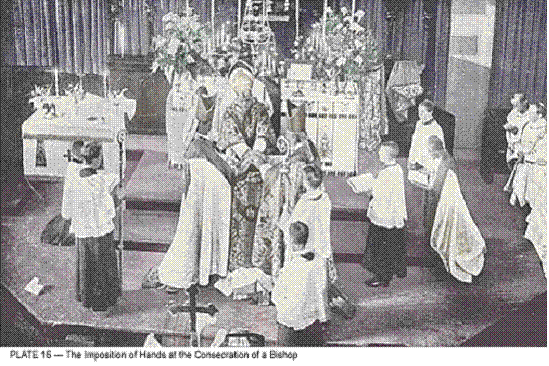
After a pause, with hands now extended over the new
Bishop, the consecrator continues with the following prayer, the assistant
Bishops likewise extending their hands, and, as already indicated, accompanying
him in a low voice:
O God the Father, God the Son, and God the Holy Ghost,
most blessed and adorable Trinity, Who wert and art and art to come as thou has
now bestowed upon this Thy servant of Thine awful power, and hast deigned to
consecrate him as thy representative and a teacher of Thy people, X open, we pray thee, his heart and mind
to Thy heavenly grace, that he may handle wisely that which he has received
and, being ever mindful of Thee, he may exercise his sacred power to the honour
and glory of thy holy Name. Fulfill in Thy chosen Bishop the perfection of Thy
service, and having entrusted him with the supreme dignity, do Thou sanctify
him with unction from above.
This takes the place of the roman prayer that God will
shed upon the newly-consecrated Bishop His strengthening blessing, and it plays
an important part in the work, for it opens the way down into the mental and
astral vehicles for the influence of the amazing development which has just
been made possible for the intuitional principle. While all the spiritual powers
of a Bishop are conferred simultaneously at the utterance of the words of
power, it would be exceedingly difficult to bring them into practical operation
without the aids which are given by this opening and by the anointing of head
and hands. The Anglican Church loses much, and makes the work of its prelates
more arduous and less readily effective by curtailing all this. She does indeed
to some extent supply the place of this prayer by inserting just before the closing
benediction a petition for heavenly blessing; but it would be much more
efficient in its proper place. She also lengthens considerably the actual
formula of consecration, which with her is as follows:
Receive the Holy Ghost, for the Office and work of a
Bishop in the Church of God, now committed unto thee by the imposition of our
hands; In the Name of the Father, and of the Son, and of the Holy Ghost.
Amen. And remember that thou stir up the grace of God which is given thee
by this Imposition of our hands; for God hath not given us the spirit of fear,
but of power and love and soberness.
It will be seen how determined is the effort made here to
impress upon the Bishop-elect the reality of the power conferred upon him by
the action ordained by Christ—an impression still further strengthened by the
invocation of the Name of the most Holy Trinity. The exhortation to “stir up
the grace” is quaint, but it shows that even the co-called reformers had a
glimpse of the great truth that all power given from on high grows greater
precisely in the proportion in which it is used. It is this sentence which, in
this maimed rite, does as far as it can the work of opening, arranging and
connecting which in more scientific schemes is achieved by the anointing.
Resuming the consideration of our own ritual, the
consecrator now takes his seat and assumes his mitre. The head of the
newly-made Bishop is then bound with a long napkin, and the consecrator with
his thumb anoints the head with holy chrism, the first in the form of a cross
over the entire top of the head, then with a series of extending circles till
all is covered with the sacred oil. He says:
May thy head be anointed and consecrated with the
heavenly blessing in the pontifical Order, so that the power which thou dost
receive from on high may flow forth from thee in ever greater abundance and
glory. In the Name of the X Father
and of the X Son and of the
Holy X Ghost. R. Amen.
This anointing of the head is an important item in the
ceremony, for the chrism is especially the vehicle of the divine Fire. On the
lower levels it is a powerful purifying influence, and on the higher it gives
strength and clearness. Although it is applied down here in the physical world,
its effects extend far above into unseen realms. The soul mirrors itself in the
personality, and this reflection, like many others, is upside down. The higher
mind or intellect is reflected in the lower mind, the intuition in the emotional
or astral body, and the spirit itself down here in the physical vehicle.
Ordinarily the triple spirit is so widely separate from the man as we know him
that there is no apparent result from this reflection; but as in the Bishop
this triple spirit has the opportunity of awakening, the application of chrism
to the head intensifies the power of reflection, and makes the triple spirit
glow most wonderfully, besides, clearing the way down into the physical brain
for the flow of the new forces.
The force-centre at the top of the head (called by Indian
students of higher physics the Sahasrara chakra, and referred to in
Baptism as the gateway through which the man passes in and out) is in most men
a vortex producing a small saucer-like depression, just as are the other
centres in the human body. They take that shape because force is constantly
flowing into the physical man through them from higher planes; but in the great
Saint force which he himself generates is constantly rushing outwards
through this centre for the helping of the world, and so the vortex, rotating
more rapidly than ever, becomes a cone instead of a depression, and is often to
be seen in statues of the Lord Buddha as a distinct projection at the top of
the head.
Manifestly it is intended that the Bishop shall join this
more advanced type of souls, for the action of the chrism tends strongly in the
direction of this development. If he understands his business and uses his opportunities,
every Bishop ought to be a veritable radiating sun, a lighthouse amid the
stormy sea of life, a battery charged with almost unlimited power for good, so
that he may be a fountain of strength, of love and of peace, and his mere presence
may itself be a benediction.
After this anointing, the consecrator rises, and, again
extending his hands, says:
Thou Who are wisdom strength, and beauty, show forth
thy glory in this Thy servant. Let Thy wisdom dwell in his mind and enlighten
his understanding, that in judgment he may be true, and a wise counseller unto
his people discerning in all spiritual knowledge. May he be strong and of good
courage, sustaining his people in the face of darkness and despondency, a tower
of strength to them that falter on the way. Let the beauty of holiness shine
forth in his conversation and his actions. Do Thou fill him, O Lord, with
reverence, and make him devout and steadfast in Thy service. May gentleness
adorn his life, that he may win the hearts of men and open them to the light of
the Holy Spirit. Above all, may he be so filled with Thy love that he may touch
the hearts of men with the fire from heaven and bring them from the darkness of
ignorance into Thy marvellous Light: Thou Who livest and reignest, O Trinity of
Might and Wisdom and Love, one holy God throughout all ages of ages. R. Amen.
The consecrator now anoints the hands of the new Bishop
with the sacred chrism. He says:
May these hands be consecrated and hallowed for the
work of the pontifical Order by this anointing with the holy chrism of
sanctification. In the Name of the X
Father, and of the X Son, and
of Holy X Ghost. R.
Amen.
This anointing of the hands with chrism arranges the
mechanism for the distribution of the three kinds of force (coming forth, if we
push our investigation far enough back into light of ineffably glory, from the
Three Aspects or Persons of the ever-blessed Trinty) which flow through the
Bishop by virtue of the gift of the Holy Ghost at his consecration. For that
reason the triple cross is made over him.
The consecrator makes the sign of the cross first over the
heart of the newly consecrated Bishop, then over his hands, saying:
Mayest thou abound with the fullness of spiritual X blessing, so that whatsoever thou dost X bless may be blessed, and whatsoever
thou dost hallow may be hallowed, and that the laying on of this consecrated
hand may avail for the spiritual safeguarding of Thy people: in the Name of our
Lord Christ. R. Amen.
He then joins the consecrated hands and binds them with a
linen strip. The sign of power made at the words “the fullness of spiritual
blessing” opens fully the direct line of connection between the intuition and
the emotional or astral body, so that if and when that intuition is developed
it may flash through at once into what is intended to be its expression in
physical life.
The un-evolved man is guided almost entirely by his
feelings and emotions; and often these may be the merest impulses, born of prejudice
or mistaken ideas. Later, the lower mind unfolds itself, and the man begins to
check his impulses by reasoning, which, however, is often narrow and based on
wrong premises. At this stage he is often a rabid freethinker, noisily denying
the existence of anything which with his very limited faculties he cannot feel,
see or understand.
Gradually the higher mind appears, and enables him to take
a broader and saner view, to realize that he must collate his tiny personal
experiences with those of others, and that the straitened limit of his
comprehension is not necessarily the frontier of the universe. Thus he learns
to subordinate isolated observation to general laws, and to weigh conclusions
before accepting them. Very slowly he learns that above and beyond the store of
knowledge obtained by wide experience there is a wisdom which knows the truth
by instinct, which infallibly and instantaneously distinguishes fact from
error; and to that inner faculty we give the name of intuition.
Its true habitat is that higher plane which we name after
it—that to which in Oriental lands is given the title of buddhi or
enlightenment; but down here in the outer world it shows itself through the
emotional body as instinctive feeling. Little by little, step by step, it dawns
upon the consciousness of man, and until he can recognize it with certainty he
wisely fears to trust it; yet how often has it happened to all of us to reason
ourselves out of obedience to some instinctive feeling, and afterward bitterly
to regret that we neglected the warning.
Intuition exists—let none doubt it; but not all of us are
yet sufficiently developed to be certain of instantly recognizing it when it
flashes upon us; and the dangers attendant upon mistaking impulse for intuition
are so serious that we do well to be cautious. The attainment of reliable
intuition in daily life means the opening of that direct channel between the
intuitional and emotional vehicles; and that is the very result which the sign
of power over the heart of the newly-made Bishop is intended to produce. When
the link is thus brought into operation, it remains for the Bishop himself to
develop the faculty by making use of it.
The sign made over the heart is by no means merely
sybolical, for it is through that centre rather than through the mind that
intuition acts; and the sign made over the hands at the words “that whatsoever
thou dost bless may be blessed” arranges the mechanism for the distribution of
that wonderful Christ-force which pours through the Bishop as a result of the
link made between his intuition and that of his Master.
Then follows the blessing by the consecrator of the
crosier, pectoral cross and ring, and immediately afterwards the delivery to
the new Bishop of these, which may very truly be called the working tools of
the sublime degree conferred upon him. Taking the crosier in his hands, the
consecrator says:
Eternal Triune God, before whose great white throne
seven flaming Spirits stand, whom yet Thou dost send forth through all the
world, X pour out upon this
staff Thy sevenfold fire, that it may be a rod of power for the ruling and
strengthening of Thy Church. Through Christ our Lord. R. Amen
I shall explain in a later chapter the arrangement of the
seven jewels in the Altar-stone, and their especial linking with the earthly
Heads of the seven Rays, who are in turn the representatives for our planet of
the seven Spirits, who while ever standing before the throne of God, yet
permeate the whole of the solar system. A similar plan is adopted with regard
to the Bishop's crosier and his pectoral cross. The linking of the jewels with
the vicegerents of the great Spirits is done yearly by the Bishop on the
festival of St. Michael and all Angels, so the object of this prayer is not to
make that link, but to offer this crosier as a channel for the divine power and
to invoke the divine blessing upon it. The reference to the Rod of Power will
be appreciated by the deeper student of the inner side of life; among Eastern
mystics it is sometimes called the dorje.
The consecrator not takes the pectoral cross between his
hands, and says:
Almighty God, Who of Thine own most holy will didst
offer Thyself as a sacrifice for all the world, and hast by that limitation of
Thyself hallowed the sign of the cross and made it for ever Thine own, let the
seven Rays of Thine ineffable glory X
shine through this sacred symbol, that this holy cross may ever by a radiant
sun to him who weareth it, and a fount of light and benison to all Thy faithful
people. O thou Who reignest from the cross for ever. R. Amen
This again, like the previous prayer, offers the cross as
a channel for mighty cosmic forces; and all who have the inner sight will
recognize the appropriateness of describing it as a radiant sun, for that is exactly
the appearance which it presents to them. Each jewel flashes with its own
especial colour, yet they blend into a wonderful and harmonious whole, and
certainly the sacred symbol shed a most powerful and continuous influence not
only upon the wearer but upon all who come in contact with him. The fact that
the cross typifies the Sacrifice involved in the descent of the Second Person
of the Holy Trinity into matter, in order that we and all the worlds may be,
makes the symbol still more suitable as a vehicle through which His grace may
shine upon the world which owes its very existence to that which the cross
signifies.
The consecrator lays aside the pectoral cross, and takes
the ring between his hands in the same way, saying:
O Christ, pure Lord of Love, whom Angel hosts obey,
touch Thou with sacred fire this ring which in Thy Name we X bless, that he who wears it shall ever
show Thy love and purity, and all who touch it shall know Thy healing grace.
R. Amen.
It will be seen that this prayer differs in character from
those which precede it. It is no longer an appeal to the Deity to recognize a
connection already made, but a petition to the World-Teacher to accept the ring
as a centre of radiation for the fire of His wondrous love. This ring, so
magnetized, becomes the most powerful of talismans, through which the special
blessing of the Christ is ever flowing forth without the intervention of the
Bishop, though he is able to concentrate and direct it by the exertion of his
will. This is further explained in Part III dealing with the instruments of the
Sacraments.
All these instruments being now duly prepared, the
consecrator presents them one by one to the new Bishop. first the crosier,
which the recipient has to take between the tips of his fingers, as his hands are
still bound together by the strip of linen. The consecrator says:
Receive this staff, and wield thy power with care as
Shepard of Christ's flock. By virtue of the sevenfold fire of god the Holy
Ghost be thou all things to all men; giving more strength unto the strong, yet
showing gentleness unto the weak; full of wisdom for the wise, and for the
devout full of deep devotion. Yet as the seven flashing colours of the bow make
but one pure white ray, so shall thy sevenfold power be all the one great power
of love.
The consecrator now suspends the cross around the neck of
the new Bishop, saying:
Receive this cross, remembering that only by the
perfect sacrifice of the lower nature to the higher canst thou fit thyself to
bear it worthily. Go forth in the power of the cross, and may the sevenfold
light of the Holy Spirit so shine through thee that thou mayest win others to
the beauty of sacrifice.
He places the ring on the ring-finger of the right hand of
the newly-made Bishop, saying:
Receive this ring in token of the link which binds thee
to our Lord, for symbol of thine office as His legate to thy people. In His
most holy name, be thou a healer of the souls of men, a channel of His love.
Then deliver to him the book of Gospels, closed, which had
previously been held on his shoulders, he says:
Recieve the Book of Gospels, and be thou a teacher of
the Divine Wisdom unto the people entrusted to thee.
The consecrator, and after him the assistant Bishops, give
the salutation of peace to the newly consecrated Bishop, whose hands are then
unbound. Both he and the consecrator then wash their hands. The now Bishop and
the assistant Bishops withdraw to the side-Altar. The Gospel is read, and the
Creed sung. After the Credo and immediately before the Offertorium is read, the
new Bishop presents his offerings to the consecrator. According to ancient custom
these consists of two small loaves of bread, two torches or candles, and two
miniature barrels with the arms of the consecrator on a golden shield and those
of the new Bishop upon a silver shield.
The newly-consecrated Bishop, accompanied by his assistant
Bishops, then proceeds to the south end of the high Altar and says aloud the
remainder of the office of the Holy Eucharist with the consecrator word for
word. Except for a special clause inserted in the prayer of consecration, the
Service proceeds to the end as usual. After the final blessing the consecrator
and the new Bishop assume the cope. The consecrator then proceeds to the
faldstool. The mitre and gloves of the new Bishop are held before him, and he
blesses them. The three Bishops then place the mitre on the head of the newly
consecrated Bishop, the consecrator saying:
Receive this mitre, wherewith I crown thee for the
service of that our most dear Lord, Who, although He be God and Man, yet He is
not two, but one Christ; and as in Himself He doth insolubly unite two natures,
so mayest thou in thyself for ever join the attributes of wisdom and that of
love.
It may be of interest here to quote the corresponding
passage in the Roman ritual, as the symbology of the mitre there given differs
from ours.
We set on the head of this Bishop, O Lord, Thy
Champion, the helmet of defence and of salvation, that with comely face and
with his head armed with the horns of either Testament, he may appear terrible
to the gainsayers of the truth, and may become their vigorous assailant,
through the abundant gift of Thy grace, who didst make the fact of Thy servant
Moses to shine after familiar converse with Thee, and didst adorn it with the
resplendent horns of Thy brightness and Thy truth, and commandedst the mitre to
be set on the head of Aaron Thy high-priest. Through Christ our Lord.
In the Roman rite the following prayer is said when the
gloves are placed on the hands of the new Bishop.
Compass about, O Lord, the hands of this servant of
Thine, with the purity of the new Man, who came down from Heaven; that, like as
Jacob, Thy beloved one, covering his hands with the skins of kids and bring to
his father most savoury meat and drink, obtained Isaac's blessing, so may he,
presenting with his hands the Saving Victim, be found worthy to obtain Thy
gracious blessing. Through our Lord Jesus Christ, Thy Son, who, in the likeness
of sinful flesh, did offer Himself to Thee, on our behalf. R. Amen.
In the Liberal Liturgy no prayer is said, the consecrator,
with the aid of the assistant Bishops, putting the gloves on the hands of the
new Bishop in silence. This being accomplished, the consecrator rises and says:
Do Thou, we pray Thee, O Lord, fulfill in Thy servant
that which is betokened by these visible emblems, so that the virtue which in
these garments is prefigured by sheen of gold, by flashing of gems and cunning
of varied embroidery, may continually shine forth in his life and actions. R.
Amen.
Then the new Bishop is solemnly enthroned, the consecrator
leading him by the right hand, and the senior assistant Bishop by the left. His
crosier is handed to him, and a solemn Te Deum is sung, during which the
new Bishop, attended by the assistant Bishops, proceeds round the church and
gives his blessing to the people. We have found it desirable to modify some of
the verses of the Te Deum, as there are phrases in the original which we
do not feel that we can honestly recite.
When the procession returns to the sanctuary, the new
Bishop is seated on the throne or faldstool, the consecrator standing upon his
right hand, and the assistant Bishops upon his left. The consecrator turns to
the people, gives the Minor Benediction, and says:
O God, the Shepherd and Ruler of all the faithful, look
down in Thy loving kindness on this servant of Thine who has now become a
pontiff and ruler in Thy Church; grant him, we pray Thee, O Lord both by his
ministration and by word and example, so to profit those over whom he is placed
that, together with the flock committed to his care, he may continually
increase in the knowledge of Thy mysteries. Though Christ our Lord. R. Amen.
The consecrator and the assistant Bishops, one on either
side of him, stand at the gospel side of the Altar. The new Bishop advances to
the middle of the Altar and thence gives his solemn benediction in the ordinary
form. The newly-consecrated Bishop then pays homage to the consecrator
according to the ancient tradition of the Church. He advances by three stages
to the consecrator, genuflecting each time and saying: Ad multos annos
(unto many years), finally receiving from the consecrator and assistant Bishops
the salutation of peace. This concluded, the procession leaves the chancel.
Though the rubric demands the presence of three Bishops to
consecrate a fourth, this is by no means necessary to the validity of the
Sacrament. One Bishop is fully able to hand on the episcopate, and in history
has often done so. When three take part in the ceremony, each is an independent
channel of force; so that even if the consecrator were himself through some
strange mistake not a properly-ordained Bishop, the action of the others would
remedy the deficiency, and the consecration would be valid. The assistant
Bishops would have the intention of consecrating, and would have the form of
consecration explicitly in their minds; and that intention would operate at the
laying on of hands, even if they did not give it vocal utterance. Still, for
safety's sake it is ordained that all three shall speak the words
simultaneously.
Those of the laity who have the opportunity of seeing any
of the major Ordinations are privileged people. It is a great thing, a fine
thing to be able to see the carrying on of this scheme given to by the Christ
hundreds of years ago. By their presence, by their earnest devotion. the laity
can help, and can strengthen the hands of those who are passing on this
wondrous gift. They themselves have not been ordained, therefore it is not in
their power to pass on the Holy Orders; but it is in their power to uphold the
hands of those who are doing it, and to give in that way very real help in what
is being done.
Another point is that such a Service offers a magnificent
opportunity to those who are trying to develop clairvoyance. Those who are
beginning to see should try to see all they can. Humanity is evolving, the
powers of our higher bodies are coming nearer to the surface, and sometimes
some of us are able to see a little more than we used to see. Here are occasions
when there is a great deal more to be seen than is visible to the physical eye.
It is well worth while for those present to make an effort to put themselves
into a receptive attitude, in the hope of seeing or feeling something of what
lies behind the outer form of what is done.
There will be wondrous outpourings of power visible to
those have learnt how to perceive them—floods of light, flashes of splendid
colour, great Angels who have come to help. Many can feel their presence, and
there are some who can see them. There is no reason why others should not share
this advantage. Let them put themselves in an attitude of sympathy; let them
try to see and to feel. That is one way in which we, the clergy, like the laity
to cooperate with us in the work which we have to do.
This document is part of the library of the The Liberal Catholic Church International.
Except for the case of official documents and liturgies,
no individual speaks for the Liberal Catholic Church as a whole.