To quote from our Liturgy: “Baptism is a Sacrament by which the recipient is solemnly admitted to membership of Christ's holy Church and grafted into His mystical body.”
It opens with the usual invocation, as do all our Services, to show that all our work is done in the Name and by the power of the ever-blessed and most holy Trinity. Then the sponsor presents the child to the Priest, asking that he may be admitted into the fellowship of the Church; and the Priest, in acceding, addresses the congregation thus:
Brethern, our fair Father Christ, in His great loving-kindness, hath ordained that His mystic Bride, our holy Mother the Church, shall guide and protect her children at every stage from the cradle to the grave. To this end is the Sacrament of holy Baptism ordained, that in His Name the Church may give welcome and blessing to him who is newly come into this world of pilgrimage, and that the soul may dwell in a body purified from the taint of evil, sanctified and set apart for the service of Almighty God. Therefore, brethren of Christ's catholic Church, I pray you to join with me in this our holy rite, whereby this child shall be made partaker of these heavenly gifts and a member of His mystical body.
We see from this that the Church meets the soul as soon as he comes into his new set of vehicles, and offers him welcome and assistance. What help can be given to a soul when he first comes into a new physical body? Remember, we cannot reach the soul himself; we are dealing with vehicles on the physical plane. What the soul most needs is to bring that new set of vehicles into order, so that he can work through them. He comes laden with the results of his past lives, which means that he has within him seeds of good qualities and also seeds of evil qualities. Those seeds of evil have often been called original sin, and quite wrongly connected with the fabled action of Adam and Eve. That is a mere distortion of the fact that each soul brings with him his own qualities, some good, some less good, some even definitely evil, according to what his previous lives have been.
Obviously the duty of the parent or guardian towards the child is to do all that he can to stimulate the good germs and to freeze or starve out those which are evil, by giving them no encouragement whatever. The student of the inner life will understand that the development of these qualities depends largely upon the surroundings given to the child. If he is surrounded with love and gentleness, the love and gentleness in him will be called out and developed. If, on the contrary, he meets with angry vibrations and irritability, if there is in him the least trace of germs of that kind (as there is almost sure to be), they will be called out and developed; and it makes an enormous difference to his life which set of vibrations is first set in motion.
The Sacrament of Baptism is especially designed to deal with this state of affairs. The water used is magnetized with a special view to the effect of its vibrations upon the higher vehicles, so that all the germs of good qualities in the unformed astral and mental bodies of the child may thereby receive a strong stimulus, while at the same time the germs of evil may be isolated and deadened. The central idea is to take this early opportunity of fostering the growth of the good germs, in order that their development may precede that of the evil—in order that when at a later period the latter germs begin to bear their fruit, the good may already be so far evolved that the control of the evil will be a comparatively easy matter.
This is one side of the baptismal ceremony; it has also another aspect, as typical of the Initiation towards which it is hoped that the young member of the Church will direct his steps as he grows up. It is a consecration and a setting apart of the new set of vehicles to the true expression of the soul within, and to the service of the Great White Brotherhood; yet it also has its hidden side with regard to these new vehicles themselves, and when the ceremony is properly and intelligently performed there can be no doubt that its effect is a powerful one. It is distinctly, therefore, what may be called an act of white magic, producing definite results which affect the whole future life of the child.
What are the factors which are influencing the newly-born child? First, there is what is called by students the karmic elemental, which requires some explanation to those who are unacquainted with the details of the process of rebirth. At the end of each life there is a balancing of accounts, and a form is made in etheric matter which represents the kind of body that the man has earned for his next adventure upon earth. When he returns, this form is vivified by a nature-spirit and becomes the mould into which the child's new physical body is built; it is the result of the actions of his past life, and that nature-spirit is the main force among those which are moulding him, Secondly, the soul himself is trying to see what he can do with his new vehicles—to take hold of them as soon as may be; but he is usually not a powerful factor in the early stages, because he has great difficulty in coming into touch with the new body. He does this by degrees, and is supposed to have grasped it fully and finally by the time that it is seven years old. In some few cases he masters it earlier; but sometimes it seems that he never gains complete control, or at least not until old age is attained. These two are the main factors, but there are other subordinate forces at play; for example, the thought of the mother has immense effect upon the vehicles of the child, both before birth and after.
The soul, then, is trying to influence the vehicles in the right direction as far as he can. The Sacrament of Baptism brings another new force into activity on his side. It is often said by Catholics that at Baptism a guardian Angel is given to the child. That is so, though perhaps not exactly in the form in which it is generally understood; but it is a beautiful symbol of what does happen in reality, because at Baptism a new though-form or artificial elemental is built, which is filled by the divine force, and also ensouled by a higher kind of nature-spirit called a slyph. This remains with the child as a factor on the side of good; so to all intents and purposes it is a guardian Angel. Through work such as this it becomes individualized, and grows from a slyph into a seraph—through its association with a thought-form permeated by the life and thought of Head of the Church Himself.
That does not mean the Christ is thinking about every baby, in the sense in which we ordinarily use that word. A tremendous power such as that of the Christ can be spread simultaneously over millions of cases, without requiring what we should commonly call “attention” from Him at all. As I mentioned when speaking of His presence upon a thousand Altars, a case parallel, but at an infinitely lower level, is that of a man in the heaven-world. He makes thought-images of his friends, and these constitute an appeal to the souls of those friends. These souls at once put themselves down into those thought-images and inhabit them. The personalities of the friends down here know nothing about it, but the real friend, the ego, the soul, the true man, is expressing himself through a hundred such thought-forms simultaneously in the heaven-lives of different people, Something of the same sort, though infinitely greater, takes place here in Baptism; and that is the first help which Christ gives to His people through His Church.
A Sacrament is not a magical nostrum. It cannot alter the disposition of a man, but it can help to make his vehicles a little easier to manage. It does not suddenly make a devil into an angel, or a wicked man into a good one, but it certainly gives the man a better chance. That is precisely what Baptism is intended to do, and that is the limit of its power.
After giving to the congregation the explanation already quoted, the Priest reads to them from St. Mark the account of the bringing of little children to Christ, and then recites the following prayer:
O God, Omnipotent and Omnipresent, whose power worketh in every living creature, who alone are the source of all life and goodness, deign to shed upon this thy servant, who has been called to the rudiments of the faith, a ray of Thy light; drive out from him all blindness of heart, break all the chains of iniquity wherewith he has been bound; open to him, O Lord, the gate of Thy glory, that being replenished with the spirit of Thy wisdom and strengthened by Thy mighty power, he may be free from the taint of evil desire, and steadfastly advancing in holiness may joyfully serve Thee in the course Thou has appointed for him.† Through Christ our Lord.† Amen.
This prayer is an appeal for help for the child, but it is also intended to direct the thought of the Priest, and enable him to gather up his forces for the exorcism immediately following it, during which the rubric instructs him to hold the requisite intention firmly in his mind.
The Roman ritual for Baptism begins by using rather strong language, assuming the devil to be in that poor innocent baby, abusing him as an accursed one and, generally speaking, trying to exterminate him. There is no such thing as a personal devil; that is one of the curious accretions which have arisen during the ages. It all really means nothing but what I have just mentioned, an endeavour to check and repress any evil germ. It is an effort, as we have put it in our ritual, to lay the spell of Christ's holy Church upon all influences and seeds of evil, “that they may be bound fast as with iron chains and cast into outer darkness, that they trouble not this servant of God”. The idea is that they should not be fed or encouraged in any way, and that the result of that will be to bind them down into their present condition; and presently they will, for lack of nutriment, be atrophied and fall out.
All these germs of evil may be regarded as a sort of temptation. There they are, ready to start into life; and as soon as their vibrations become vigorous they will inevitably tend to arouse similar vibrations in the various bodies of the unfortunate child, and so exercise upon him a steady pressure in the direction of evil. If they can be repressed, the temptation is removed from the child and he has a better opportunity. The average man is very much a creature of his surroundings, and if we can give him better surroundings, in all human probability we are making him a much better man than he otherwise would be. That is exactly what the Church does; it gives him a better chance.
It is for this reason that so much importance is attached to the Baptism of infants, especially if they are in danger of death. It would be quite possible for the germs of evil brought over from the previous life to be unfolded to a considerable extent in the astral world on the other side of death. There is always plenty of influence about in that world which may stimulate them. Therefore it is considered of great importance to do whatever can be done to deaden them before the child dies. In the same way the good germs may also be stimulated during the short astral life of a baby, so that Baptism distinctly gives him a better chance in that life also. When he takes his next new body the evil germs will not have developed, and so he will bear just where he was before, with the additional advantage of any good quality which the spiritual stimulus may have worked into his character.
Then comes another curious feature of the Service. In the old Roman ritual it is ordered that the Priest shall say over the child, quoting the words of the Christ: “Ephphatha, that is to say, be thou opened.” At the same time he is directed to make the sign of the cross over the ears and nostrils of the child. Looking back to olden times, we find that the Priest made the sign over the forehead, the throat, the heart and the solar plexus, so we have restored that arrangement in the ritual of the Liberal Catholic Church. These are four of the special force-centres in the human body, and the effect of the sign, and of the intelligent exercise of the will, is to set these centres in motion.
If a clairvoyant looks at a new-born baby he will see these centres marked; but they are tiny little circles like a threepenny piece—little hard discs scarcely moving at all, and only faintly glowing. The particular power which the Priest exercises in Baptism opens up these centres and sets them moving much more rapidly, so that a clairvoyant will see them growing before his eyes to the size, perhaps of a crown-piece, and beginning to sparkle and whirl, as they do in grown-up people. The centre opens much in the same way as the eye of a cat opens in the dark; or it is still more like the way in which a properly-made iris shutter opens in a photographic camera. These centres are opened in order that the force which is to be poured in may flow more readily; otherwise it would burst its way in with violence, which puts an unnecessary strain on the baby body. When the Priest has performed this action, he continues:
Let thy mind and thy heart be opened to the most holy Spirit of the living God, that thy whole nature may be dedicated for ever to His service; so mayest thou have power to receive the heavenly precepts and to be such in thy conduct that thou mayest be a pure temple of the living God.
Still standing, he stretches out his right hand over the child, and says:
Do thou, O Lord, with Thy ever-abiding power, watch over this Thy chosen servant, whom we dedicate to Thy service, that, using well the beginnings of Thy glory and heedfully observing Thy holy laws, he may be found worthy to attain to the fullness of the new birth.† Through Christ our Lord.† Amen.
In these words he tries still further to prepare the child for the great outpouring of divine force which is about to be bestowed upon him; and then, placing the end of his stole upon the child's shoulder, he says: “Come into the temple of God, that thou mayest have part with Christ unto life eternal.” It is said that in old times the service up to this point took place in a vestibule outside the church proper, and that with these words the priest let the candidate (or the person carrying the baby) into the baptistery.
Having thus opened the centres, the Priest proceeds to make the thought-form. In the Liberal Catholic Church, just as in the Roman and the Greek Churches, we use not only water at Baptism, but also oil. Three different kinds of oil are used by the Church, and they are magnetized for different purposes, just as a talisman is magnetized. One of these kinds of oil is taken here (that which is called the Oil of Catechumens), and with that the signs are made which build up the thought-form. The Priest says:
In the Name of Christ our Lord, I anoint there with oil for thy safeguarding; may His holy Angel go before thee;
Meanwhile he makes a small cross upon the breast of the child with the oil, and a large one in the air before the child, reaching to the entire length of the body; and as he says:
and after thee;
he makes a small sign on the skin between the shoulders, followed by a larger cross in the air down the entire length of the back, and continues:
may he be with thee in thy downsitting and thine uprising, and keep thee in all thy ways.
I fancy that many a Priest who performs that ceremony almost every day has little idea of what he is really doing. He is building the two sides of the thought-form by that effect—making a sort of cuirass of white light before and behind the child. While doing this he ought to visualize that armour strongly, as he says the words; “May His holy Angel go before thee and follow after thee.” A priest who does not know anything about all this usually makes only a thin film; one who understands it, and uses his will, makes a far stronger form. Having opened the centres and built the thought-form, the Priest now substitutes a white stole for the violet which he has been wearing, and proceeds to pour in the triple spiritual force, thinking all the time very intently of what he is doing. While the godparents hold the child over the font, the Priest, using a shell or other convenient vessel, pours some of the consecrated baptismal water over the head of the child thrice. The water should be poured upon the top of the head in the form of a cross, care being taken that some of it flows over the skin of the forehead. At the same time he pronounces the words:
N.: I baptize thee in the name of the Father X and of the Son X and of the Holy X Ghost.† Amen.
That pouring in of the force is the actual Baptism, and for that all through history the Church has told us that two things are necessary: The use of water and of a certain form of words: “I baptize thee” (or, in the Russian Church, “Thy servant of God is baptized”) “in the Name of the Father, and of the Son, and of the Holy Ghost”.
There is reason for both these things, and certainly they are necessary in order to make the ceremony effective. The magnetized water is needed because as I have already said, we cannot yet reach the soul; but through the magnetized physical water the Priest sets violently in vibration the etheric part of the physical body, stimulates the brain, and through the pituitary body affects the astral body, and through that in turn the mental body. So the force rushes down and up again, like water finding its own level. In this lies the necessity for the use of water, and for its definite contact with the skin, and not with the hair merely. If the water were not properly applied the Sacrament would be truncated—would, as it were, miss fire as far as the personality is concerned. It is possible that even then something of the divine force or its influence might reach the soul by some kind of osmosis or through another dimension; the touch of the Priest and the exertion of his will must produce some sort of result, but it is not the Sacrament of Baptism working through the appointed channel.
Then comes the invocation of the Three Persons of the Blessed Trinity. That is a true word of power, which calls down three kinds of force, and ought not to need much explanation to thoughtful students. Let me put it very briefly, referring readers for a fuller statement to the volume on theology in this series. God has made man in His own image. Theologians tell us that God, when making Adam, foresaw the physical form which Christ would take when He came down into the world, and made Adam according to that pattern. That seems to us a laboured, round-about and ridiculous explanation, for we know that the body of man was gradually evolved from lower forms. We say rather that it is not the body of man that is made in the form of God, but the soul.
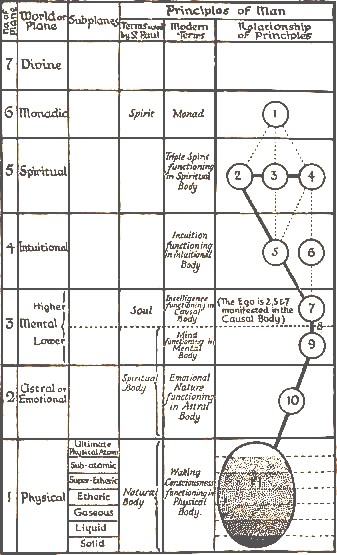
Precisely as in God there are Three Persons, so in man there is the Triple Spirit which manifests itself as what the Indian philosophers thousands of years ago called in Sanskrit atma, buddhi, manas—spirit, intuition and intelligence—exactly as the Three Aspects of the Trinity manifest Themselves as the Father, the Son and the Holy Ghost. Therefore man is not a mere reflection of God, but actually in some mysterious way an expression of Him; and each of those principles in the man is, in a way which we cannot yet hope to understand, part of a corresponding Principle or Person of the Deity.
So the use of those words, with the effort of will to bless in that Name, brings down from on high that threefold force, which acts upon the three principles in man simultaneously. The force unquestionably flows from the Three Persons of the Solar Deity Himself, though it reaches us only through intermediate stages. It is stored in the great reservoir of which we shall write when we come to deal with Holy Orders, and it seems to be drawn thence into the corresponding principles of the Lord Christ, the Head of the Church. At his ordination the Priest's principles are linked in a special way with those of his Master the Christ; and thus it is through the Christ and His Priest that the divine force reaches the child, and the thought which fills the form and makes the guardian Angel is really that of the Christ. It is force which will help the soul in his endeavour to gain control, and will encourage him to persevere.
Baptism by a deacon is less powerful than that by a Priest, as he is not so fully connected with the Lord; that by a layman is still less effective, for he cannot draw upon the reservoir or attract the force through the Lord Christ in that special way. Nevertheless, in using those words with intention he calls, however ignorantly, upon the spirit, intuition and intelligence in himself, and they in turn draw down some influence from their far higher counterparts. So a layman's Baptism avails, and is unquestionably useful and effective; but it is by no means the same thing as that of a Priest. Even if the layman is not himself a Christian (for example, he might be a Jewish doctor) his Baptism would still be operative if he used pure water and the right words, having in his mind the honest intention to do what the child's relations wished done, and to help and satisfy them. The word “validity” is often used in this connection; but it is calculated to convey a false impression. The rite is intended to help, and does so with varying degrees of efficiency according to the means employed.
As soon as the divine force has been poured in, the Priest proceeds to close the centres which he has opened, so that the force may not immediately pass out again, but may abide in the child as a living power, and radiate from him but slowly, and so influence others. Therefore the next step is to take another kind of sacred oil, the chrism, and with that the centres are closed.
The Priest says:
With Christ's holy chrism do I anoint X thee, that His strength may prevent thee in thy going out and thy coming in, and may guide thee into life everlasting.
The chrism is that kind of sacred oil which contains incense, and therefore it is used always for purificatory purposes. Incense is made in various ways, as we have said; but it almost always contains benzoin, and benzoin is a powerful purifying agent. Therefore it is the chrism with which the cross is made on the top of the child's head—in order, as an old ritual said “to purify the gateway”. Remember that man, when he “goes to sleep,” as we call it, passes out of and away from his physical body through the force-centre at the top of the head, and returns that way on awakening. Therefore this chrism is applied to the gateway through which he goes out and comes in, while the Priest utters the word given above. The word “prevent” is of course used here in the old English sense of “come before,” not in our modern meaning of “thwart”.
The effect of this anointing is great, even upon those who are but little evolved. It makes the force-center into a kind of sieve, which rejects the coarser feelings, influences, or particles; it has been likened to a doorscraper, to remove pollution from the man, or to an acid which dissolves certain constituents in the finer vehicles, while leaving others untouched. If during the day the man has yielded to lower passion of any kind, whether it be anger or lust, this magnetized force-centre seizes upon the excited astral particles as they sweep out and will not let them pass until their vibrations are to a certain extend deadened. In the same way if undesirable emotions have been aroused in the man while away from his physical body, the sieve comes into operation in the opposite direction, and slows the vibrations as he passes through it on his way back to waking life.
The four centres which have been opened—the forehead, the throat, the heart and the solar plexus—are now closed by an effort of the will of the Priest. Each centre is still distended, but only a small effective aperture remains, like the pupil of an eye. While it was open it was all pupil, like an eye into which belladonna has been injected. Now the pupil is closed to its normal dimensions, and a large iris remains, which contracts only slightly after the immediate effect of the ceremony wears off. The centre at the base of the spine is not touched, because it is not desired at this stage to arouse the force latent within it, which is called in the old books the serpent-fire. The spleen is not touched, because that is already in full activity in absorbing and specializing physical vitality for the child. The centre at the top of the head has been dealt with by the chrism, so that now all of them have been awakened, and set to their respective work.
After that part of the ceremony has been performed, the Priest formally admits the child to the Church. To this action also there is an inner and magical side. The Priest lays his hand upon the child's head, and says: “I receive this child into the fellowship of Christ's holy Church and do sign him with the sign of the cross.” He makes the sign upon the child's forehead with the purifying oil. This is a beautiful symbol; but it is much more than that, because the cross which is made in this way is visible in the etheric double all through the life of the person. It is the sign of the Christian, precisely in the same way as the tilaka spot is the sign of Shiva, and the trident of Vishnu. Those marks are placed upon the forehead in India with ordinary physical paint, but they are the outward and visible signs of an inner and real dedication which may be seen on the higher planes. This signing with the cross, then, is the dedication of the child to Christ's service, the setting of Christ's seal upon him, and his admission to the body of the faithful.
Then follow two pretty little bits of primitive symbolism. The Priest brings from the Altar a white silk handkerchief or scarf, and places it upon the shoulders of the child, saying:
Receive from holy Church this white vesture as a pattern of the spotless purity and brightness of Him whose service thou hast entered to-day, and for a token of thy fellowship with Christ and His holy Angels, that thy life may be filled with His peace.
He then bring from the Altar a candle which has been lighted from the Altar light on the Gospel side, and, delivering it to the child, says:
Take this burning light, enkindled from the fire of God's holy Altar, for a sign of the ever-burning light of thy spirit. God grant that hereafter His love shall so shine through thy heart that thou mayest continually enlighten the lives of thy fellow-men.
The candle is replaced upon the Altar and subsequently extinguished by the server.
In the early Church a white robe was placed upon the child or the adult candidate at this point, to indicate the condition of comparative purity which the Sacrament had produced in him, and as an expression of the hope that he would in his future life endeavour to fulfil the good promise of this auspicious beginning, and never forget the privilege and the obligation laid upon him by his admission to Christ's holy Church. We see no sense in exacting vicarious pledges from the godparents as to what the baby shall do and shall believe when he grows up, for a pledge is a solemn thing, by no means to be given lightly, or when one has no possibility of controlling its fulfilment. So we entirely omit that part of the Service; but in this fragment of symbolism we express the earnest hope that the seed sown in this beautiful Sacrament may bring forth good fruit in due season.
The white silk scarf is given by the godparents, but is blessed by the Priest and laid upon the Altar before the Service begins. It is intended that it shall be carefully kept for the child and embroidered with his name, and that when he comes to receive the Sacrament of Confirmation he shall wear it round his neck. In the early Church it was called poetically “the white robe of the Angels” and “this gift from Christ to His newly-born son”. It is the lineal descendant of the white garment which was always worn by the candidate in the ancient Mysteries; indeed, the very word “candidate” is derived from it, for candidus in Latin means white.
The candle lighted from the Altar is a symbol of the love of God manifested towards His creature, and is again expressive of a hope—the hope that in gratitude for the help now extended to him, the child may in later life devote his strength to the helping of others. The baby often grasps at the candle; if not, his hand is guided to touch it by the godparent, who must of course see that no harm is done by the flame, and that the candle is duly handed to the server.
The Priest then lays his hand upon the child's head in blessing, and says to him: “Go in peace, and may the Lord be with thee.” He then proceeds to deliver to the sponsors the following charge:
Ye who have brought this child here to be baptized, seeing that now he is regenerate of water and the Holy spirit, and grafted into the mystical body of Christ's Church, remember that there lies upon you a duty not lightly to be cast aside. It is your part to see that so soon as he is old enough to understand, he is taught God's holy will and commandment, as it was spoken by our Lord Himself when He said: “Thou shalt love the Lord thy God with all thy heart and with all thy soul and with all thy mind and with all thy strength. This is the first and great commandment; and the second is like unto it: Thou shall love thy neighbour as thyself. On these two commandments hang all the law and the prophets.
Also he shall be taught the doctrine of the holy catholic Church into which he has this day been admitted, and shall be brought in due course to the Bishop to be confirmed by him.
These are the real responsibilities of the sponsors—not to make impossible promises on the child's behalf, but to see that his is taught the great law of love, and that he has the advantage of the Sacrament of Confirmation as soon as he is old enough to profit by it. The commandment taught to him is not the weird Jehovistic jumble of the Mosiac decalogue, with its blasphemous attribution to the Deity of one of man's worst and most foolish sins, but the version given by our Lord Himself.
Much embittered controversy has surrounded the question of the exact signification of regeneration. The word means simply being born again, and it is by no means inappropriate as a description of what takes place at Baptism. The opening of the centres in the body to spiritual influence, the repression of the germs of evil, and the endowment of the child with what is practically a guardian Angel, a new and powerful influence in the direction of good—all these together constitute so marked a change in the condition of the child that it may well be regarded as a second birth—a birth into Christ's Church, following speedily upon his re-entry into the physical world.
Two other forms of the baptismal Service are given in our Liturgy—one for children who are of an age to understand something of what is being done, and the one for adults who are desirous to be formally admitted to the church. Only such modification are introduced as are necessary to adapt the prayers and charges to the age of the candidate. The exorcism of all influences and seeds of evil, and the opening and closing of the force-centres are omitted, because for good or for evil those centres are already working and those seeds have to some extent developed. For the exorcism a prayer is substituted that the candidate may be so purified that he may be able rightly to receive the Sacrament.
If the candidate has already received some form of Baptism, but there is uncertainty as to whether the words of power were said, or whether water was properly used, we rebaptize him conditionally saying: “If thou are not already baptized, then do I baptize thee.” Even if we have knowledge, evidence, or presumption that the Baptism was fully performed, but that the anointings and other parts of the ceremony were omitted (as would be the case, for example, with one baptized in the Church of England), it is permissible to repeat the rite in order to supply the missing parts if the candidate desires it. In this case also the conditional form must of course be used.
If any form of Baptism has been previously administered, the reception into Christ's Church is omitted, for Baptism admits to that Church as a whole, and not to one section of it only, and we must presume that any person whatever who administered that rite must have had at least so much of intention. In the final charge the exhortation is addressed not to the sponsors, but to the candidate himself.
In the case of adults, the gospel referring to Christ's reception of little children is omitted, and also usually the giving of the white scarf and the light, unless these are specially desired. Baptism is primarily intended for infants, and its omission in infancy cannot be fully supplied by Baptism in later life. The operation of the Sacrament upon the baby is far-reaching, for the power rushes through all the vehicles and cleans them thoroughly, setting the machinery going in exactly the right way.
The adult has necessarily long ago set things going for himself, and his currents are flowing much in the same way as Baptism would have caused them to flow, but it will usually be found that the corners are not cleaned up, much of the man's aura seems unvivified, and there is a large amount of indeterminate matter with which nothing is being done, and therefore it has a tendency to pass out of the general circulation, to settle and form a deposit, and so gradually to clog the machinery and prevent its efficient working. Much of this unpleasant results is obviated when a person has been baptized in infancy; for in infant Baptism it is the power of the Christ Himself which awakens the germs of good into activity and thereby lays a splendid foundation for subsequent development. The child who is not baptized has to do this work for himself, and is likely to do it less satisfactorily, the more so as he has not received the further advantage of the repression of the germs of evil.
Another reason in favour of infant Baptism is that there is in the child a clear field for action, which does not exist in the adult; and so, though the thought-form is made in the same way, the conditions under which the sylph has to work are so different that it is not operative to anything like the same extent. In fact, for the older people quite a different type of slyph is given, with somewhat less, perhaps, of the motherlike love of the seraph, but a more worldly-wise entity, capable of development into a keener intelligence. There is something half-cynical about him; he has unwearying patience, but he does not seen to be expecting much, while the Angel of the baby is optimistic—vaguer, it may be, than the other, but full of love and hope and schemes for the future. Still, a wholesome and beneficent influence is exercised by the administration of the Sacrament to the adult; the anointing with chrism is not without its use in cleansing the gateway, and even the making of the cuirass is good, especially for those who are young and unmarried.
The Sacrament are arranged in a definite order—Baptism to meet and help the child soon after birth, Confirmation to strengthen him through the difficult time of puberty, and the Holy Eucharist to give him frequent spiritual sustenance during the whole of his life. It is unquestionably best that they should be taken at the time and in the order intended, but I see no foundation for the theory that the absence of one invalidates the others. It is the Roman belief that a man who has not been baptized cannot be validly ordained, and this idea has caused a great deal of anxiety in certain cases. There used to be doubt in the minds of many as to the Baptism of the late Archbishop Tait of Canterbury (he having been of a Scottish Presbyterian family) and of various other Anglican prelates; and for that reason some have feared that the clergy ordained by them might not really be Priests at all, and that consequently Sacraments celebrated by these clergy might be inefficacious. This does not appear to be the fact.
At the same time, to remove the slightest possibility of any doubt or difficulty in the minds of our members, or people of other Churches, we of the Liberal Catholic Church are always careful to rebaptize conditionally any candidates for ordination unless we have irrefragable evidence that they have already been baptized according to a full and absolutely reliable rite, such as that of the Church of Rome.
The water to be used for Baptism is according to Roman custom blessed only once a year on Holy Saturday, a little of the sacred oils being poured into it. We find it more convenient to bless water afresh for each occasion, using the same formula as in making holy water, except that the Priest holds strongly the special intention of preparing it for the Sacrament of Baptism.
The next sacramental help which the Church offers to her young members is that of Confirmation. It consists of a wonderful outpouring of the Holy Spirit, given to the child as soon as he is at all able to receive it understandingly, and is capable to a certain extent of thinking for himself. It is obvious that no exact age can be prescribed, as children differ so much in the rate of development; but in the Western Church it is not the custom to administer this Sacrament before the age of seven, by which time the soul is supposed to have definitely taken hold of its vehicles. The theological presentation of this truth (meagre and distorted, as is so often the case) is that before the age of seven a child is incapable of mortal sin. About twelve is perhaps the ideal age. Though many children are ready for it much sooner. It is not advisable to deter it much beyond that, as it is primarily intended to meet the child when he is approaching puberty, and to help him through a difficult period of his life. The Service, as contained in our Liturgy, explains itself so well that much of it may be quoted without comment.
The Bishop, vested in white cope and mitre, and holding his pastoral staff in his hand, is seated on a faldstool before the Altar facing westwards, and the candidates for Confirmation are seated in due order before him outside the chancel—their sponsors also, if still alive and able to attend, being near at hand to present them at the proper time. Then the Bishop delivers the following exhortation:
My beloved children; on your entry into this mortal life you were brought into the house of God, and our holy Mother the Church met you with such help as then you could receive. Now that you can think and speak for yourselves, she offers you a further boon—the gift of God's most Holy Spirit. This world in which we live is God's world, and it is growing better and better day by day and year by year; but it is still far from perfect. There is still much of sin and selfishness; there are still many who know not God, neither understand His laws. So there is a constant struggle between good and evil, and, since you are members of Christ's Church, you will be eager to take your stand upon God's side and fight under the banner of our Lord.
In this Sacrament of Confirmation the Church gives you both the opportunity to enrol yourselves in Christ's army and strength to quit yourselves like men.
But if you enter His most holy service, take heed that you are such soldiers as He would have you be. Strong must you be as the lion, yet gentle as the lamb, ready ever to protect the weak watchful ever to help where help is needed, to give reverence to those to whom it is due, and to show knightly courtesy to all. Never forgetting that God is Love, make it your constant care to shed love around you wherever you may go; so will you fan into living flame the smouldering fires of love in the hearts of those in whom as yet the spark burns low. Remember that the Soldier of the Cross must utterly uproot from his heart the giant weed of selfishness, and must live not for himself but for the service of the world; for this commandment have we from Him, that he who loveth God love his brother also. Remember that the power of God, which you are now about to receive from my hand, will ever work within you for righteousness, inclining you unto a noble and upright life. Strive therefore earnestly, that your thoughts, your words, and your works shall be such as befit a child of Christ and a knight dedicated to His service. All this shall you zealously try to do for Christ's sweet sake and in His most Holy Name
The Bishop then asks the candidates whether they will strive to live in the spirit of love with all mankind, and manfully to fight against sin and selfishness; whether they will endeavour to show forth in their thoughts, words and works the power of God which he is about to give them. They reply in the affirmative, and the Bishop pronounces over them this blessing:
May the blessing of the Holy Ghost come down upon you, and may the power of the Most High preserve you in all your ways.
This preliminary blessing is intended to widen out the connection between the soul and his vehicles—to prepare the way for what is coming. We might put it that the object is to stretch both soul and vehicles to their utmost capacity, that they may be able to receive more of the divine outpouring. Immediately after this (all kneeling) the hymn Veni Creator is sung.
This has been called the most famous of hymns. Its authorship is uncertain. It has been attributed to St. Ambrose, to Gregory the Great, and to the Emperor Charlemagne, but perhaps the weight of evidence is rather in favour of Rabanus Maurus, who was archbishop of Mainz and abbot of Fulda about the year A.D. 850. There are some sixty English translations and paraphrases, of varying degrees of merit. That which we have selected will be found in our Liturgy in the Confirmation Service.
It is assigned in the Roman breviary to Vespers and Terce of Whitsunday and its octave, and is also sung at the coronation of Kings, the consecration of Bishops and the ordination of Priests. In the Liberal Catholic Church we use it on the last two occasions mentioned, and also at the ordination of deacons and Confirmation. It has become the accepted form for the appeal to God the Holy Ghost on all occasions when we ask for a special outpouring of His mighty power, and its effect is vary remarkable. As it is being sung, the whole church is gradually filled with a wonderful red glow, a kind of luminous fiery mist, which is quite distinct from the splendid crimson of love on the one hand, and the vermillion tinged with orange that indicates anger on the other. It is indeed a magnificent colour—nearest perhaps to what we call amaranth red, which when one sees it in an aura signifies high courage and determination. I have seen a rare variety of rose which comes near to it—I think it is the kind called Kitchener of Khartoum. This celestial fire grows stronger and stronger as the hymn proceeds, and eventually a mighty vortex of it forms itself above the head of the Bishop, and pours itself down through him shortly afterwards at the critical moment of the imposition of his hand. As soon as the hymn is finished, the Bishop immediately proceeds with the actual Confirmation.
He takes his seat upon the faldstool—or if there be no proper faldstool, an ordinary chair may be used—still wearing his mitre and holding his crosier. A gremial—which is a linen cloth like a towel, having often some sacred symbols embroidered upon it in red thread, and is intended as a kind of apron to protect the Bishop's vestments—is spread over his knees, and a cushion placed at his feet. Each candidate is severally let up to him by the sponsors, and instructed to kneel upon the cushion and to place his hands together, palm to palm, resting them upon the gremial. The Bishop, relinquishing his staff to his attendant, lays his hands upon each side of those of the candidate, so that the candidate's joined hands lie between his, the candidate, prompted if necessary by his sponsor, then says:
“Right Reverened Father, I offer myself to be a knight in Christ's service”; and the Bishop, pressing his hands lightly, answers: “In Christ's most holy Name do I accept thee.”
In the Liberal Catholic Church the whole Service has a military and chivalric flavour, and this emerges very clearly at this stage. The candidate adopts precisely the position of those who come before the King at his coronation to do homage to him and declare themselves to be his men, at his disposal in utter loyalty and self-abnegation; and the Bishop touches the hands of the child on each side in response, just as the King does when he accepts the homage and promises his protection. The vow goes up through him to the Christ, from whom the response flows down. The Bishop now utters the words of power. Holding his staff in his left hand, he takes some chrism upon his thumb, and lays his right hand on the head of the candidate, saying:
Receive the Holy Ghost for the sweet savour of a godly life; whereunto I do sign thee with the sign of the cross, and I confirm thee with the chrism of salvation. In the Name of the Father and of the Son and of the Holy Ghost.† Amen.
As he says “I do sign thee,” he makes the cross with the chrism upon the forehead of the neophyte, and after the word “salvation” he rises his hand and makes the sign three times over the head of the neophyte, but without touching him, as he recites the Names of the Holy Trinity.
The power which the Bishop pours into the candidate is definitely and distinctly that of the Third Person of the Blessed Trinity, and Third Aspect of the Deity; but it comes in three waves, and its acts at the three levels upon the principles of the candidate. As in Baptism, there is first an opening up by the force, which moves from below upwards; then there is a filling and a sealing process, which moves from above downwards.
But we are dealing now with the soul, and not merely with his vehicles. At the words: “Receive the Holy Ghost,” the divine power rushes in through the soul or ego of the Bishop into that lower stratum of the soul of the candidate which we call the intelligence (or in Sanskrit the higher manas); at the signing of the cross it pushes upwards into the next stage, the intuition or buddhi; and at the words: “I confirm thee with the chrism of salvation,” it presses upwards into the spirit or atma. But it must be understood that there is a Third-Person aspect to each of these principles (Diagram 21), and that it is through it in each case that the work is being done; it is all the direct action of the Holy Spirit. Some candidates are far more susceptible to this process of opening up than others; upon some the effect produced is enormous and lasting; in the case of others it is often but slight, because as yet that which has to be awakened is so little developed as to be barely capable of any response.
When the awakening has been achieved as far as it may be, comes the filling and the sealing. This is done, as ever, by the utterance of the great word of power, the Name of the Blessed Trinity. At the Name of the Father the highest principle is filled and sealed; at the Name of the Son the same is done to the intuitional principle, and at the Name of the Holy Ghost the work is finished by the action upon the higher intelligence. As this further outpouring which I have called the filling takes place, the effect upon the spirit is reflected into the etheric double of the neophyte so far as his development allows; the impression upon the intuition is in the same way reproduced in the emotional vehicle; and what is done to the higher mind should similarly mirror itself in the lower. But all these reflections into the personality depend upon the extent to which it is able to express and reflect the soul behind it.
The very intention of the Sacrament is to tighten the links all the way up—to bring about a closer connection between the soul and its vehicle the personality, but also between that soul and the spirit which it in turn expresses. This result is not merely temporary; the opening up of these connections makes a wider channel through which a constant flow can be kept going. Confirmation arms and equips a boy for the battle of life, and makes it easier for the soul to act on and through its vehicles.
When his great sacramental act has been performed, the Bishop again lays his hand upon the head of the neophyte, saying: “Therefore go thou forth, my brother, in the Name of the Lord, for in His strength thou canst do all things.”
Then he touches him lightly on the cheek as a caress of dismissal, and says to him: “Peace be with thee.”
When all the neophytes have returned to their places, a beautiful and appropriate hymn is sung. After this is finished, the Bishop addresses a few wards of advice to the neophytes, telling them to see to it that their bodies are ever pure and clean as befits the temple of the most high God and the channel of so great a power; and he further tells them that as they keep that channel open by a useful life spent in the service of others, so will the divine life that is within them shine forth with ever greater and greater glory. Then he makes a prayer in which he offers unto Christ the lives which He that day has blessed, asking that those whom He has thus accepted as soldiers in the Church militant here on earth may bear themselves as true and faithful knights, so that they may be found worthy to stand before Him in the ranks of the Church triumphant hereafter.
Then, holding his crosier and wearing his mitre, so that the neophytes may have the fullest benefit of all possible channels, he dismisses them with a beautiful variant of the Aaronic blessing:
God the Father, God the Son, God the Holy Spirit, bless, preserve, and sanctify you; the Lord in His loving-kindness look down upon you and be gracious unto you; the Lord lift up the light of His countenance upon you and give you His peace, now and for evermore.
This is followed by the first-Ray benediction, just as at the end of the celebration of the Holy Eucharist.
There is also in this Sacrament, as I said before, the idea of preparing the boy (or girl) for the temptations and difficulties of attaining to puberty, and, generally speaking, to help him to think and act for himself. Its effect is undoubtedly a great stimulation and strengthening. What use the neophyte makes of this opportunity depends upon himself, but at any rate the opportunity is given to him by the Church. After receiving this, he is then considered eligible for the greatest help of all, the Sacrament of the Holy Eucharist. The Church, however, has universally recognized that it is not an essential prerequisite, for she has always been ready to admit to her Altars those who are “ready and willing to be confirmed”.
I have often been asked whether we are willing to repeat the Sacrament of Confirmation for those who have received it from the Church of England. We are ready to do so if desired, because that Church has dropped so many points from the form of Confirmation which has been handed down through the ages, that we believe we can add something to what she has given. We do not, of course, insist upon it, for there is no actual necessity for this or any other Sacrament; but we recommend it, for we know that it is helpful, and that the help may often act in unexpected directions. Our attitude is that since our dear Lord and Master has in His lovingkindness offered us this most valuable assistance, it would be foolish as well as ungrateful not to accept it. The sum of His love is always shining; why should we refuse to come out into the sunshine? But if one comes to us from the Roman Church it would be useless and improper to repeat the ceremony, since her form contains everything that we can give.
In the Eastern Church Confirmation in our sense of the word cannot be said to exist. What is called by that name is a ceremony supplementary to Baptism, and administered to the infant immediately thereafter by the Priest, though with chrism that has been blessed by the Bishop. It may perhaps be a survival of the tradition of anointing with chrism at Baptism, so that the two Sacraments have become to some extent confused.